
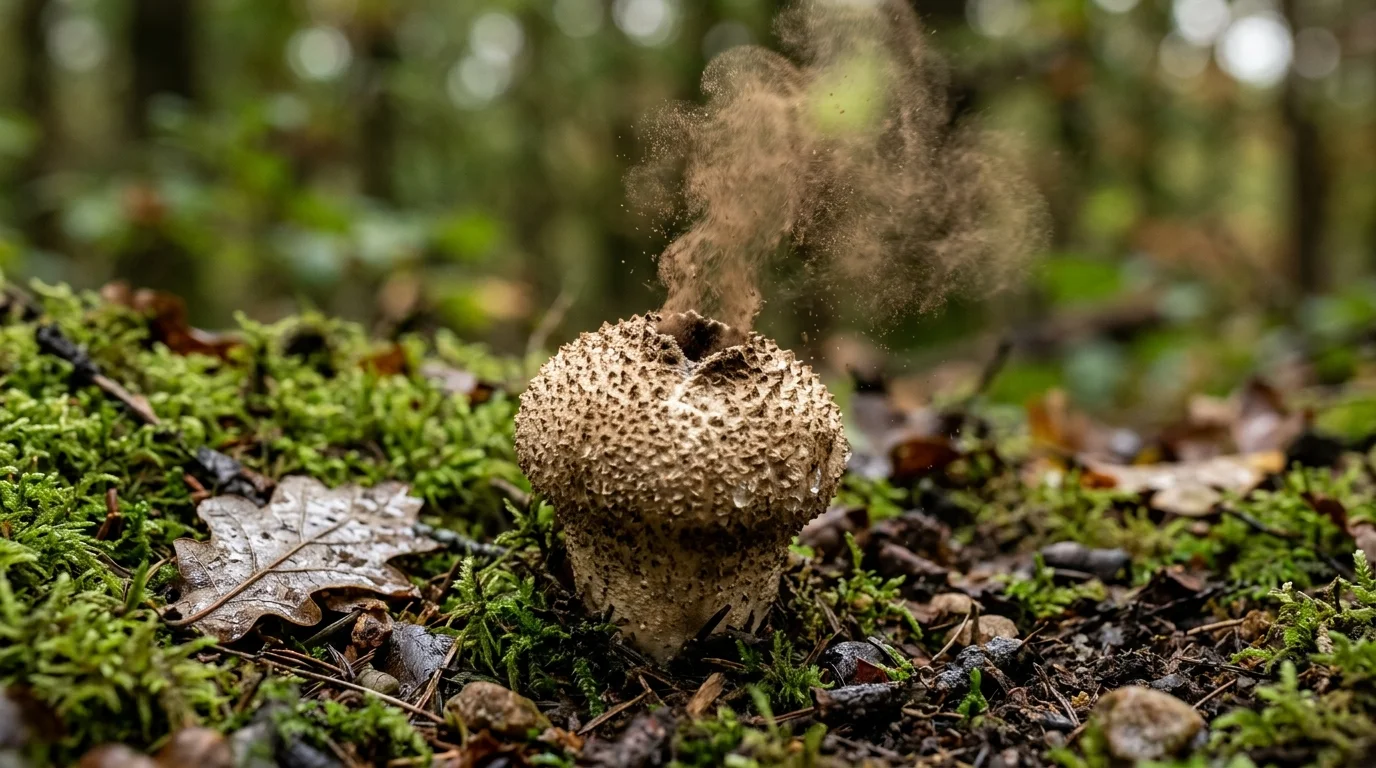
A small, round mushroom sits quietly among fallen leaves. Suddenly, a raindrop strikes its surface, and a delicate brown cloud rises into the air. The cloud looks almost like smoke, but it consists of countless microscopic reproductive particles.
This remarkable phenomenon is one of the most recognizable features of mature puffball mushrooms.
Puffball mushroom spores are tiny structures that allow these fungi to reproduce and spread into new environments. When conditions are suitable, a mature puffball releases its spores through an opening or by breaking apart, allowing air currents to carry them away.
Puffballs appear in forests, lawns, meadows, and other habitats throughout North America. Many become particularly noticeable during autumn, when moisture and moderate temperatures favor the development of fungal fruiting bodies.
Their unusual appearance and dramatic spore release make them fascinating subjects for natural-history observation.
However, not every puffball releases spores in exactly the same way. Different species have evolved different structures and dispersal mechanisms.
Understanding how these mushrooms reproduce reveals an intricate relationship between fungal anatomy, weather, air movement, and the ecosystems beneath our feet.
Table of Contents
- What Are Puffball Mushrooms?
- Why Puffballs Produce So Many Spores
- What Happens When Raindrops Hit a Puffball?
- The Structure Behind Puffball Spore Release
- How Spores Travel Through the Air
- The Puffball Mushroom Life Cycle
- Where Puffball Mushrooms Grow in North America
- The Ecological Role of Puffball Fungi
- Safety and Mushroom Identification
- Frequently Asked Questions
- Conclusion
What Are Puffball Mushrooms?
Puffballs are fungi that develop enclosed, usually rounded fruiting bodies rather than the familiar exposed gills found beneath many mushroom caps.
Their reproductive spores mature inside these structures.
The name puffball describes their characteristic appearance and the powdery spore clouds that many species release when mature.
Puffballs are not a single species or one uniform taxonomic group. The term includes several related groups of fungi with broadly similar fruiting structures.
Common North American examples include species belonging to the genera Lycoperdon, Calvatia, and Bovista.
The giant puffball, Calvatia gigantea, can develop an exceptionally large fruiting body, sometimes reaching sizes comparable to a basketball or larger.
Other puffballs remain only a few centimeters wide.
Despite these differences, many share an important characteristic: their spores develop internally and are released after the fruiting body matures.
Young true puffballs typically contain firm, white internal tissue. As their spores develop, the interior changes into a powdery mass.
Why Puffballs Produce So Many Spores
Fungal reproduction depends on successful spore dispersal.
A single spore is microscopic and contains only a limited supply of resources. After reaching a suitable environment, it must germinate and establish fungal growth.
Most spores never develop into mature fungi.
Many land in locations that are too dry, too exposed, or otherwise unsuitable. Others are damaged, consumed by organisms, or unable to establish themselves because of competition.
Producing enormous numbers of spores increases the likelihood that at least some will reach favorable conditions.
Large puffballs can produce extraordinary quantities of reproductive particles.
For example, the giant puffball is frequently described in mycological literature as capable of producing trillions of spores under favorable conditions.
However, spore production varies substantially among species and individual fruiting bodies.
The visible cloud released by a mature puffball therefore represents only a portion of its reproductive output.
Each spore is a potential starting point for new fungal growth, although successful establishment depends on environmental conditions and biological compatibility.
What Happens When Raindrops Hit a Puffball?
One of the most fascinating examples of puffball mushroom reproduction involves the impact of falling raindrops.
In many mature puffballs, a small opening develops near the top of the fruiting body.
When a raindrop strikes the flexible outer surface, it briefly compresses the structure.
This pressure can force a small volume of air and loose spores through the opening.
The result is a visible puff of brownish spore dust.
Repeated raindrop impacts may release additional spores as long as the fruiting body contains a suitable supply.
This mechanism is sometimes described as a bellows-like action because compression pushes air outward through a restricted opening.
However, raindrops are not the only possible trigger.
Wind, falling debris, or contact with an animal may also disturb a mature puffball and release spores.
Some species disperse their spores through the gradual breakdown of the fruiting body rather than through a persistent, well-defined opening.
The exact mechanism depends on the species and its stage of maturity.
Importantly, the visible cloud is not smoke, steam, or fungal gas. It consists primarily of microscopic spores and may contain small fragments of dried fungal tissue.
The Structure Behind Puffball Spore Release
The unusual anatomy of puffballs explains how they store and release their spores.
The outer covering of a puffball is called the peridium.
Depending on the species, this protective structure may be smooth, textured, or covered with small spines.
Inside the fruiting body is the gleba, the tissue where spores develop.
During early development, the gleba of many true puffballs appears white and firm.
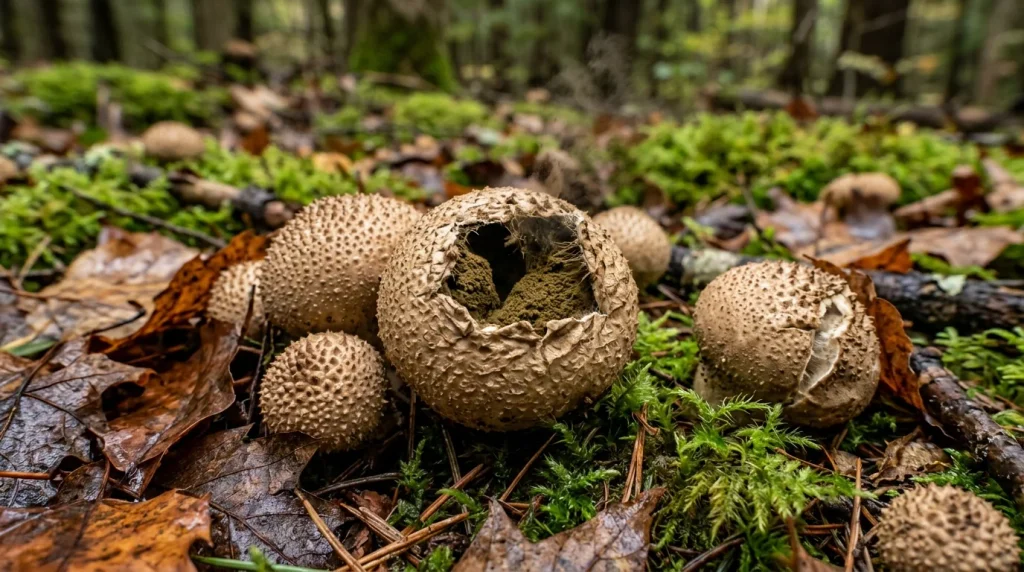
As the mushroom matures, its internal reproductive tissue changes. Eventually, the interior may become a dry, powdery mixture of spores and specialized fungal threads.
In some species, these threads form a network called the capillitium.
Capillitium fibers can help organize the spore mass and influence how spores are released.
Many puffballs develop an opening called an ostiole, through which spores escape.
Others rupture irregularly or disintegrate as they age.
The giant puffball, for example, commonly releases spores as its outer tissues deteriorate, rather than relying exclusively on the small apical opening typical of some smaller puffballs.
These structural differences explain why mushroom spore clouds vary in appearance and intensity.
How Spores Travel Through the Air
Once released, puffball spores become part of the surrounding air.
Their microscopic size allows even relatively gentle air movement to transport them away from the parent fruiting body.
Wind may carry spores across a woodland clearing, through grassland vegetation, or beyond the immediate area where the mushroom developed.
Some spores settle quickly onto nearby soil and leaves. Others remain suspended longer, depending on their physical properties and atmospheric conditions.
Air turbulence, humidity, rainfall, and vegetation influence dispersal.
A visible puff may appear to disappear within seconds, but this does not mean the spores have vanished.
Instead, they become increasingly dispersed and difficult to see individually.
Eventually, gravity, precipitation, or contact with surfaces removes them from the air.
Successful dispersal does not guarantee successful reproduction.
A spore must encounter appropriate moisture, temperature, nutrients, and other conditions before it can germinate.
This dependence on environmental suitability is one reason fungi produce such large numbers of spores.
The Puffball Mushroom Life Cycle
The puffball mushroom life cycle begins when a viable spore reaches an environment suitable for germination.
With sufficient moisture, appropriate temperatures, and available nutrients, the spore may produce microscopic fungal filaments called hyphae.
These filaments grow through soil, leaf litter, or decaying wood. Collectively, they form a network known as mycelium.
Mycelium is the main feeding and growing structure of many fungi. It absorbs nutrients from its surroundings while remaining largely hidden.
In typical puffball species, compatible fungal partners must combine genetically before a fertile reproductive structure can develop.
When environmental conditions favor reproduction, the established mycelium produces a fruiting body.
Initially, the puffball contains developing tissues rather than a mature mass of dry spores.
As reproduction progresses, specialized cells produce spores through a process involving meiosis.
The spores mature inside the fruiting body until the internal tissues become powdery.
Eventually, openings form or the outer covering deteriorates, allowing spores to escape.
The cycle can then begin again when successfully dispersed spores establish new fungal growth.
Importantly, the visible mushroom is only the reproductive structure. The underlying mycelium may persist after the fruiting body disappears.
Where Puffball Mushrooms Grow in North America
Puffball mushrooms occur across much of the United States and Canada.
Their distribution depends on species, soil conditions, moisture, available organic material, and local climate.
Some species are common in woodland habitats, where they develop among fallen leaves and decaying plant material.
Others grow in grasslands, pastures, lawns, and disturbed ground.
The pear-shaped puffball, Lycoperdon pyriforme, is particularly associated with decaying wood, including fallen logs, stumps, and wood chips.
The gem-studded puffball, Lycoperdon perlatum, frequently develops on woodland soil.
Giant puffballs are often found in grassy areas, open woods, and pastures.
Many puffballs become especially noticeable during late summer and autumn, although fruiting periods vary by species and region.
Rainfall can encourage fruiting when temperatures and other environmental conditions are favorable.
In the eastern United States, moist deciduous forests provide suitable habitats for several species.
In western regions, puffballs also occur in coniferous forests, grasslands, and other environments.
Not every round fungus encountered outdoors is a true puffball, making identification important even when observation is the only goal.
The Ecological Role of Puffball Fungi
Puffballs are more than unusual mushrooms that release clouds of spores.
Many species play important roles in decomposition and nutrient cycling.
As saprotrophic fungi, they obtain nutrients from dead organic material.
Their underground hyphae release enzymes that help break down complex substances in decaying plant tissues.
This process contributes to the gradual recycling of nutrients through forest and grassland ecosystems.
Decomposition also helps transform fallen leaves, dead wood, and other organic material into substances that become part of the soil environment.
Fungal activity supports interactions among microorganisms, plants, and soil invertebrates.
Puffballs growing on decaying logs are especially visible examples of fungi participating in wood decomposition.
Other species help process organic matter in soil and leaf litter.
These activities contribute to ecosystem functioning, although the specific ecological role varies among fungal species.
The appearance of puffballs during autumn also reflects broader seasonal changes in woodland environments.
Moisture, falling leaves, and moderate temperatures influence the activity of many fungi.
Safety and Mushroom Identification
Puffball mushrooms are fascinating to observe, but wild mushroom identification requires caution.
Never eat an unidentified wild mushroom.
Although some true puffball species are considered edible when young and correctly identified, several dangerous mushrooms can resemble them.
Young mushrooms in the genus Amanita, including potentially deadly species, may initially appear as rounded white structures.
When cut vertically, immature Amanita mushrooms can reveal developing caps, stems, or gills inside.
True young puffballs generally have a uniform internal structure without a developing mushroom cap or gills.
However, this distinction alone is not sufficient for safe identification by inexperienced collectors.
Some earthballs, particularly species of Scleroderma, also resemble puffballs but can cause poisoning.
The safest approach is to observe wild mushrooms without collecting them for food unless a qualified local expert has confirmed their identity.
Mature puffballs also deserve caution because concentrated spore clouds can irritate the respiratory system.
Deliberately inhaling large amounts of spores can cause serious respiratory illness, including the rare condition known as lycoperdonosis.
Avoid squeezing puffballs near your face or intentionally creating large spore clouds.
Children and pets should also be discouraged from disturbing unknown fungi.
Frequently Asked Questions
1. Why do puffball mushrooms release clouds of spores?
Puffballs release microscopic reproductive spores to disperse into new environments. In many species, pressure from raindrops, wind-driven debris, or physical contact pushes mature spores through an opening in the fruiting body.
2. Are puffball mushroom spore clouds smoke?
No. The clouds consist mainly of microscopic fungal spores, sometimes mixed with tiny fragments of dried fungal tissue. Their dusty appearance can resemble smoke, but they are biological particles rather than combustion products.
3. Do all puffball mushrooms release spores when touched?
No. Spore release mechanisms differ among species. Some puffballs eject spores through a small opening when compressed, while others release spores as their outer tissues split or gradually disintegrate.
4. Are puffball mushroom spores dangerous to breathe?
Breathing concentrated amounts of puffball spores can irritate the respiratory system and, in rare cases, cause serious illness. Avoid deliberately inhaling spore clouds or disturbing mature puffballs near your face.
5. When are puffball mushrooms most common?
Many species appear during late summer and autumn, particularly after periods of suitable rainfall. However, fruiting seasons vary according to species, geography, temperature, and moisture conditions.
Conclusion
The remarkable clouds released by mature puffballs illustrate one of nature’s most interesting reproductive strategies.
Puffball mushroom spores develop inside specialized fruiting bodies and are released when the mushrooms reach maturity.
In many species, raindrops or physical disturbances compress the fruiting body, forcing microscopic spores into the surrounding air.
Other puffballs disperse their spores through openings, ruptures, or the gradual breakdown of their outer coverings.
Once airborne, spores may travel away from the parent fungus before settling into new environments.
Only a small proportion will encounter conditions suitable for successful growth.
Beyond reproduction, many puffball fungi contribute to decomposition and nutrient cycling in forests, grasslands, and gardens.
Their presence reminds us that much of an ecosystem’s biological activity takes place in soil, decaying wood, and other easily overlooked places.
Observing puffballs from a respectful distance offers a fascinating opportunity to appreciate fungal biology while avoiding unnecessary exposure to airborne spores.
External Sources
- Cornell University — Cornell Mushroom Blog: Puffballs Ate My Mulch. Explains how rain, animals, and other disturbances can release puffball spores.
Read Cornell’s Puffball Articlee - Iowa State University Extension — Puffballs. Discusses puffball fruiting bodies, common habitats, seasonal appearance, and identification concerns.
Read Iowa State’s Puffball Guide - University of Edinburgh — Fungal Biology: Puffballs, Earthballs, Earthstars and Similar Fungi. Explains enclosed spore production, fruiting-body anatomy, and dispersal through pores or ruptures.
Explore the University of Edinburgh’s Fungal Biology Resource - Montana State University — Collecting Fungi and Mushrooms for Identification. Explains the risks of confusing puffballs with poisonous mushrooms, including immature Amanita species.
Read Montana State’s Mushroom Identification Guide