
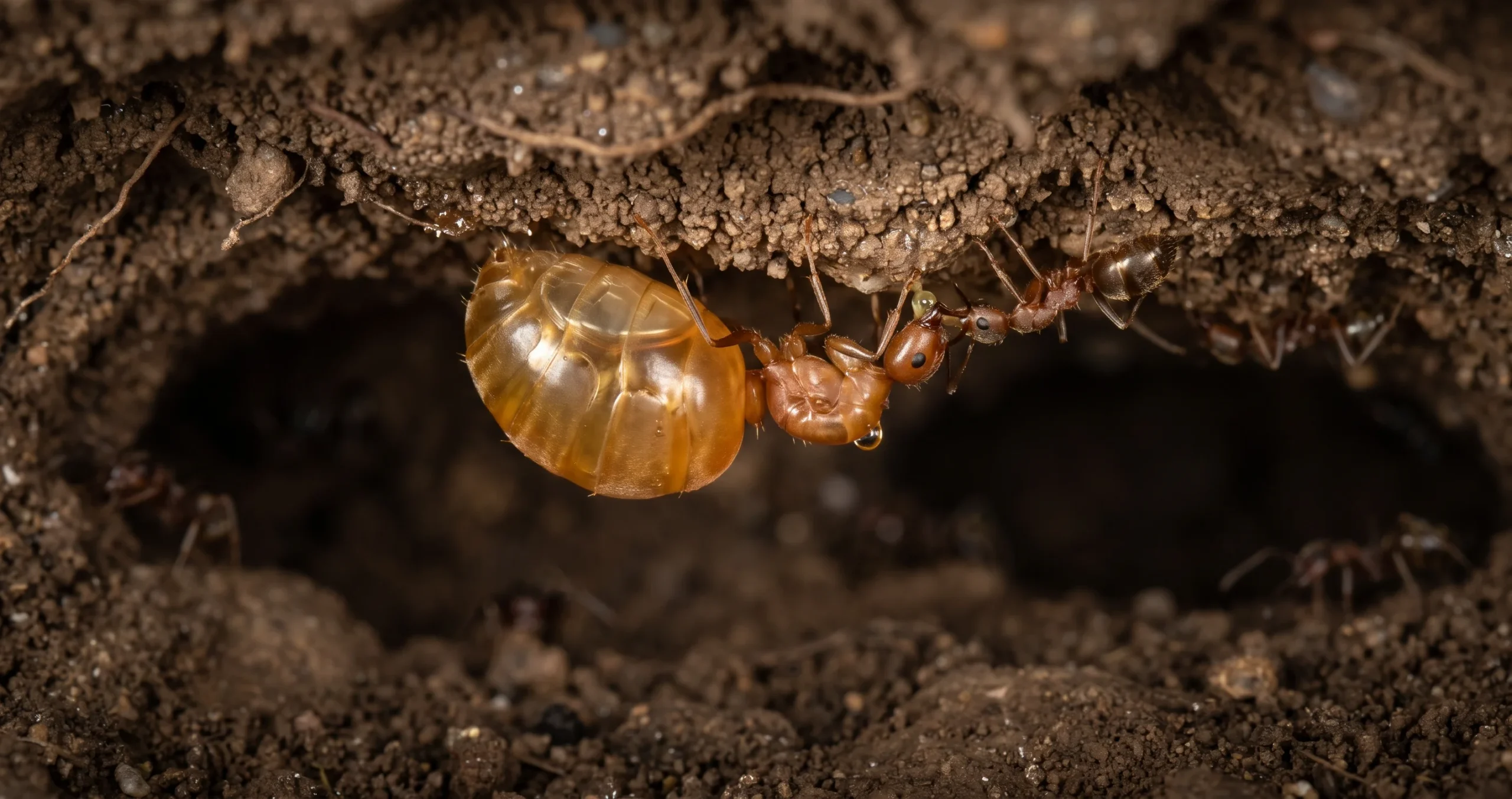
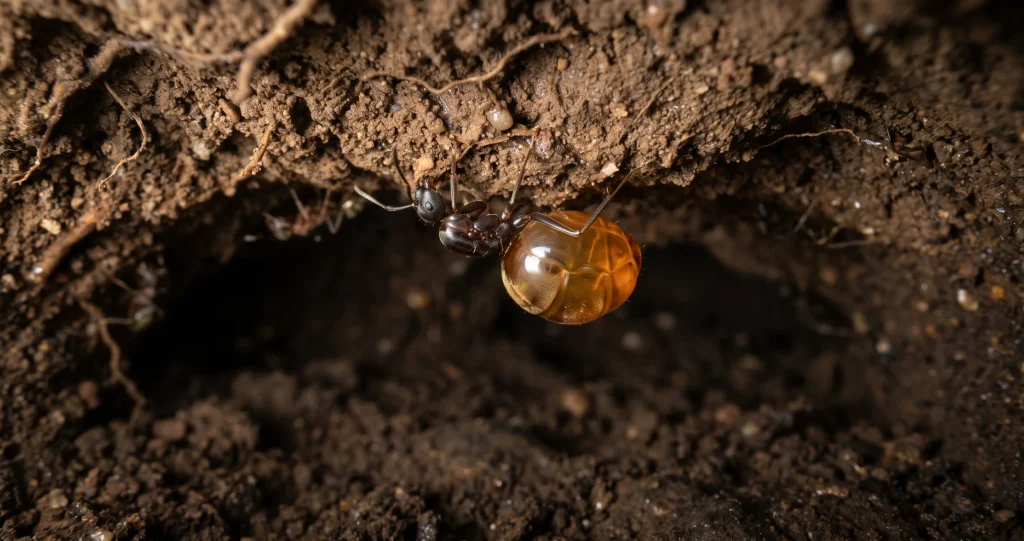
Imagine walking through a dry desert landscape, unaware that beneath your feet, an underground chamber contains dozens of tiny golden spheres hanging from the ceiling. They look almost like miniature grapes filled with honey. But each one is alive.
These remarkable creatures are honeypot ants, insects that have developed one of nature’s most unusual food-storage systems.
Instead of building separate containers for their food, some members of a honeypot ant colony become living reservoirs. Their abdomens expand dramatically as they store liquid food, which can later be shared with other ants when resources become scarce.
This extraordinary adaptation allows certain ant colonies to survive in environments where food availability changes with the seasons.
From the deserts of the American Southwest to the dry landscapes of Australia, honeypot ants reveal how cooperation, specialization, and survival are closely connected in the insect world.
Table of Contents
- What Are Honeypot Ants?
- Why Honeypot Ants Become Living Food Containers
- How the Living Storage System Works
- Where Honeypot Ants Live
- What Honeypot Ants Eat
- The Social Organization of a Honeypot Ant Colony
- How Honeypot Ants Survive Desert Conditions
- Honeypot Ants and Their Ecological Importance
- In Your Own Yard: Supporting Ants and Desert Wildlife
- Common Misconceptions About Honeypot Ants
- Frequently Asked Questions
- Conclusion
What Are Honeypot Ants?
Honeypot ants are not a single species. The name describes ants whose colonies contain specialized workers capable of storing unusually large quantities of liquid food inside their bodies.
Several ant groups have evolved this behavior, including species in the genus Myrmecocystus, which occur in North America.
These ants belong to the family Formicidae, the same insect family that includes carpenter ants, leafcutter ants, and fire ants.
The Ants With Enormous Abdomens
The most recognizable members of a honeypot ant colony are called repletes.
Repletes are worker ants whose gasters, the rear portions of their abdomens, become greatly enlarged as they accumulate liquid food.
The flexible membranes between their abdominal plates stretch, creating a rounded appearance.
Depending on the species and the contents of the abdomen, repletes may appear amber, golden, reddish, or darker in color.
Their swollen bodies can become so large that moving around the nest becomes difficult.
As a result, repletes often remain suspended inside underground chambers.
Not Every Worker Becomes a Replete
A honeypot ant colony contains workers performing different tasks.
Some collect food, others maintain the nest, and certain workers become living storage containers.
Repletes are not a separate species or a special reproductive caste.
They are workers whose bodies become adapted to storing food under particular colony conditions.
Why Honeypot Ants Become Living Food Containers
In many desert environments, food availability is unpredictable.
A brief period of favorable weather may produce flowering plants, insect activity, and abundant sugary resources.
Later, intense heat or prolonged dry conditions may make food much harder to obtain.
For an ant colony, this creates a major challenge.
Desert Food Supplies Change Quickly
Many desert plants produce nectar or support insects that release sugary secretions.
However, these resources may be available only during certain periods.
A colony that gathers food when it is plentiful may benefit from storing some of that energy for later use.
Honeypot ants accomplish this through their repletes.
Living Storage Instead of External Containers
Humans store food in jars, refrigerators, and underground cellars.
Some social insects store food in specialized nest structures.
Honeypot ants use a different strategy: certain workers hold liquid food inside their digestive storage organs.
The stored material can later be transferred to nestmates.
This allows the colony to maintain a reserve without constructing a separate physical container.
A Colony-Level Survival Strategy
The benefit is not limited to the individual replete.
Stored food can support other workers and developing colony members when foraging becomes difficult.
This illustrates an important feature of social insects: individuals often perform specialized tasks that contribute to the survival of the entire colony.
How Honeypot Ants Store Food: The Science Behind Their Living Jars
The most fascinating part of the honeypot ant story is the biological process that turns an ordinary worker into a living reservoir.
Understanding this process requires looking at ant anatomy, food sharing, and colony organization.
Step 1: Foraging Workers Collect Liquid Food
Foraging workers leave the nest to search for available food.
Depending on the species and habitat, they may collect floral nectar, sugary secretions from insects, and other energy-rich liquids.
Some honeypot ants also consume or collect animal-derived foods.
When a forager finds a useful food source, it can transport liquid food back to the nest inside its crop.
The crop is a storage section of the digestive tract that temporarily holds food.
Step 2: Food Is Shared Through Trophallaxis
Once inside the nest, a forager may transfer liquid food to another worker.
This process is called trophallaxis.
During trophallaxis, ants exchange liquid food mouth-to-mouth.
Food sharing helps distribute resources among colony members.
In honeypot ant colonies, repletes can receive repeated food transfers from other workers.
Over time, this causes their storage organs to expand.
Step 3: The Replete’s Abdomen Expands
As a replete accumulates liquid food, its crop becomes greatly enlarged.
The ant’s abdominal segments are connected by flexible membranes that allow expansion.
The hardened external plates remain present, but the softer tissues between them stretch.
This produces the distinctive rounded abdomen associated with honeypot ants.
The stored liquid is not simply loose fluid inside the body cavity.
It is held within the digestive storage system.
That distinction matters because the ant remains alive and can later release the food through controlled feeding interactions.
Step 4: Repletes Remain Inside Protected Chambers
A heavily swollen replete may have limited mobility.
In many species, repletes remain attached to the ceilings or walls of underground nest chambers.
These locations provide some protection from environmental extremes and disturbances at the surface.
Other workers move through the chamber and interact with the repletes.
The arrangement resembles a pantry, but every storage vessel is a living colony member.
Step 5: Stored Food Returns to the Colony
When food becomes scarce, workers can obtain liquid nourishment from repletes through trophallaxis.
A replete transfers some of its stored food to a requesting nestmate.
The receiving worker can consume the liquid or distribute it elsewhere within the colony.
This process allows energy collected during favorable conditions to remain available later.
The precise timing and amount of food exchange vary among colonies and species.
Why This System Is So Unusual
The replete system combines several biological features:
- A digestive crop capable of holding liquid food.
- Flexible abdominal tissues that permit substantial expansion.
- Social feeding behavior that moves food between workers.
- Colony organization that supports specialized storage individuals.
Together, these adaptations create a remarkable example of food storage through cooperation.
Where Honeypot Ants Live
Honeypot ants are especially associated with dry and seasonally challenging environments.
However, their distribution is broader than a single desert.
Honeypot Ants in the American Southwest
Species of Myrmecocystus occur in parts of the western United States and Mexico.
They can be found in habitats that include deserts, dry grasslands, and other open environments.
Their nests are typically underground.
The soil provides a more sheltered environment than the exposed surface.
Honeypot Ants in Australia
Australia also has honeypot ants, including species traditionally placed in the genus Camponotus.
Some Australian honeypot ants are culturally significant to Aboriginal communities.
Knowledge of their habitats, seasonal availability, and collection has been passed down through generations in certain communities.
These relationships are part of the broader human history of living with and understanding arid environments.
Why Underground Nests Matter
Desert surfaces can experience extreme temperature changes.
Underground chambers often provide more stable conditions.
For insects that store food inside living workers, this protected environment can be especially valuable.
What Honeypot Ants Eat
Despite their name, honeypot ants do not necessarily collect honey produced by bees.
Their stored food is usually derived from other sugary resources.
Nectar From Flowers
Flowering plants can provide nectar rich in sugars.
When nectar is available, foraging ants may collect it and transport it back to the nest.
The importance of nectar depends on the local vegetation and the species involved.
Honeydew From Sap-Feeding Insects
Aphids, scale insects, and other sap-feeding insects can produce a sugary liquid called honeydew.
Some ants collect honeydew as a food source.
These relationships vary widely.
Certain ant species protect honeydew-producing insects, while others collect the liquid opportunistically.
Other Food Sources
Honeypot ant workers may also collect insects or other animal material.
Sugary liquids provide readily available energy, while animal-derived foods can contribute nutrients needed for colony growth.
Their overall diet depends on the environment and species.
The Social Organization of a Honeypot Ant Colony
A honeypot ant colony is a coordinated community rather than a collection of independent individuals.
The Queen
The queen is primarily responsible for reproduction.
After establishing a colony, she produces eggs that develop into new colony members.
The number of queens and details of colony founding vary among ant species.
Foraging Workers
Foragers search outside the nest for food.
Their activities connect the colony to available resources in the surrounding environment.
Some species forage during cooler periods to reduce exposure to extreme daytime conditions.
Repletes
Repletes function as food-storage workers.
Their role becomes especially important when stored liquid resources are needed.
Although their appearance is unusual, they remain part of the worker population.
Other Nest Workers
Workers also maintain tunnels, care for developing ants, and perform other essential activities.
These overlapping roles help the colony function as a cooperative unit.
How Honeypot Ants Survive Desert Conditions
Food storage is only one part of desert survival.
Honeypot ants also rely on behaviors that help them cope with demanding environments.
Timing Their Foraging Activity
Some desert ants avoid the hottest parts of the day.
Depending on the species and season, activity may increase during cooler evening, nighttime, or morning conditions.
This can reduce exposure to dangerous surface temperatures.
Using Underground Shelter
Nests provide protected spaces for brood development, food storage, and colony activity.
The depth and structure of nests vary.
Soil conditions, temperature, and moisture influence where ants can establish colonies.
Responding to Seasonal Changes
Rainfall and plant growth can create temporary periods of food abundance.
When conditions become less favorable, stored resources may help colonies continue functioning.
However, honeypot ants are not completely independent of their environment.
Long-term survival still depends on suitable habitat and access to food.
Honeypot Ants and Their Ecological Importance
Honeypot ants participate in the larger ecological networks of the habitats they occupy.
Soil Disturbance and Nest Building
Excavating underground nests moves soil particles.
Ant activity can influence soil structure and the distribution of organic material.
The magnitude of these effects varies with colony size, soil type, and habitat.
Interactions With Other Insects
Honeypot ants may interact with nectar-producing plants, honeydew-producing insects, and other arthropods.
They can also compete with neighboring ant colonies for food and territory.
These interactions form part of desert food webs.
Food for Other Animals
Ants are consumed by various predators, including some birds, reptiles, and other arthropods.
Their ecological role extends beyond the food they store.
They are both consumers and potential prey within their ecosystems.
In Your Own Yard: Supporting Ants and Desert Wildlife
You do not need to live beside a large desert to appreciate the ecological importance of ants.
Even an ordinary backyard can support beneficial insect communities.
Preserve Small Areas of Natural Soil
Many ground-nesting insects need access to undisturbed soil.
Leaving suitable patches of bare ground can provide nesting opportunities.
Avoid unnecessary digging in areas where harmless native ants are established.
Grow Regionally Appropriate Native Plants
Native flowering plants can support insects through nectar and habitat resources.
Choose plants suited to your climate and soil.
In the Southwest, drought-adapted native plants can help create habitat while reducing irrigation needs.
Reduce Unnecessary Pesticide Use
Broad-spectrum insecticides may affect organisms beyond the intended target.
Whenever possible, identify an insect before deciding whether control is necessary.
Many outdoor ants contribute to local ecosystems without creating serious problems.
Observe Ants Without Disturbing Their Nests
Watch ant trails from a comfortable distance.
You may notice workers carrying food, interacting with plants, or moving between nest entrances.
Avoid excavating nests to search for repletes.
Disturbing underground chambers can injure workers, expose developing ants, and damage the colony.
Keep Wildlife Habitat Safe
If ants enter living spaces or create a genuine safety concern, use targeted management appropriate to the species.
Supporting wildlife does not require allowing insects to establish themselves inside a home.
The goal is to maintain a healthy balance between people and local ecosystems.
Common Misconceptions About Honeypot Ants
Myth: Honeypot Ants Are Filled With Bee Honey
The liquid stored by repletes is generally collected from nectar, honeydew, and related food sources.
It is not necessarily honey made by bees.
Myth: Repletes Are a Different Ant Species
Repletes are specialized workers within honeypot ant colonies.
They belong to the same species as their nestmates.
Myth: Honeypot Ants Are Found Only in One Desert
Honeypot ants occur in several regions, including parts of North America and Australia.
Different groups have evolved similar food-storage strategies.
Myth: Repletes Are Dead Storage Containers
Repletes remain alive.
They receive food from other workers and can transfer stored liquid back to the colony.
Frequently Asked Questions
1. Why do honeypot ants have such large abdomens?
Certain worker ants become repletes by storing large amounts of liquid food in an expandable digestive crop. Their abdominal membranes stretch as the storage organ fills, giving them a distinctive rounded appearance.
2. Where can honeypot ants be found in the United States?
North American honeypot ants, especially species in the genus Myrmecocystus, occur in parts of the western and southwestern United States. They often inhabit dry, open environments and build underground nests.
3. Do honeypot ants make honey like bees?
No. Honeypot ants store sugary liquids collected from sources such as flower nectar and honeydew. They do not produce honey through the same processes used by honeybees.
Conclusion
Deep beneath a dry landscape, a colony may survive difficult periods with help from workers that barely move.
Their swollen abdomens hold food gathered when resources were more plentiful.
Through cooperation and food sharing, honeypot ants transform individual bodies into a remarkable colony-wide storage system.
These insects remind us that survival in nature does not always depend on strength or speed. Sometimes it depends on cooperation, specialization, and the ability to prepare for uncertain conditions.
And beneath the desert soil, those tiny golden spheres are not jars at all.
They are living ants, quietly helping their colony endure.