
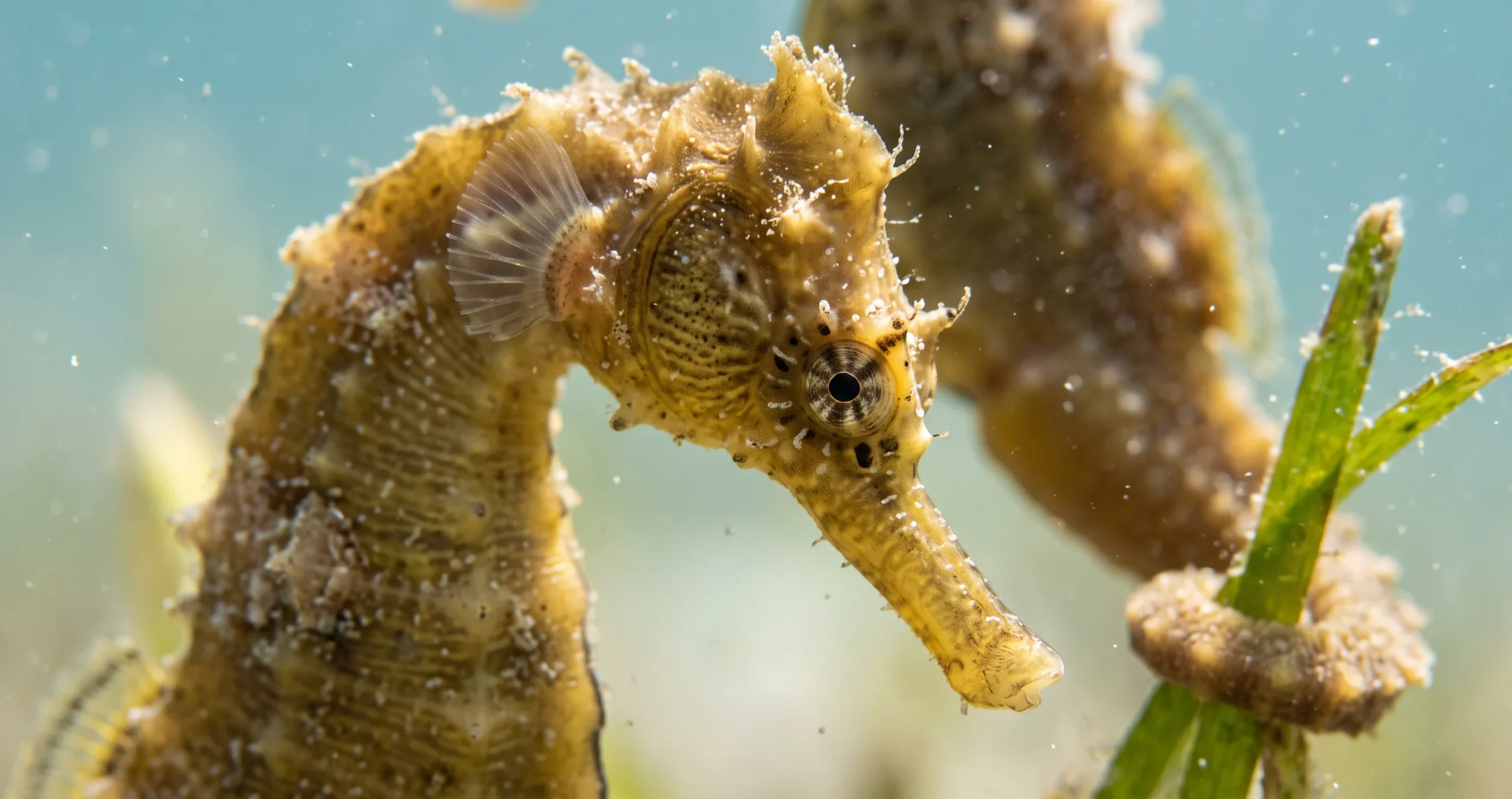
Imagine a fish that swims upright, holds onto underwater plants with its tail, and uses a tiny fin to move through the ocean. Now imagine that the male carries developing babies and eventually gives birth.
That remarkable animal is the seahorse.
Few marine creatures possess such an unusual combination of adaptations. From their armored bodies to their specialized feeding systems, seahorse anatomy reflects millions of years of evolution in underwater environments where staying hidden, holding position, and catching tiny prey can mean the difference between survival and becoming someone else’s meal.
Seahorses belong to the genus Hippocampus, part of the family Syngnathidae, which also includes pipefish and seadragons. Despite their horse-shaped heads and upright posture, they are genuine bony fish.
Their bodies tell a fascinating story about reproduction, movement, feeding, and survival. Understanding how these features work also reveals why seahorses depend so heavily on healthy coastal ecosystems.
Table of Contents
- Understanding Seahorse Anatomy
- How Male Seahorse Pregnancy Works
- How Seahorses Swim With a Tiny Fin
- Gripping Tails and Armored Bodies
- How Seahorses Eat Without a Stomach
- Seagrass Habitats and Survival
- Threats Facing Seahorses
- How to Identify Different Seahorse Species
- Common Seahorse Myths
- Frequently Asked Questions
- Conclusion
Understanding Seahorse Anatomy
A Fish That Looks Nothing Like a Typical Fish
A seahorse’s upright body immediately distinguishes it from most fish. Instead of a streamlined shape with a prominent tail fin, it has a curved neck, an elongated snout, and a tail designed for gripping.
Its body is supported by a series of bony rings beneath the skin rather than being covered in the familiar overlapping scales of many other fish.
These features make seahorses recognizable, but their appearance varies considerably among species. Some have smooth-looking bodies, while others display prominent spines or fleshy skin projections.
Eyes That Can Look in Different Directions
Seahorses can move their eyes independently, allowing them to examine different parts of their surroundings.
This is useful for detecting small prey and watching for potential predators while remaining relatively motionless.
Their eyes can also coordinate when they focus on a target, supporting accurate feeding movements.
How Male Seahorse Pregnancy Works
The Female Produces the Eggs
One of the most extraordinary aspects of seahorse reproduction is that males carry developing embryos.
The process begins with courtship, which can include synchronized movements, color changes, and repeated interactions between potential mates.
When mating occurs, the female transfers eggs into a specialized brood pouch on the male’s body using an organ called an ovipositor.
The male fertilizes the eggs as part of the reproductive process and carries them through development.
What Happens Inside the Brood Pouch
The brood pouch is much more than a simple storage compartment.
Its tissues help maintain a suitable environment for developing embryos, including functions associated with gas exchange and the regulation of salts and water.
Research has also identified complex physiological interactions between pregnant males and their developing offspring. The precise mechanisms and degree of nutrient contribution can differ among species.
Unlike a mammalian uterus, the seahorse brood pouch is an independently evolved reproductive structure with its own specialized features.
How Male Seahorses Give Birth
When development is complete, the male uses muscular contractions to expel the young through the pouch opening.
The newborns resemble miniature seahorses, complete with recognizable heads, bodies, and tails.
Brood size and pregnancy duration vary substantially among species and environmental conditions. Some males release relatively small groups of offspring, while others produce hundreds.
After birth, young seahorses generally receive no prolonged parental care and must begin surviving independently.
How Seahorses Swim With a Tiny Fin
The Dorsal Fin Provides Propulsion
Seahorses may look as though they drift passively, but they actively control their movements.
A small dorsal fin on the back beats rapidly, producing the thrust needed to move forward.
Rather than generating powerful bursts of speed like many other fish, this fin supports controlled movement through relatively sheltered habitats.
The fin’s rapid motion can be difficult to see without close observation.
Small Fins Help With Steering
Seahorses also have small pectoral fins near the head that assist with steering and maintaining position.
These fins help them adjust their orientation as they approach a plant, inspect prey, or move through underwater vegetation.
Seahorses are generally slow swimmers. Their unusual body shape is better suited to maneuvering through complex habitats than traveling rapidly across open water.
This makes shelter especially important when currents become strong.
Gripping Tails and Armored Bodies
A Tail That Works Like an Anchor
Unlike the tails of many fish, a seahorse’s tail is prehensile, meaning it can curl around and grip objects.
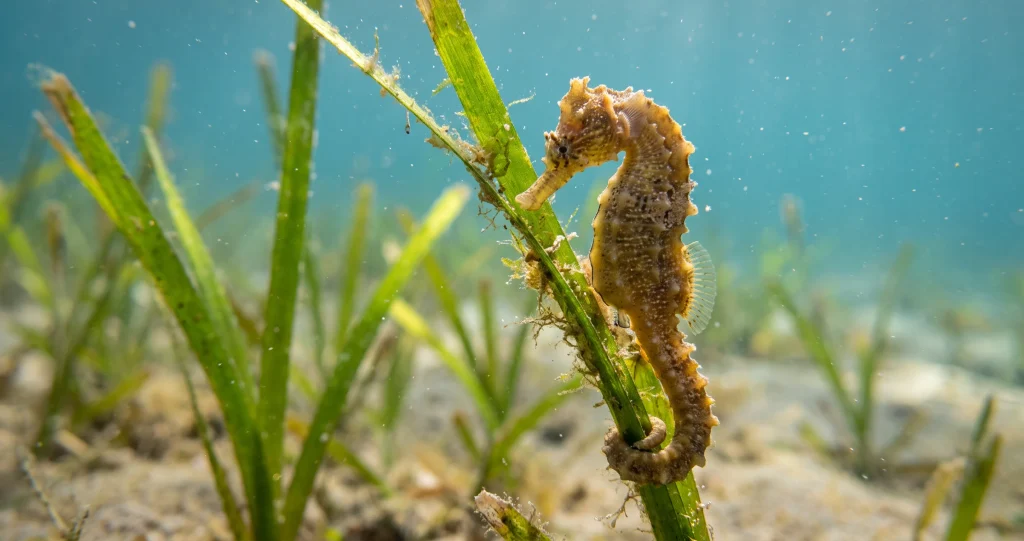
A seahorse may wrap its tail around seagrass, algae, coral branches, or other suitable structures.
This allows it to remain anchored while currents move through the surrounding habitat.
The tail also helps the animal maintain a stable position while watching for prey.
The Surprising Shape of Seahorse Tails
Research into seahorse tail mechanics has highlighted the unusual arrangement of their bony segments.
Rather than having a simple round cross-section throughout, the tail includes a roughly square arrangement of armored plates.
This structure contributes to controlled bending and mechanical protection while allowing the tail to grip objects.
Its combination of flexibility and armor has even attracted interest from engineers studying adaptable protective structures.
Bony Plates Instead of Ordinary Scales
Seahorses possess a series of bony plates arranged in rings along their bodies.
These structures provide support and some protection against physical forces and predators.
However, armor does not make seahorses invulnerable. Their limited swimming speed and dependence on cover mean they still face considerable risks in exposed environments.
How Seahorses Eat Without a Stomach
A Tubular Snout Built for Suction
Seahorses do not chew prey with teeth.
Instead, they use a specialized suction-feeding mechanism to capture small aquatic animals.
When a suitable target approaches, the seahorse rapidly moves its head and expands parts of its mouth and throat region, drawing water and prey through its tubular snout.
This feeding action happens extremely quickly.
What Seahorses Actually Eat
Their diets commonly include small crustaceans, such as copepods, amphipods, and mysid shrimp, depending on the species and habitat.
Many seahorses remain anchored while watching for prey moving nearby.
Their independently moving eyes help them track activity without constantly repositioning their bodies.
Why Having No True Stomach Matters
Seahorses lack a distinct, acid-secreting stomach like that found in many other vertebrates.
Instead, food passes through a relatively simple digestive system where nutrients are processed and absorbed.
This does not mean they cannot digest food. It means their digestive anatomy works differently.
Seahorses feed frequently when prey is available, although feeding rates depend on species, size, temperature, and other environmental factors.
Seagrass Habitats and Survival
Why Underwater Meadows Matter
Seagrass meadows provide shelter, attachment points, and feeding opportunities for many seahorse species.
Their dense vegetation supports small crustaceans while giving seahorses places to anchor their tails and avoid exposure.
Seahorses Live Beyond Seagrass
Not all seahorses occupy identical environments.
Depending on the species, they may inhabit mangroves, coral reefs, sponge communities, or other underwater structures.
Some pygmy seahorses live in particularly close association with specific corals.
Their habitat requirements reflect differences in body size, camouflage, feeding behavior, and local environmental conditions.
Threats Facing Seahorses
Habitat Loss and Coastal Development
Seagrass destruction, pollution, dredging, and coastal construction can reduce the habitats seahorses need.
When underwater vegetation disappears, seahorses may lose both protective cover and reliable feeding opportunities.
Habitat degradation can also affect the small animals that form their diet.
Fishing and International Trade
Seahorses are captured for several commercial purposes, including dried wildlife products and the aquarium trade.
They are also caught unintentionally in fishing gear, particularly equipment that disturbs the seafloor.
International commercial trade in seahorses is regulated under CITES Appendix II, although regulation does not eliminate illegal or unsustainable exploitation.
Protecting Seahorse Populations
Conservation requires protecting suitable habitats, reducing damaging fishing practices, and improving trade monitoring.
Research and identification are also essential because different species face different threats.
The IUCN Seahorse, Pipefish and Seadragon Specialist Group provides identification resources that support scientific monitoring and conservation.
How to Identify Different Seahorse Species
Size, Snout, and Body Shape
Seahorse identification requires more than examining color.
Researchers compare characteristics such as body proportions, snout length, head shape, the number and arrangement of body rings, and the shape of the coronet on the head.
Some species have prominent spines, while others appear comparatively smooth.
Color Is Not Always Reliable
Seahorses can change coloration, and individuals of the same species may look different.
A yellow seahorse and a brown seahorse are not necessarily different species.
Habitat, geographic range, and anatomical features provide more reliable identification clues.
For example, the lined seahorse (Hippocampus erectus) occurs in the western Atlantic, while Bargibant’s pygmy seahorse (Hippocampus bargibanti) is associated with particular gorgonian corals in the Indo-Pacific.
Accurate identification may require expert examination or genetic analysis.
Common Seahorse Myths
Myth: Female Seahorses Give Birth
Female seahorses produce eggs, but males carry the developing embryos and give birth.
The female transfers her eggs to the male during mating.
Myth: Seahorses Mate for Life
Some seahorse species form strong pair bonds, but lifelong monogamy is not universal.
Mating patterns differ between species and populations.
Myth: Seahorses Cannot Swim
Seahorses swim using their dorsal and pectoral fins.
They are generally slow swimmers, but they can actively maneuver through their environments.
Myth: Seahorses Have No Digestive System
Seahorses lack a true stomach, but they possess functioning digestive organs.
They process food and absorb nutrients through their intestinal tract.
Myth: Every Seahorse Is Endangered
Conservation status varies by species.
Some are threatened, while others have different classifications or insufficient information for reliable assessment.
The distinction matters when discussing conservation priorities.
Frequently Asked Questions
Are seahorses actually fish?
Yes. Seahorses are bony fish belonging to the genus Hippocampus. They breathe through gills, possess fins, and share the fundamental anatomical characteristics of fish despite their unusual appearance.
Why do male seahorses get pregnant?
Male pregnancy is a specialized reproductive strategy within the seahorse family. Males carry developing embryos in a brood pouch, where physiological processes support their development until birth.
How do seahorses move underwater?
Seahorses use rapid movements of their small dorsal fin for propulsion. Their pectoral fins assist with steering and positioning.
Can seahorses change color?
Yes. Many seahorses can alter their coloration through specialized pigment cells. Color changes may relate to camouflage, communication, or physiological conditions.
Do seahorses have teeth?
No. Seahorses capture small prey using suction through their tubular snouts rather than chewing with teeth.
How many babies do seahorses have?
Brood sizes vary greatly between species. Some males produce relatively few offspring, while others may release hundreds of young during a single birth.
Conclusion
Seahorses demonstrate how unusual physical structures can support specialized lifestyles.
Male pregnancy, suction feeding, delicate swimming fins, armored bodies, and gripping tails all contribute to their survival in complex marine habitats.
Understanding seahorse anatomy also highlights the importance of protecting the coastal ecosystems these remarkable fish depend on.
Their unusual appearance may attract attention, but the biological systems behind it reveal an even more fascinating story.
External sources
1. NOAA — How Do Seahorses Differ From Other Animals? — Male pregnancy, anatomy, and camouflage.
2. IUCN Seahorse Specialist Group — Species Identification — Species identification, distribution, and conservation. IUCN Seahorse, Pipefish & Seadragon
3. Peer-Reviewed Research — Seahorse Male Pregnancy — Brood pouch physiology, embryo development, and environmental effects.