
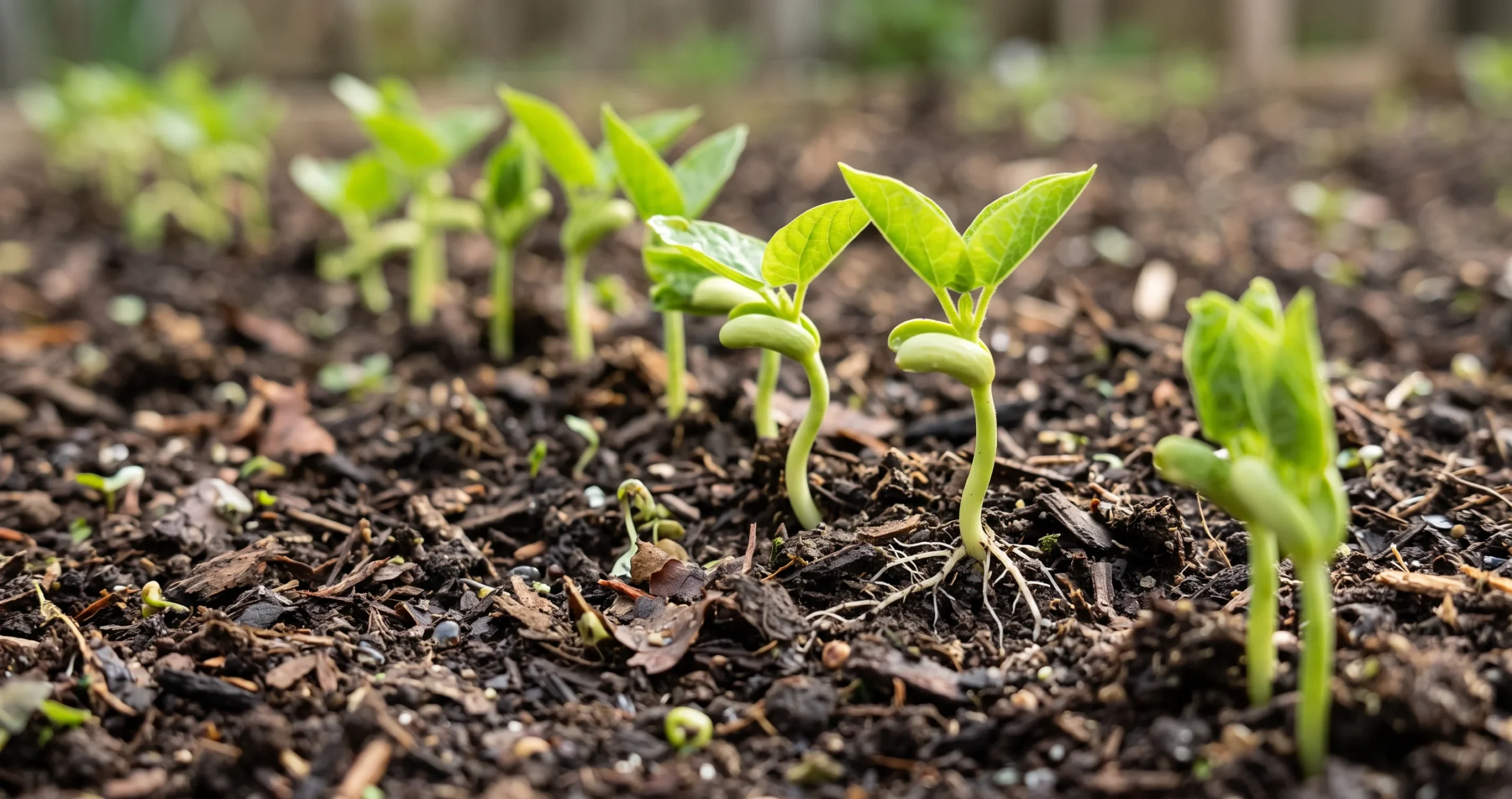
A dry bean may look lifeless, but hidden beneath its protective coat is a tiny plant waiting for the right conditions to grow. Add moisture, warmth, and oxygen, and an extraordinary biological process begins.
Understanding how seeds germinate reveals what happens between planting a seed and seeing the first green shoot emerge from the soil. Inside a bean, stored nutrients fuel the development of roots and shoots long before the young plant can produce enough food through photosynthesis.
By examining the structure of a bean seed, following each stage of germination, and exploring simple experiments, gardeners can learn how to improve seed-starting success and recognize problems before they become serious.
Table of Contents
- What Is Seed Germination?
- The Parts of a Bean Seed
- What Seeds Need to Germinate
- How Seeds Germinate: Seven Stages
- Why the Root Emerges First
- Common Reasons Seeds Fail to Sprout
- Simple Bean Germination Experiments
- Practical Tips for Starting Seeds
- Common Seed Germination Myths
- Frequently Asked Questions
- Conclusion
What Is Seed Germination?
Seed germination is the process through which a viable seed resumes active growth and begins developing into a seedling.
A mature seed contains an embryonic plant, stored food reserves, and protective tissues. Under suitable conditions, the embryo absorbs water, activates metabolic processes, and begins growing.
Botanically, germination is generally considered complete when the embryonic root, called the radicle, emerges through the seed coat.
However, gardeners often use the word germination more broadly to describe the entire process from sowing to visible seedling emergence.
Beans are excellent examples because their relatively large seeds make the internal structures and early growth stages easy to observe.
The Parts of a Bean Seed
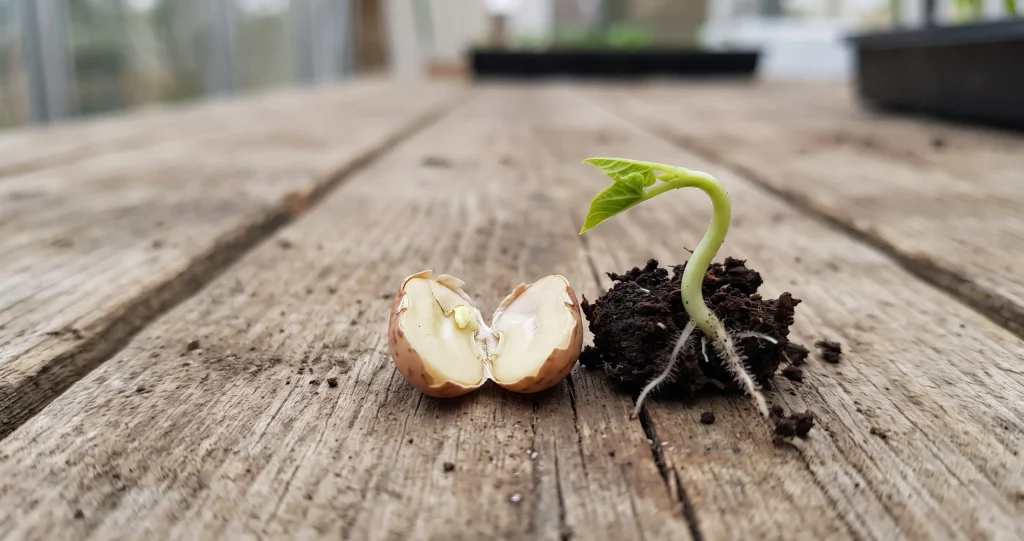
A common bean (Phaseolus vulgaris) is a dicotyledonous seed, meaning its embryo has two seed leaves called cotyledons.
Each structure has a specific role in protecting or supporting the developing plant.
Seed Coat: The Protective Outer Layer
The seed coat, or testa, surrounds the embryo and stored nutrients.
It helps protect the seed from physical damage and regulates interactions with the surrounding environment.
The seed coat also helps maintain the seed’s condition during dormancy or dry storage.
When germination begins, the coat absorbs moisture and eventually splits as the embryo expands.
Cotyledons: The Food Storage System
Inside a bean are two large, fleshy cotyledons.
These structures contain stored nutrients, including carbohydrates and proteins, that support early seedling growth.
Before the seedling can photosynthesize effectively, it relies heavily on these reserves.
In common beans, the cotyledons are typically lifted above the soil during emergence and gradually shrink as their stored resources are used.
Embryo: The Young Plant
The embryo is a miniature plant already containing the foundations of its future root and shoot systems.
The radicle develops into the primary root.
The plumule contains the embryonic shoot and developing leaves, while the hypocotyl is the stem region below the cotyledons.
Together, these structures establish the young plant’s basic organization.
Hilum and Micropyle
The hilum is the small scar marking where the seed was attached to its parent plant.
Near it is the micropyle, a tiny opening associated with the seed’s development.
These features can be seen on many bean seeds and provide useful clues when studying seed anatomy.
What Seeds Need to Germinate
Three environmental factors are especially important for most bean seeds: water, suitable temperature, and oxygen.
Each supports a different part of the germination process.
Water Activates the Seed
A dry bean contains relatively little water, and its metabolic activity is greatly reduced.
When moisture becomes available, the seed absorbs water through a process called imbibition.
The tissues swell, enzymes become active, and stored nutrients begin to be mobilized.
Without sufficient moisture, the embryo cannot resume normal growth.
However, too much water can be equally problematic because saturated conditions restrict oxygen availability.
Warmth Supports Metabolism
Temperature influences the activity of enzymes involved in germination.
Common beans generally germinate best in warm soil, often around 70–85°F (21–29°C), although exact preferences vary by variety.
Cold soil slows germination and may increase the risk of seed decay.
Excessively high temperatures can also reduce germination or damage the developing embryo.
Oxygen Provides Energy
Germinating seeds require oxygen for cellular respiration.
During respiration, stored organic compounds are broken down to release energy that supports cell division and growth.
Poorly aerated or waterlogged soil can limit oxygen availability.
This is one reason seeds sometimes rot in saturated growing media rather than producing healthy seedlings.
Do Beans Need Light?
Common bean seeds do not normally require light to initiate germination.
They can germinate beneath the soil surface because their early development is powered by stored food reserves.
Light becomes increasingly important after the seedling emerges and begins photosynthesis.
Other plant species may have different light requirements, so seed-starting instructions should always be species-specific.
How Seeds Germinate: Seven Stages
The development of a bean seedling follows a recognizable sequence.
Although the timing varies with temperature, moisture, seed condition, and variety, the biological order remains broadly consistent.
Stage 1: The Dry Seed Absorbs Water
The process begins when the bean encounters sufficient moisture.
Water enters the seed, causing its tissues to swell.
The seed coat becomes more flexible as hydration increases.
This initial phase can occur before any visible root or shoot appears.
Stage 2: Metabolic Activity Increases
As hydration continues, enzymes and other cellular processes become more active.
The embryo begins using stored nutrients to support growth.
Respiration increases, supplying energy for cellular maintenance and development.
At this stage, the seed may look only slightly swollen, even though major biochemical changes are occurring inside.
Stage 3: The Seed Coat Splits
As the embryo grows and internal pressure increases, the seed coat begins to rupture.
The opening commonly develops near the area where the embryonic root will emerge.
This visible change indicates that the seed has progressed beyond simple water absorption.
However, a split seed coat alone does not guarantee that the seedling will survive.
Stage 4: The Primary Root Emerges
The radicle is usually the first embryonic structure to break through the seed coat.
It grows outward and generally curves downward in response to gravity.
This early root begins establishing contact with the surrounding soil.
Root hairs and branching roots develop later, increasing the plant’s ability to absorb water and nutrients.
Stage 5: The Hypocotyl Pushes Upward
In common beans, the hypocotyl elongates and often forms a curved hook as it moves through the soil.
This hook helps protect delicate growing tissues during emergence.
As the seedling reaches the surface, the hypocotyl straightens.
The cotyledons are lifted above the soil in a process called epigeal germination.
Stage 6: The First Leaves Unfold
The cotyledons separate, exposing the developing shoot.
The first true leaves begin expanding from the plumule.
These leaves differ from the cotyledons because they develop into the plant’s normal photosynthetic foliage.
As they expand, the seedling becomes increasingly capable of producing its own carbohydrates.
Stage 7: The Seedling Becomes Established
The young root system expands into the soil, while the shoot produces additional leaves.
Stored nutrients in the cotyledons become depleted.
Eventually, the plant depends primarily on photosynthesis for energy and on its roots for water and mineral uptake.
At this point, the bean has moved beyond initial germination into early seedling establishment.
Why the Root Emerges First
The first root has a critical role in helping the young plant survive.
It anchors the developing seedling and begins accessing moisture in the surrounding soil.
Establishing Water Supply
As the shoot grows, its demand for water increases.
Developing roots provide the pathway through which water can enter the plant.
Without a functioning root system, the seedling would struggle to maintain hydration.
Responding to Gravity
Roots generally exhibit positive gravitropism, meaning they grow in the direction of gravity.
Specialized cells detect changes in orientation and influence growth patterns.
This helps direct the primary root into the soil even when the seed was planted in an unusual position.
Supporting Future Growth
Once the primary root becomes established, additional roots and root hairs increase the absorbing surface.
This expanding system supports the rapid growth of leaves and stems.
For further guidance on seed starting, the University of Minnesota Extension’s seed-starting guide provides practical, research-based recommendations.
Common Reasons Seeds Fail to Sprout
Even healthy-looking seeds do not always germinate successfully.
Several environmental and biological factors can interrupt the process.
Excess Water
Waterlogged soil limits oxygen availability and encourages some disease-causing organisms.
Seeds may soften, decay, or fail to produce healthy roots.
Soil That Is Too Cold
Bean seeds are particularly sensitive to cold, wet conditions.
Low temperatures slow metabolic activity and can leave seeds vulnerable to decay.
Planting Too Deeply
Seeds buried too deeply may exhaust their stored reserves before their shoots reach the surface.
Planting depth should match the species, seed size, and soil conditions.
Old or Damaged Seeds
Seed viability generally declines with age, especially under warm or humid storage conditions.
Physical damage and poor storage can also reduce germination.
Seedling Diseases
Fungi and fungus-like organisms can attack germinating seeds and young seedlings.
Damping-off diseases may cause seedlings to collapse near the soil surface.
Clean containers, well-drained growing media, and appropriate watering help reduce these risks.
Simple Bean Germination Experiments
Beans are inexpensive and easy to observe, making them useful for hands-on plant science.
Experiment 1: The Clear Container Method
Place a folded, damp paper towel against the inside of a transparent container.
Position several bean seeds between the towel and the container wall.
Keep the towel moist but not saturated, and place the container in a warm location.
Observe the seeds daily as they swell, produce roots, and develop shoots.
This method makes early growth visible without disturbing the developing seedlings.
Experiment 2: Warm Versus Cool Conditions
Prepare two identical containers with the same number of seeds and similar moisture levels.
Place one in a suitably warm location and the other in a cooler environment.
Record how many seeds germinate and how long emergence takes.
Avoid extreme temperatures, and remember that small experiments demonstrate patterns rather than proving universal rules.
Experiment 3: Moist Versus Waterlogged Conditions
Place equal numbers of seeds in two containers.
Keep one paper towel evenly damp and the other excessively wet.
Compare germination and seed condition over several days.
This experiment illustrates why moisture must be balanced with adequate oxygen.
Practical Tips for Starting Seeds in the Garden
Successful seed starting begins with matching the plant’s needs to local conditions.
Choose Suitable Seeds
Use seeds from a reputable supplier and check the recommended planting season.
Select varieties appropriate for your climate and growing space.
Prepare Well-Drained Soil
Beans grow best in soil that drains adequately while retaining enough moisture for steady growth.
Avoid compacted or persistently waterlogged planting areas.
Plant at the Correct Depth
Common garden beans are often planted approximately one inch deep, although recommendations vary with soil type and variety.
Follow the seed packet’s guidance.
Water Consistently
Keep the soil evenly moist during germination without saturating it.
Gentle watering helps prevent seeds from being displaced.
Protect Emerging Seedlings
Young bean plants can be damaged by frost, pests, and physical disturbance.
Wait until frost danger has passed and soil temperatures are suitable before direct sowing outdoors.
For additional gardening advice, visit Secrets of the Green Garden for planting and plant-care resources.
Common Seed Germination Myths
Myth 1: Every Seed Needs Sunlight to Germinate
Many seeds, including common beans, can germinate in darkness.
Light requirements vary among plant species.
Myth 2: More Water Always Means Faster Germination
Excessive moisture can restrict oxygen and encourage decay.
Seeds need suitable moisture, not continuous saturation.
Myth 3: Seeds Must Be Planted With the Root Facing Down
Most viable seeds can orient their roots through gravitropism.
Correct planting depth and growing conditions are usually more important than exact orientation.
Myth 4: All Seeds Germinate at the Same Temperature
Different species have different temperature requirements.
Warm-season crops such as beans generally prefer warmer conditions than cool-season crops such as peas.
Myth 5: A Seed That Has Not Sprouted Is Dead
Some seeds germinate slowly because conditions are unsuitable or because they possess dormancy mechanisms.
However, prolonged failure to germinate can also indicate loss of viability.
Frequently Asked Questions
How long do bean seeds take to germinate?
Under favorable conditions, many common bean varieties germinate within approximately five to ten days. Cooler temperatures may delay the process.
Can beans germinate without soil?
Yes. Beans can germinate on moist paper towels or other suitable materials, provided they receive moisture, oxygen, and appropriate warmth.
Why does the root grow downward?
Roots respond to gravity through a process called gravitropism, which helps direct their growth into the soil.
Do bean seeds need fertilizer to sprout?
No. Bean seeds contain stored nutrients that support early germination. Fertilizer is generally unnecessary during the initial stages.
Can a dried grocery-store bean germinate?
Some dried beans remain viable and may germinate under suitable conditions. However, age, processing, and storage conditions can reduce their ability to sprout.
Why do some seeds rot before sprouting?
Common causes include excessive moisture, inadequate oxygen, cold soil, damaged seeds, and disease-causing microorganisms.
What is the first visible sign of germination?
The earliest obvious sign is often swelling, followed by rupture of the seed coat and emergence of the radicle.
Conclusion
A bean seed contains everything needed to begin the development of a new plant, but successful germination depends on suitable environmental conditions.
Water activates metabolic processes, warmth supports enzyme activity, and oxygen provides the energy required for growth.
The embryonic root emerges first, followed by the expanding shoot, cotyledons, and true leaves.
Understanding these stages helps gardeners diagnose germination problems, improve planting techniques, and appreciate the remarkable biology hidden inside an ordinary seed.
Whether observed through a clear container or beneath garden soil, the transformation from dry bean to growing seedling is one of nature’s most accessible examples of plant development.
External Sources
1. University of Minnesota Extension — Starting Seeds Indoors: Research-based guidance on germination temperatures, moisture, seed-starting media, lighting, and early seedling care. University of Minnesota Extension: Starting Seeds Indoors
2. University of Maryland Extension — Starting Seeds Indoors: Practical information about seed germination, seed-starting conditions, and preventing common problems with young seedlings. University of Maryland Extension: Starting Seeds Indoors
3. University of California Agriculture and Natural Resources — UC Master Gardener Program: University-based horticultural education covering vegetable gardening, seed starting, and plant growth. UC Master Gardener Program.