
A climbing vine appears along your fence, wrapping around a tree or spreading across the garden. Before reaching for your pruning shears, identifying the plant could save you from an uncomfortable skin reaction.
The confusion between poison ivy vs Virginia creeper is common because both plants grow in similar environments, climb trees and fences, and develop attractive fall colors. However, their leaves, climbing structures, and berries provide important clues that help distinguish them.
Poison ivy contains an oily substance that can cause an intensely itchy allergic rash, while Virginia creeper is generally less hazardous to handle, although it can occasionally irritate sensitive skin.
Learning the differences allows gardeners to protect themselves while preserving beneficial native plants when appropriate.
Table of Contents
- Poison Ivy vs Virginia Creeper: Quick Identification Guide
- Leaflet Count: Three Versus Five
- Vines, Stems, and Climbing Structures
- Berries, Flowers, and Seasonal Changes
- Why the Leaves of Three Rhyme Is Not Perfect
- What Causes a Poison Ivy Rash
- Safe Removal and Garden Management
- First Aid After Poison Ivy Exposure
- Other Plants Commonly Mistaken for Poison Ivy
- Common Myths
- Frequently Asked Questions
- Conclusion
Poison Ivy vs Virginia Creeper: Quick Identification Guide
Poison ivy (Toxicodendron radicans) and Virginia creeper (Parthenocissus quinquefolia) are native North American plants that commonly grow along woodland edges, fences, roadsides, and disturbed areas.
Both can climb trees, spread across the ground, and develop reddish foliage during autumn.
However, several distinguishing features make identification easier.
| Feature | Poison Ivy | Virginia Creeper |
|---|---|---|
| Scientific name | Toxicodendron radicans | Parthenocissus quinquefolia |
| Typical leaflets | 3 | 5 |
| Leaf arrangement | Alternate | Alternate |
| Climbing method | Hairlike aerial rootlets | Tendrils with adhesive pads |
| Mature climbing vine | Often looks hairy | Generally smoother, with tendrils |
| Berries | Whitish or pale greenish-white | Dark blue to blue-black |
| Fall foliage | Yellow, orange, or red | Often bright red or burgundy |
| Skin irritation | Common allergic reaction to urushiol | Occasional irritation possible |
No single characteristic should be used in isolation, especially when examining immature plants.
Leaflet Count: Three Versus Five
The most familiar difference between these plants is the number of leaflets.
A leaflet is one section of a compound leaf. Understanding this distinction matters because what looks like several individual leaves may actually be parts of a single leaf.
Poison Ivy Usually Has Three Leaflets
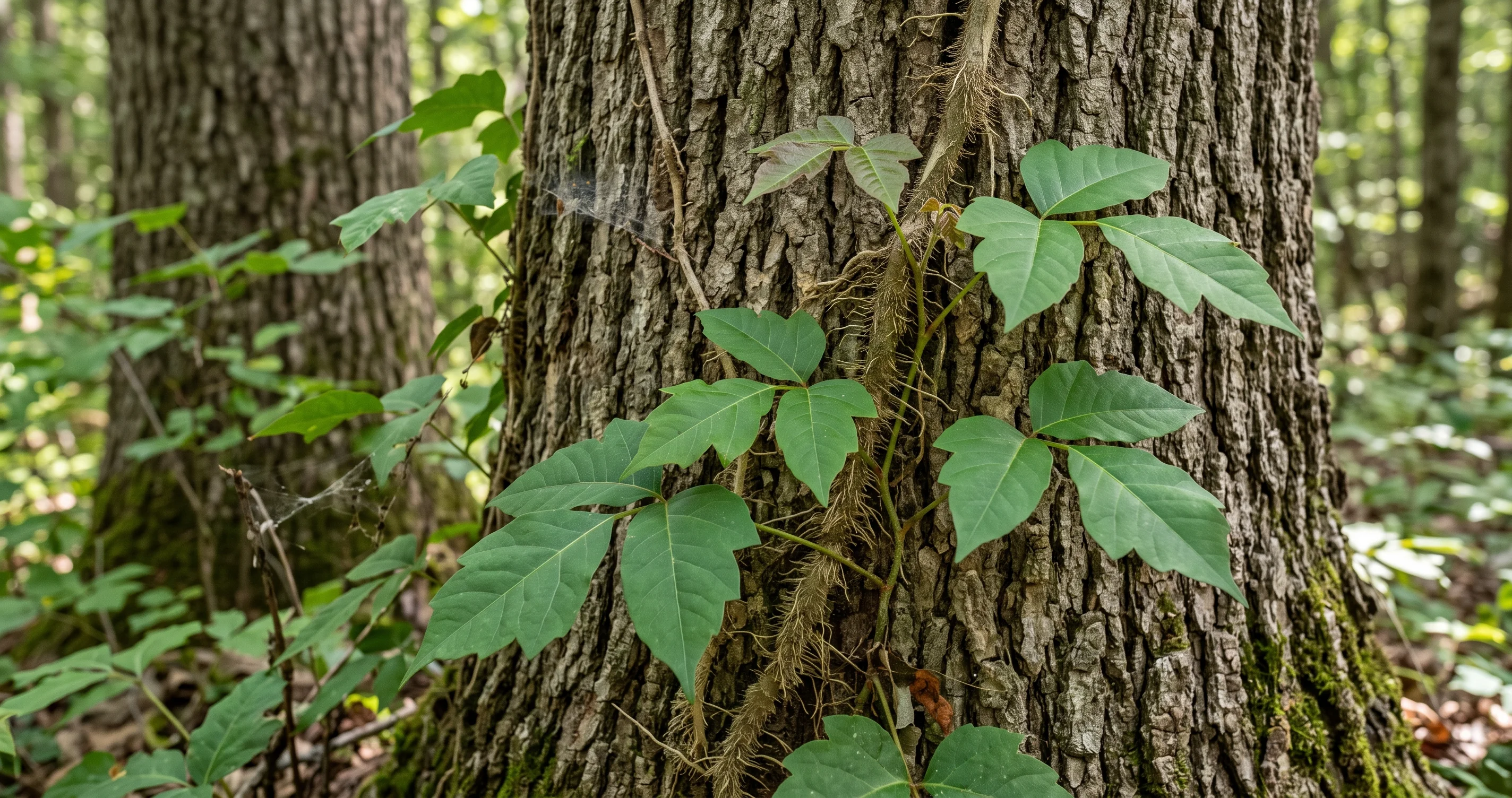
Poison ivy typically produces a compound leaf consisting of three leaflets.
The central leaflet often has a longer stalk than the two side leaflets.
Leaflet edges may be smooth, toothed, or irregularly lobed. Their shape and surface appearance can vary considerably between plants.
Young foliage may appear reddish or bronze before turning green.
Virginia Creeper Usually Has Five Leaflets
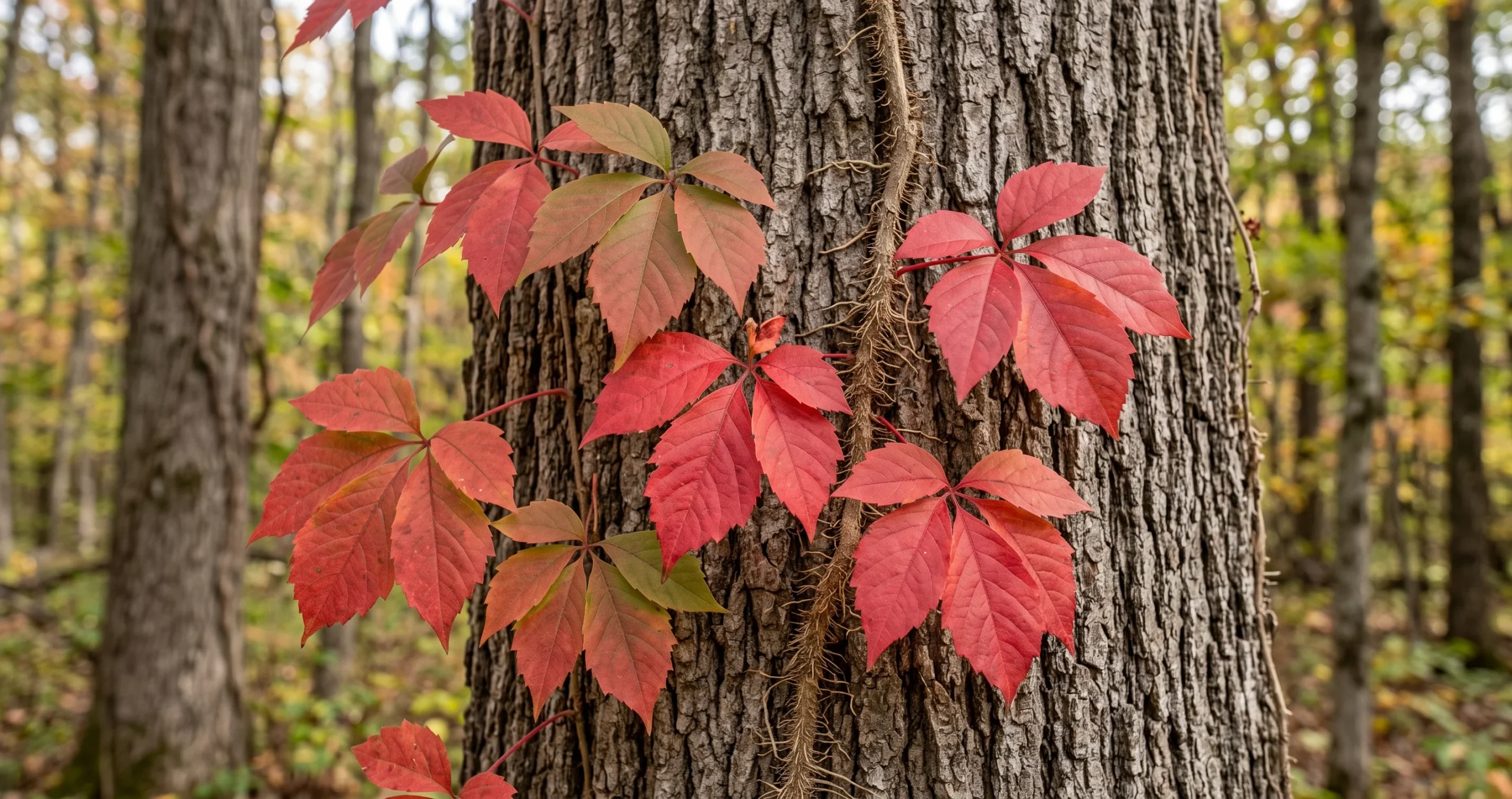
Virginia creeper normally produces palmately compound leaves with five leaflets radiating from one central attachment point.
The leaflets often have toothed margins and pointed tips.
Young plants, however, may occasionally produce leaves with only three leaflets, which can cause confusion with poison ivy.
This is why examining several mature leaves and additional plant characteristics is more reliable than counting leaflets on a single shoot.
Vines, Stems, and Climbing Structures
When leaf characteristics are uncertain, the climbing structures provide another useful identification clue.
Poison Ivy’s Hairy Climbing Vines
Mature climbing poison ivy vines often develop numerous aerial rootlets.
These fine, rootlike structures attach the plant to tree bark and other surfaces.
From a distance, they can give the vine a distinctly fuzzy or hairy appearance.
Poison ivy also grows as a trailing groundcover or shrub, so not every plant will display a large climbing stem.
Virginia Creeper’s Tendrils
Virginia creeper climbs using branched tendrils, frequently ending in small adhesive pads.
These structures attach to bark, masonry, fences, and other surfaces.
Unlike poison ivy’s dense aerial rootlets, the tendrils are specialized climbing organs.
However, gardeners should avoid touching unfamiliar vines merely to examine their attachment structures.
A close photograph or careful visual inspection from a safe distance is preferable.
Berries, Flowers, and Seasonal Changes
Leaves are often the easiest identification feature, but reproductive structures can provide additional evidence.
Poison Ivy Berries
Poison ivy produces clusters of small, pale fruits that commonly become whitish as they mature.
These fruits can remain visible after the leaves fall.
Birds and other wildlife may consume the fruits, helping disperse the seeds.
Although the fruits are useful for identification, they should not be touched or tasted.
Virginia Creeper Berries
Virginia creeper develops small, dark blue to blue-black berries on reddish stalks.
These fruits are consumed by various birds, but they are not safe for human consumption.
Virginia creeper fruits contain compounds, including calcium oxalate, that can cause harmful reactions if eaten.
Fall Color Is Not Enough
Both species can develop striking red foliage during autumn.
Virginia creeper often turns brilliant crimson or burgundy, while poison ivy may display red, orange, or yellow.
Because their fall colors overlap, foliage color alone cannot reliably distinguish them.
Why the Leaves of Three Rhyme Is Not Perfect
The familiar warning “Leaves of three, let it be” is a useful reminder, but it is not a complete identification system.
Many harmless plants also produce leaves or leaflets in groups of three.
Wild strawberry, raspberry, and some young tree seedlings can resemble poison ivy at first glance.
Meanwhile, immature Virginia creeper may occasionally produce three leaflets instead of the usual five.
The rhyme also does not help identify leafless poison ivy vines during winter.
A more reliable approach combines leaflet arrangement, vine attachment, fruit color, growth habit, and seasonal characteristics.
What Causes a Poison Ivy Rash
Poison ivy contains urushiol, an oily mixture of compounds responsible for the allergic skin reaction associated with the plant.
Urushiol occurs in multiple plant tissues, including leaves, stems, and roots.
Contact with the oil can trigger allergic contact dermatitis in susceptible individuals.
How the Reaction Develops
When urushiol reaches the skin, it can bind to skin proteins and trigger an immune response.
The resulting reaction may include redness, itching, swelling, and fluid-filled blisters.
Symptoms commonly develop within hours to several days after exposure, depending on the person’s sensitivity and previous contact history.
The rash is not caused by a conventional plant poison circulating through the bloodstream. It is an immune-mediated skin reaction.
The Oil Can Remain on Objects
Urushiol can contaminate gloves, tools, clothing, pet fur, and other surfaces.
Touching a contaminated object may transfer the oil to exposed skin.
This explains why a person can develop a rash without remembering direct contact with the plant.
Proper cleaning of tools and clothing is an important part of prevention.
Safe Removal and Garden Management
Removing poison ivy requires more caution than pulling an ordinary garden weed.
The safest method depends on the plant’s size, location, and the gardener’s ability to avoid exposure.
Identify Before Disturbing
Never pull an unidentified vine with bare hands.
If the plant’s identity remains uncertain, treat it as potentially hazardous until it can be identified confidently.
For large climbing vines, extensive infestations, or plants growing near frequently used areas, professional removal may be the safer option.
Wear Protective Clothing
When handling suspected poison ivy, use protective gloves, long sleeves, long pants, closed shoes, and suitable eye protection.
Disposable protective gloves or chemical-resistant gloves can reduce contamination risks.
Remember that ordinary fabric gloves can absorb or retain plant oils.
Remove Small Plants Carefully
Small plants may be removed by carefully digging out their root systems when soil conditions allow.
Avoid breaking or crushing stems unnecessarily.
Place removed material directly into a sturdy disposal bag without touching exposed skin or clothing.
Regrowth is possible if underground plant structures remain.
Never Burn Poison Ivy
Burning poison ivy is dangerous because smoke can carry urushiol-containing particles.
Inhalation may cause serious irritation and potentially severe respiratory reactions.
Do not burn poison ivy debris, even when the plant appears dry or dead.
Use Herbicides Responsibly
For persistent infestations, a properly labeled herbicide may be appropriate where permitted.
Follow the product label, protect desirable vegetation, and avoid applications that could contaminate waterways.
Cut-stump treatments may be useful for established climbing vines, but they require careful technique and adherence to label instructions.
First Aid After Poison Ivy Exposure
Prompt action can reduce the amount of urushiol remaining on the skin.
Wash Exposed Skin
Rinse exposed skin promptly with plenty of running water and soap.
Wash gently rather than scrubbing aggressively, which can irritate the skin.
Clean under fingernails because plant oils may collect there.
Clean Clothing and Equipment
Wash potentially contaminated clothing separately using detergent according to fabric instructions.
Clean tools, footwear, and other equipment that may have contacted the plant.
Avoid transferring contamination from gloves to your face or other skin.
Relieve Mild Symptoms
Cool compresses, calamine lotion, and colloidal oatmeal baths may help relieve itching.
Over-the-counter hydrocortisone cream may be useful for some mild reactions when used according to the product instructions.
Avoid scratching blisters, as damaged skin can become infected.
Know When Medical Care Is Necessary
Seek medical advice for severe or widespread reactions, significant facial or genital involvement, or signs of infection.
A clinician may recommend prescription treatment for more serious allergic dermatitis.
Seek emergency medical care immediately if exposure is followed by breathing difficulty, especially after inhaling smoke from burning poison ivy.
Other Plants Commonly Mistaken for Poison Ivy
Several familiar plants can create identification confusion.
Box Elder Seedlings
Box elder (Acer negundo) seedlings can produce leaves with three leaflets.
However, their leaves are arranged oppositely along the stem, while poison ivy leaves are alternate.
This distinction is particularly useful when examining young plants.
Wild Strawberry
Wild strawberry plants also have three leaflets.
Their low-growing habit, serrated leaflet edges, and characteristic flowers and fruits help distinguish them from poison ivy.
Raspberry and Blackberry
Some raspberry and blackberry leaves resemble poison ivy because they can contain three leaflets.
However, their canes frequently have prickles, and their overall growth structure differs.
Not every bramble is prickly, so multiple features should still be checked.
Fragrant Sumac
Fragrant sumac (Rhus aromatica) has three leaflets and can resemble poison ivy.
Its growth habit, leaflet structure, and aromatic foliage provide distinguishing clues, but unfamiliar plants should not be rubbed or crushed for identification.
Common Myths About Poison Ivy
Myth 1: Poison Ivy Is Only Dangerous When Green
Urushiol can remain present in stems, roots, and other plant tissues throughout the year.
Leafless winter vines can still cause exposure.
Myth 2: Poison Ivy Blisters Spread the Rash
Fluid inside poison ivy blisters does not contain urushiol and does not spread the allergic reaction.
New areas of rash may appear later because of differences in exposure, skin sensitivity, or residual oil contamination.
Myth 3: Everyone Reacts to Poison Ivy
Sensitivity varies among individuals.
Some people may initially show little reaction but become sensitized after repeated exposure.
Myth 4: Virginia Creeper Is Completely Harmless
Virginia creeper generally does not produce the same urushiol-associated reaction as poison ivy.
However, it can occasionally irritate skin, and its berries should not be eaten.
Myth 5: Dead Poison Ivy Is Safe to Handle
Dead poison ivy can retain urushiol for an extended period.
Dried vines, roots, and discarded plant material should still be handled cautiously.
Frequently Asked Questions
What is the easiest way to distinguish poison ivy from Virginia creeper?
Count the leaflets on several mature leaves. Poison ivy typically has three, while Virginia creeper usually has five. Confirm the identification using climbing structures and fruit characteristics.
Can Virginia creeper cause a rash?
Yes, some people experience skin irritation after handling Virginia creeper. However, it does not cause the same characteristic urushiol-induced allergic reaction as poison ivy.
Can poison ivy grow as a shrub?
Yes. Poison ivy can grow as a climbing vine, trailing groundcover, or shrub-like plant.
Is poison ivy contagious?
The rash itself is not contagious. However, urushiol remaining on skin, clothing, tools, or other objects can be transferred to another person.
Can pets carry poison ivy oil?
Yes. Urushiol can remain on animal fur and potentially transfer to people who touch the contaminated fur.
Should Virginia creeper be removed from gardens?
Not necessarily. Virginia creeper is a native climbing plant that provides wildlife benefits, including berries for birds. Removal may be appropriate when it grows where it is unwanted or threatens vulnerable structures.
What should I do if I cannot identify a vine?
Avoid direct contact and photograph the plant from a safe distance. A local Cooperative Extension office or qualified plant professional can help confirm its identity.
Conclusion
Distinguishing poison ivy from Virginia creeper is an essential gardening skill, particularly when managing climbing vines and unfamiliar plants.
Poison ivy typically has three leaflets, hairy aerial rootlets, and pale berries. Virginia creeper generally has five leaflets, adhesive climbing tendrils, and dark blue berries.
However, young plants and seasonal changes can complicate identification, making it important to examine several characteristics together.
Understanding urushiol exposure, using protective removal methods, and responding promptly after contact can help reduce the risk of painful reactions.
With careful identification and sensible precautions, gardeners can manage unwanted vines while preserving beneficial native vegetation where appropriate.
External Sources
1. CDC/NIOSH — Poisonous Plants: Guidance on identifying poison ivy, understanding urushiol exposure, preventing skin contact, and responding to exposure. CDC: Poisonous Plants
2. American Academy of Dermatology — Poison Ivy, Oak, and Sumac: Dermatologist-reviewed information about allergic skin reactions, first aid, symptom management, and when medical treatment is necessary. American Academy of Dermatology: Poison Ivy Guidance
3. NC State Extension — Virginia Creeper: Botanical identification details covering leaflet arrangement, climbing structures, fruit characteristics, growing conditions, and potential irritation. NC State Extension: Virginia Creeper