
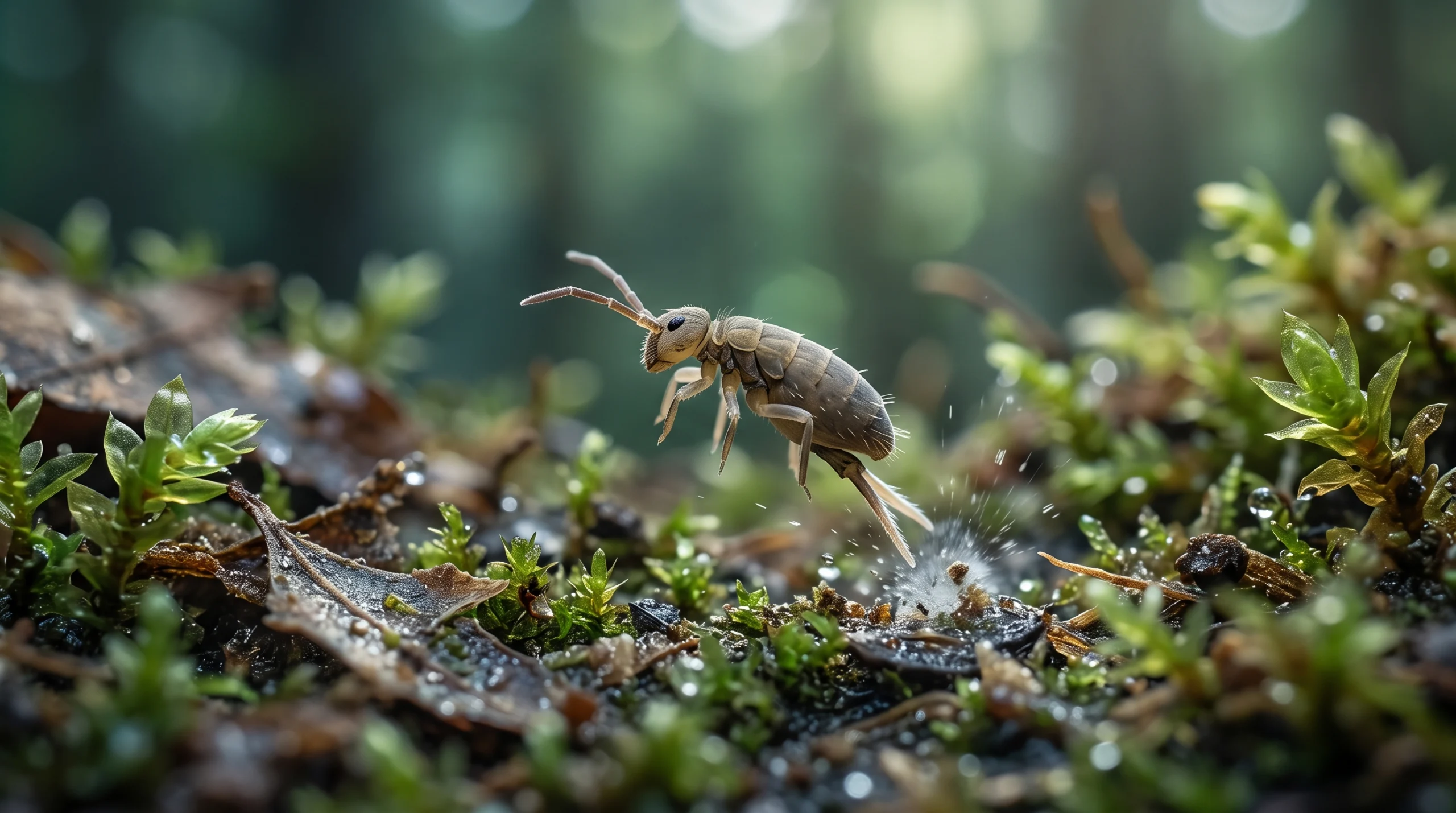
On a damp forest floor, a springtail moves through a landscape that, at its scale, is enormous. Moss stems rise around it. Fungal threads cross fragments of decomposing leaves, and droplets of water form obstacles comparable to ponds. The animal itself may be only a millimeter or two long.
A vibration disturbs the litter. An approaching predator, a moving leaf, or a nearby touch changes the scene. Almost instantly, the springtail is gone from its original position.
It has launched itself into the air.
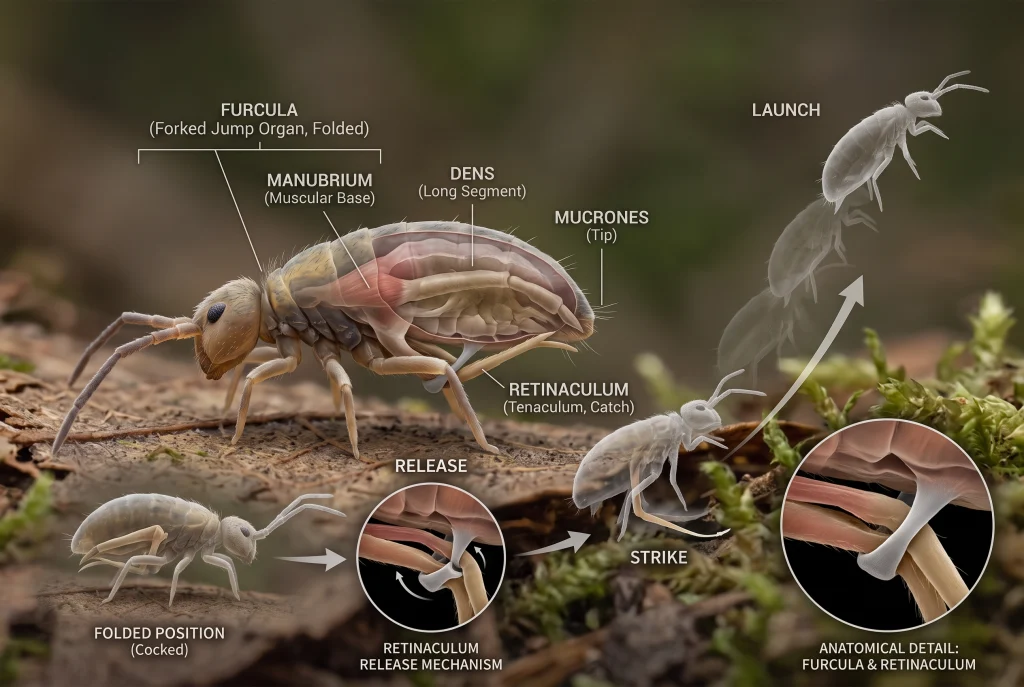
The jump does not come from enlarged hind legs like those of a flea or grasshopper. In many springtails, the main jumping apparatus is a specialized, forked appendage folded beneath the abdomen. Called the furcula, it can be released extremely rapidly and driven against the surface beneath the animal, accelerating the tiny body away.
High-speed cameras reveal that what looks to human eyes like disappearance is a remarkably sophisticated form of miniature locomotion. In some species, takeoff occurs within only a few milliseconds. Yet springtails are not all built or behaving identically. Their jumping abilities range from extraordinary aerial maneuvers to species in which the furcula is reduced or absent.
Together, they provide a remarkable demonstration of what movement looks like when evolution operates at millimeter scale.
A Tiny Animal Hidden Beneath Our Feet
Springtails belong to Collembola, an ancient and highly successful lineage of hexapods.
They have six legs, but modern classifications generally place Collembola outside Insecta rather than treating them as true insects. Along with insects and other closely related six-legged arthropods, they belong to the broader group Hexapoda.
Springtails occur worldwide, including in remarkably harsh environments.
Many familiar species are tiny, commonly measuring only around 0.5 to a few millimeters long, although size varies across the group. Their small bodies allow them to occupy spaces that larger animals barely experience.
They can be abundant in:
- Soil and leaf litter
- Mosses and lichens
- Rotting wood
- Beneath bark
- Compost and decomposing vegetation
- Fungal-rich microhabitats
- Shorelines and water surfaces
- Snow and other cold environments in specialized species
Moisture is especially important. Their small size creates a high surface-area-to-volume ratio, making water balance a significant physiological challenge.
A handful of litter can therefore contain an entire world of springtail activity invisible to a casual observer.
Their abundance also makes them important components of terrestrial food webs. Folsomia candida, for example, is so widespread and easy to maintain that it has become a standard laboratory soil arthropod used in ecotoxicology and ecological research. (Annual Reviews)
The Fork Beneath the Abdomen
The structure responsible for the characteristic jump is the furcula, also called the furca.
It is not a tail, stinger, wing, or modified leg.
The furcula is an abdominal appendage located on the underside of the body. Its name reflects its forked construction.
Although exact morphology varies among groups, the apparatus generally includes a basal portion called the manubrium, paired sections called the dentes, and terminal structures called the mucrones.
When the animal is walking normally, a developed furcula is folded forward beneath the abdomen.
This arrangement makes the jumping apparatus surprisingly difficult to notice. Viewed from above, a springtail may appear to have nothing unusual about its rear end.
Under magnification, however, the folded apparatus reveals an entirely different locomotor system.
Modern imaging studies combining scanning electron microscopy, micro-CT, confocal microscopy, and high-speed video have shown that the architecture varies substantially between elongated and globular springtails. Researchers are still investigating details of how the muscles, basal structures, latch, and furcula interact during takeoff. (PubMed)
Calling the furcula “spring-like” is therefore useful descriptively, but it should not be mistaken for a literal metal-spring mechanism.
It is a biological system involving cuticle, joints, muscles, stored mechanical energy, and a latch.
The Retinaculum Holds the System Ready
A powerful jumping appendage would be far less useful if the animal could not keep it securely stored until needed.
That role involves another specialized abdominal structure: the retinaculum, also known as the tenaculum.
The retinaculum engages the folded furcula and helps hold it beneath the abdomen.
This creates a latch-mediated jumping system. The animal can prepare the apparatus while the furcula remains restrained and then release it rapidly.
The arrangement has sometimes been compared with a catapult. That analogy captures the idea of storing and rapidly releasing mechanical energy, but the biological mechanism is more complex than a manufactured catapult.
The furcula itself is not simply a rigid lever that sits passively under tension.
Its components deform and rotate during the launch, while internal musculature and associated cuticular structures contribute to the mechanics. Recent morphological research emphasizes that some details—particularly the exact sequence of unlatching and the contributions of flexion and extension mechanisms—still warrant further study. (PubMed)
Release Happens Extremely Fast
When a jumping springtail initiates takeoff, the retained furcula is released.
It rapidly rotates away from its folded position beneath the abdomen.
The distal portions interact with the substrate, transferring momentum and accelerating the body upward and away.
To human vision, the event is extremely difficult to resolve. High-speed cameras are needed to separate the movement into individual phases.
A particularly detailed 2024 study examined the globular springtail Dicyrtomina minuta, a species only about 1–2 millimeters long. Researchers recorded its jumps at tens of thousands of frames per second.
In the measured jumps, the furcula rotated rapidly against the substrate as the body began to accelerate and rotate backward. Average takeoff velocity was approximately 1 meter per second, reached over an average takeoff period of only 1.7 milliseconds. (PubMed)
Those numbers apply to D. minuta under the experimental conditions of that study. They should not be treated as universal measurements for Collembola.
The important general principle is that a springtail can concentrate the release of mechanical energy into an extraordinarily short interval.
Why the Jump Looks Almost Instantaneous
Scale changes the meaning of speed.
A velocity of about one meter per second does not sound remarkable when compared with a running mammal. For an animal around 1.5 millimeters long, however, it represents movement across hundreds of body lengths per second.
The Dicyrtomina minuta experiments illustrate this dramatically.
The researchers measured a fastest acceleration to takeoff of about 1,939 meters per second squared. Recorded jumps reached as much as 102 millimeters horizontally and 62 millimeters vertically, despite the animals being only 1–2 millimeters long. (PubMed)
The animal also rotated backward extremely rapidly.
Average rotation during flight was about 282 rotations per second in the measured jumps, with the fastest rates approaching 369 rotations per second. (PubMed)
These spectacular measurements describe one globular species, not a standard performance specification for every springtail.
Other body forms produce different trajectories and strategies.
That diversity is scientifically important because it allows researchers to investigate how changes in anatomy influence locomotion at extremely small scales.
An Escape Mechanism Rather Than Precision Flight
Jumping provides an obvious defensive advantage.
Springtails share their microscopic environment with predators that can include mites, spiders, pseudoscorpions, beetles, predatory insects, and other small invertebrates.
A predator attempting to seize a springtail at close range may suddenly find that its target has been displaced by dozens of body lengths.
The escape does not require the springtail to outrun the predator across the ground. It needs only to break contact quickly enough to make capture more difficult.
That does not mean every springtail carefully selects and controls an aerial destination.
The D. minuta study found that escape jumps induced by stimulation did not produce forward-directed launches. The animals characteristically performed rapidly rotating backward trajectories, and some landings ended in chaotic tumbling. (PubMed)
Yet other springtails show considerably more control.
This contrast demonstrates why broad statements about “the springtail jump” can be misleading.
Springtails That Live on Water
Some of the most sophisticated jumping behavior has been discovered in springtails living on or near water.
At human scale, a pond surface seems easily penetrated.
At springtail scale, surface tension is a major physical force.
The water-air interface can behave almost like a flexible substrate, and a millimeter-sized animal must negotiate it very differently from a larger creature.
Researchers investigating the semiaquatic springtail Isotomurus retardatus discovered an unusually refined system of takeoff, aerial control, and landing.
The animals can jump from the water surface using their furcula. Experiments showed that they adjust body posture and the impulse generated during takeoff, producing some directional control. (PubMed Central (PMC))
The furcula is only part of the story.
Another springtail organ, the collophore, or ventral tube, plays a critical role.
Before leaving the surface, I. retardatus can carry a tiny water droplet associated with its hydrophilic collophore. During flight, the springtail curves its body into a U-shaped posture. Aerodynamic forces help orient the ventral surface downward, with aerial righting measured in less than about 20 milliseconds. (PubMed Central (PMC))
Upon returning to the water, the collophore can adhere to the surface.
In the experiments, the springtails landed ventral-side down approximately 85% of the time. (OpenAlex)
This is genuine aerial control—but it is documented for a particular semiaquatic species and should not be generalized to every member of Collembola.
Not Every Springtail Is an Equally Powerful Jumper
The common name “springtail” can create the impression that every species possesses the same prominent jumping fork.
Evolution has produced considerably more variation.
Many surface-dwelling and litter-associated springtails possess a conspicuous, well-developed furcula and can jump effectively.
In some species adapted to deeper soil layers or other specialized microhabitats, however, the furcula is reduced. In others it may be effectively absent.
This makes ecological sense.
A dramatic aerial escape can be highly useful on an exposed leaf, bark surface, or water film. Deep inside tiny soil pores, launching through the air may offer much less advantage because there is little open space in which to jump.
Body form varies as well.
Elongated springtails and globular springtails do not necessarily use geometrically identical jumping systems. Recent comparative work has found substantial anatomical differences in their jumping apparatus. (PubMed)
Springtail locomotion is therefore an evolutionary spectrum rather than a single standardized design.
Small Body, Different Physics
The furcula becomes especially interesting when considered in the physical world of a millimeter-sized animal.
A springtail has extremely little mass.
That means a small force can produce enormous acceleration.
At the same time, forces that humans barely notice become disproportionately important.
Air Resistance
For a springtail spinning through the air, aerodynamic drag can meaningfully alter body orientation.
That helps explain how Isotomurus retardatus can exploit body posture for rapid aerial righting. (PubMed Central (PMC))
Surface Tension
A microscopic water droplet can be a major physical object.
The water-air interface can support a springtail, while adhesion between water and the collophore can influence takeoff and landing.
Moisture
Thin films of water across soil particles, moss, and vegetation can profoundly affect movement and survival.
Terrain
A grain of sand or fragment of bark can represent an obstacle comparable, relative to body size, to substantial terrain encountered by larger animals.
This is one reason the springtail mechanism cannot simply be enlarged into a hypothetical giant jumping animal.
Scaling up increases mass much faster than many structural dimensions and changes the relative importance of inertia, gravity, drag, adhesion, and material strength.
The furcula is effective partly because it evolved specifically for the physics of being tiny.
Springtails Are More Than Their Jump
The furcula may be their most visually dramatic feature, but springtails are ecologically important for less spectacular reasons.
They are major members of soil and litter communities.
Different species consume different resources, including:
- Fungal hyphae and spores
- Bacteria and other microorganisms
- Algae
- Decaying plant material
- Pollen
- Microbial films
- Other organic resources
Some species are selective fungal grazers. Others have broader diets, and feeding ecology varies substantially across Collembola.
Through these interactions, springtails influence microbial communities, decomposition, and nutrient cycling.
Their grazing can alter fungal growth and interactions around plant roots. Folsomia candida, for example, has been used experimentally to investigate springtail grazing on both pathogenic fungi and mycorrhizal fungi associated with roots. (Annual Reviews)
Springtails are also food.
Their abundance makes them prey for numerous small predators, transferring energy from microorganisms and decomposer-associated food webs toward larger soil animals.
Calling every springtail simply a “decomposer” therefore misses much of their ecological complexity.
They are participants in an intricate microbial and invertebrate food web.
Why Scientists Study the Furcula
Springtails give biomechanists an unusually useful natural system.
Their jumps allow researchers to investigate how very small organisms:
- Store and rapidly release mechanical energy
- Use latch-mediated locomotor systems
- Transfer force through flexible appendages
- Control rotation
- Interact with water surfaces
- Exploit aerodynamic drag
- Stabilize landings
The problem is that most of this happens too quickly and at too small a scale for ordinary observation.
Modern technology has transformed the field.
High-speed video can record tens of thousands of frames per second, turning a millisecond launch into a sequence researchers can measure. Scanning electron microscopy reveals tiny surface structures. Micro-CT reconstructs internal anatomy in three dimensions, while confocal microscopy helps scientists map structures that conventional photography cannot resolve. (PubMed)
The results also interest engineers.
Latch-mediated mechanisms, rapid miniature propulsion, water-surface locomotion, passive aerial stabilization, and adhesive landing all have potential relevance to bio-inspired robotics.
Recent engineering research on water-surface jumping explicitly draws on biological systems such as springtails when investigating how miniature devices can overcome or exploit surface tension. (Nature)
Nature is not providing engineers with a finished blueprint. Instead, springtails demonstrate physical principles that may inspire entirely different artificial mechanisms.
An Extraordinary Machine at Millimeter Scale
Return to the forest floor and the springtail is easy to overlook again.
It moves beneath leaves and between moss stems, grazing on microscopic resources in a humid world. Nothing about its size suggests the speed hidden beneath its abdomen.
Then the substrate moves.
The retinaculum releases. The folded furcula swings downward. Force passes into the ground, and an animal scarcely larger than a punctuation mark accelerates away within milliseconds.
In some species the result is a tumbling escape. In others, especially semiaquatic forms studied on water, takeoff can be followed by sophisticated aerial righting and adhesive landing. Other springtails have reduced the jumping apparatus as evolution carried them into habitats where a powerful leap offered less advantage.
That diversity is what makes the furcula more interesting than a simple biological catapult.
It is a specialized locomotor system shaped around the physical reality of an extremely small animal.
At springtail scale, water behaves differently, air resistance matters more, microscopic surfaces become landscapes, and tiny forces can generate enormous acceleration. Evolution has worked within those conditions to produce an escape mechanism unlike the enlarged legs of familiar jumping animals.
The result has been operating beneath forests, lawns, moss, bark, and fallen leaves all around us—often at a scale too small and a speed too fast for human eyes to appreciate without a camera capable of slowing milliseconds into moments.
Internal Linking Suggestions: Link naturally to articles about soil invertebrates living beneath leaf litter; microscopic wildlife and hidden garden ecosystems; unusual jumping or escape adaptations in arthropods; fungi, decomposition, and nutrient cycling; and other examples of specialized animal locomotion.