
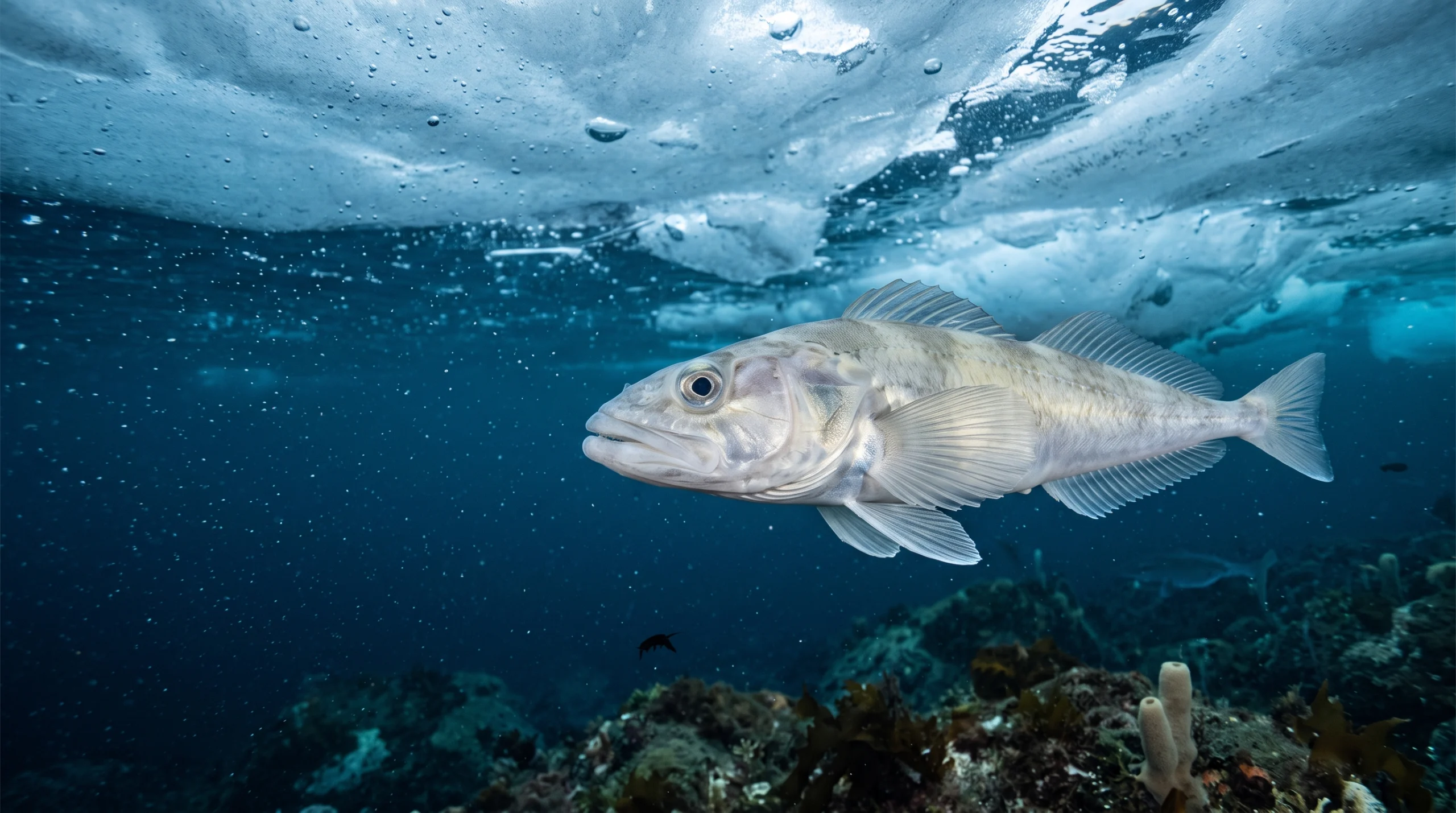
Beneath Antarctic sea ice, seawater hovers close to its freezing point. Light filters through cracks in the ice, illuminating a world of sponges, crustaceans, and fishes whose bodies have been shaped by millions of years in one of Earth’s coldest marine environments.
Among them are the Antarctic icefishes of the family Channichthyidae. If the circulation of one of these fishes could be seen clearly, its blood would look startlingly pale compared with the familiar red blood of almost every other vertebrate. The reason is extraordinary: adult channichthyid icefishes do not produce functional hemoglobin, the oxygen-binding pigment responsible for the red color and much of the oxygen-carrying capacity of ordinary vertebrate blood.
Calling them “bloodless fish,” however, is misleading. Icefishes have a heart, blood vessels and circulating blood plasma. Modern developmental research also shows that they retain early erythroid precursors even though mature red-cell production is lost. Their remarkable feature is not an absence of circulation but the loss of the hemoglobin-based oxygen-transport system that virtually every other vertebrate depends upon.
Their survival is possible only because the loss occurred within an exceptional environment—and because icefish physiology was extensively remodeled around it.
The Fish With Pale Blood
Channichthyidae belong to the Antarctic notothenioids, a remarkable radiation of fishes that diversified as Antarctica and the surrounding Southern Ocean became increasingly isolated and cold.
Most vertebrate blood looks red because erythrocytes, or red blood cells, contain large quantities of hemoglobin. Oxygenated and deoxygenated forms of the pigment produce variations in color, but hemoglobin remains responsible for the characteristic red appearance.
Icefish circulation is radically different.
Research going back to Norwegian zoologist Johan Ruud’s classic work in the 1950s established that the nearly transparent blood of icefish lacked hemoglobin and mature erythrocytes. Later molecular studies revealed the genetic basis of this unusual condition.
The result is blood with dramatically less capacity to transport oxygen.
This seems almost incompatible with vertebrate life. Yet in the Southern Ocean, icefish evolved a different physiological solution.
What Hemoglobin Normally Does
Oxygen does not dissolve especially well in watery fluids such as blood plasma. For an active vertebrate, simply pumping oxygenated water around the body would ordinarily provide nowhere near enough oxygen to sustain its tissues.
Hemoglobin solves that problem.
The protein is packed inside red blood cells and contains iron-bearing heme groups capable of reversibly binding oxygen.
In a typical fish, the basic process works like this:
- Water flows across the gills and oxygen diffuses into the blood.
- Oxygen binds to hemoglobin inside erythrocytes.
- The heart pumps this oxygen-rich blood through the body.
- Hemoglobin releases oxygen in tissues where it is needed.
- Cells use the oxygen during aerobic metabolism to extract energy from nutrients.
Hemoglobin therefore multiplies the amount of oxygen that blood can transport compared with plasma alone.
That advantage is so fundamental that functional hemoglobin is nearly universal among vertebrates.
Channichthyid icefishes represent the extraordinary exception.
What Icefish Lost
The hemoglobinless condition was inherited from the common ancestor of living channichthyid icefishes. Molecular evidence shows extensive deletion and inactivation of the globin genes needed to manufacture functional adult hemoglobin.
Most studied icefishes retain only remnants of the adult alpha-globin region while lacking the corresponding functional beta-globin gene. Neopagetopsis ionah, Jonah’s icefish, retains a disrupted alpha-beta globin complex, but it does not provide functional adult hemoglobin.
The loss goes beyond hemoglobin production. Modern genomic and developmental work indicates that channichthyids fail to complete normal maturation of the erythroid lineage, although early red-cell precursors remain.
This distinction makes statements that icefish simply have “no red blood” imprecise. Their blood-forming biology has not vanished wholesale.
And they most certainly have blood.
What has disappeared is the ordinary mature erythrocyte-and-hemoglobin oxygen-delivery system.
Oxygen Dissolved Directly in Plasma
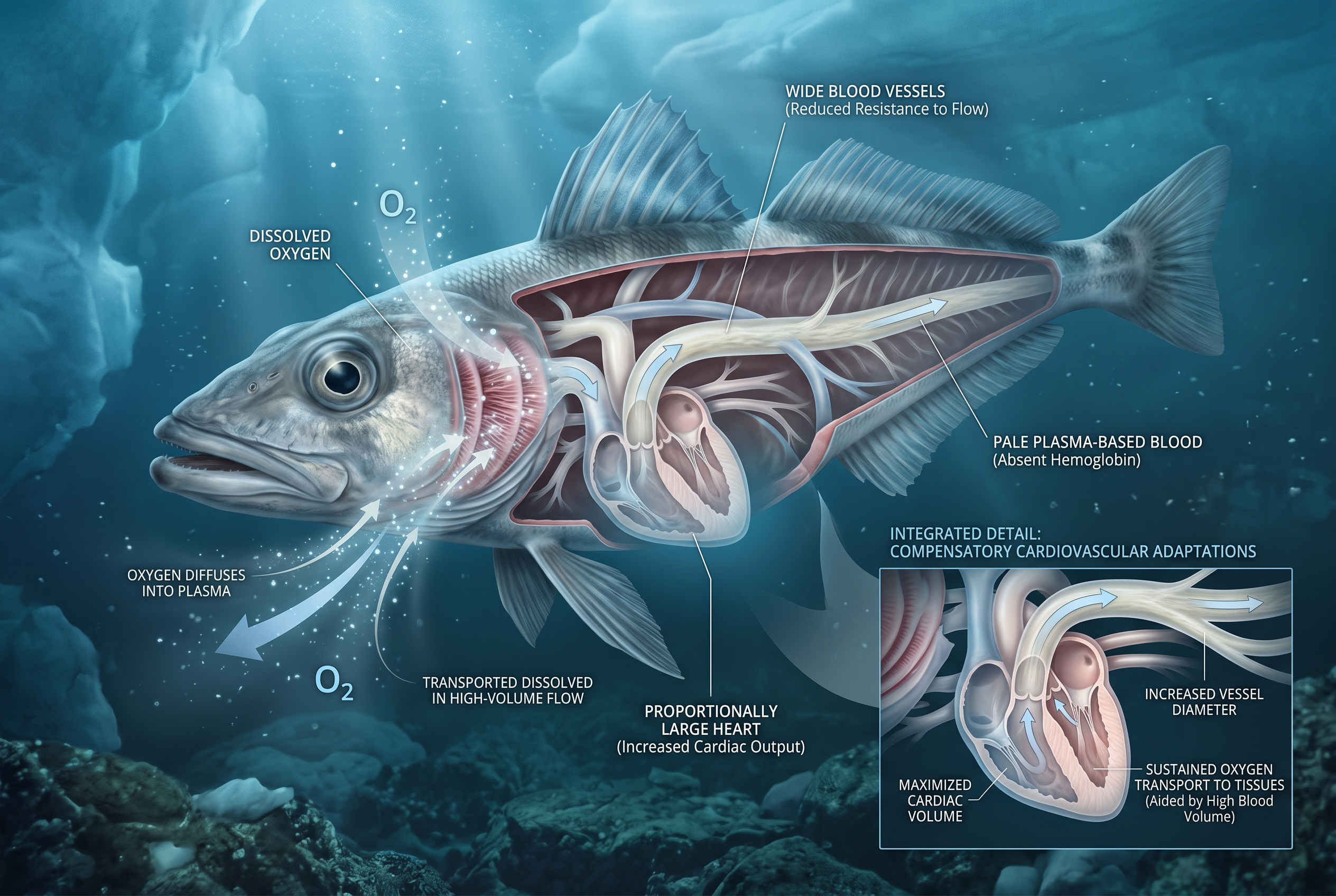
Without functional hemoglobin, oxygen reaching an icefish’s tissues must travel largely as gas physically dissolved in the liquid component of its blood.
The principle is simple.
Place water in contact with oxygen, and some oxygen molecules enter solution. Blood plasma is mostly water, so oxygen can dissolve directly into it after crossing the gills.
Humans and other vertebrates also carry a small quantity of oxygen this way. The difference is that hemoglobin normally carries overwhelmingly more.
For icefish, dissolved oxygen is the main bloodstream transport mechanism.
The price is enormous.
Classic physiological measurements indicate that hemoglobinless icefish blood has only around one-tenth—or less—of the oxygen-carrying capacity per unit volume of blood in red-blooded Antarctic relatives.
An icefish therefore cannot compensate simply by using ordinary fish circulation without hemoglobin.
It has to move much more fluid.
Why Antarctic Water Helps
The Southern Ocean provides unusually favorable circumstances for such an improbable system.
One crucial physical property is that gases are generally more soluble in cold water than warm water. Antarctic marine waters therefore contain abundant dissolved oxygen, particularly when compared with warmer environments under otherwise comparable conditions.
The fishes themselves are ectotherms, meaning their body temperatures largely track the surrounding seawater. Their tissues operate at exceptionally low temperatures, and their metabolic physiology is specialized for permanent cold. Historically, these conditions relaxed some of the demand for an exceptionally high-capacity oxygen carrier.
Cold water did not make hemoglobin useless.
Red-blooded Antarctic fishes living beside icefishes still possess hemoglobin. Indeed, the persistence of hemoglobin in their relatives is an important warning against describing its loss as an obviously superior Antarctic adaptation.
Instead, the oxygen-rich, cold environment appears to have made an otherwise devastating loss survivable.
Once that happened, extensive compensatory changes became essential.
An Extreme Cardiovascular System
An icefish solves its oxygen-delivery problem partly through brute-force circulation.
If each unit of blood transports relatively little oxygen, substantially more blood can be moved through the tissues.
Channichthyid cardiovascular systems show a striking suite of characteristics associated with this challenge:
- Enlarged hearts
- Large stroke volumes
- High cardiac outputs
- Increased blood volume
- Large-diameter blood vessels
- Extensive capillary networks
- Relatively low vascular resistance
Research comparing icefishes with red-blooded Antarctic fishes has shown just how extensively their cardiovascular system has been remodeled.
Rather than pumping a small quantity of highly oxygenated blood, the icefish pumps a large quantity of weakly oxygenated plasma.
Wide vessels help keep resistance relatively low. A large heart can eject a substantial volume with each contraction. Expanded vascular networks facilitate oxygen movement into tissues.
At the cellular level, many icefish tissues also have unusually high mitochondrial densities. Mitochondria are the structures where oxygen-dependent energy production occurs, and their organization in icefish may help shorten diffusion distances and support oxygen delivery within tissues.
The whole animal has effectively been reorganized around poor oxygen-carrying blood.
Skin, Gills and Oxygen Uptake
Icefishes have not abandoned gills. Branchial respiration—oxygen uptake across the gills—remains central to their biology.
Their gills offer a large exchange surface across which oxygen dissolved in seawater can enter the circulation.
Cutaneous respiration can provide another route in some circumstances and species.
Icefishes generally lack the heavy scale covering found in many other fishes, and their skin can contribute to gas exchange. Classic physiological work has identified cutaneous oxygen uptake as part of the compensatory suite associated with hemoglobin loss.
Experiments involving Chaenocephalus aceratus have also observed behavior during acute warming that may increase water movement over the scaleless integument and thereby facilitate cutaneous respiration.
The contribution should not be generalized identically across every member of Channichthyidae. Species differ in ecology, anatomy and physiology.
The key point is that oxygen acquisition is not accomplished by a single replacement for hemoglobin. Icefish survival emerges from several interacting features involving respiratory surfaces, circulation and tissue organization.
Hemoglobin and Myoglobin Are Not the Same Thing
The icefish story is sometimes made even more confusing by another oxygen-binding protein: myoglobin.
Hemoglobin primarily transports oxygen through the bloodstream.
Myoglobin is found within muscle cells, especially cardiac and oxidative muscle, where it can facilitate intracellular oxygen movement and provide an oxygen reserve.
All living channichthyid icefishes characteristically lack functional hemoglobin, but myoglobin is a different story.
Research has shown that loss of myoglobin expression occurred independently multiple times during icefish evolution. Some channichthyids retain myoglobin in the heart; others do not. The myoglobin gene itself is retained across the icefishes examined, even when mutations or regulatory changes prevent its normal expression.
This distinction matters because losing cardiac myoglobin can have functional consequences. Experiments indicate that retained myoglobin can improve cardiac performance under demanding conditions.
It is therefore inaccurate to treat hemoglobin loss and myoglobin loss as one universal icefish characteristic.
Why Losing Hemoglobin Could Evolve
Hemoglobin loss presents an evolutionary puzzle because the trait itself does not appear to provide a straightforward advantage.
The most strongly supported part of the story concerns environmental permissiveness.
As the Southern Ocean cooled over evolutionary time, its waters became exceptionally cold and oxygen rich. Comparative genomic research indicates that relaxation of selection on erythrocyte-related biology followed sustained Antarctic cooling.
Under those conditions, mutations that damaged hemoglobin production were less immediately catastrophic than they would have been in warm water.
Lower blood viscosity has sometimes been suggested as a potential benefit of losing erythrocytes. Without masses of red cells, icefish blood is indeed less viscous.
But that does not mean losing hemoglobin made circulation energetically cheaper overall.
Icefishes must compensate by pumping dramatically larger volumes of blood. Reviews of their physiology conclude that hemoglobin loss itself should not simply be interpreted as an energetically advantageous adaptation.
A useful evolutionary interpretation is therefore more subtle.
An initially disadvantageous molecular loss became tolerable in an exceptional environment. Natural selection subsequently favored or maintained compensatory traits that allowed descendants carrying that loss to survive and diversify.
Researchers sometimes describe this as a disaptation followed by compensatory readaptation, rather than a simple improvement over the ancestral hemoglobin-containing condition.
Evolution does not necessarily build organisms by replacing an old system with something objectively better. It works with whatever inherited variation remains viable under current conditions.
The Cost of This Specialization
The icefish solution works, but it has consequences.
The most fundamental limitation remains low blood oxygen capacity. Even with enormous cardiovascular compensation, each unit of circulating plasma transports much less oxygen than hemoglobin-rich blood.
The fish therefore depends on:
- Continuous high-volume circulation
- Efficient oxygen uptake
- Large cardiovascular structures
- Low vascular resistance
- Favorable environmental oxygen availability
This highly specialized system evolved under remarkably stable cold conditions.
Warming presents a particular physiological problem because two processes can move in unfavorable directions simultaneously.
First, warmer water holds less dissolved oxygen under comparable conditions.
Second, warming generally raises metabolic demand in ectothermic animals, at least within their physiological range.
The animal can therefore need more oxygen precisely as environmental and physiological conditions make supplying it more challenging.
Climate Change and Antarctic Specialists
The Western Antarctic Peninsula and other parts of the Southern Ocean are undergoing substantial environmental change. For highly cold-adapted fishes, temperature is only one component.
Warming can interact with:
- Oxygen availability
- Metabolic demand
- Food-web changes
- Habitat distribution
- Disease
- Competition and predation
Hemoglobinless icefishes have often been considered particularly vulnerable because their oxygen transport already operates with such limited capacity.
Experimental evidence supports caution—but not simplistic predictions.
Some studies have found lower upper thermal limits in hemoglobinless icefishes than in red-blooded Antarctic relatives. Yet experiments have also demonstrated cardiovascular and behavioral responses that allow certain icefishes to cope with short-term warming. In cardiac experiments, two icefish species retained considerable capacity when experimentally warmed, emphasizing that short-term responses cannot automatically be translated into predictions of future extinction.
Other work also indicates that oxygen transport alone does not fully explain differences in thermal tolerance among Antarctic fishes.
Long-term outcomes will depend on species-specific physiology, acclimation capacity, ecological interactions and the magnitude and rate of environmental change.
The scientifically defensible conclusion is not that warming will inevitably eliminate icefishes.
It is that organisms whose physiology evolved under exceptionally stable cold conditions face a complicated challenge as those conditions change.
Why Icefish Matter to Science
Channichthyid icefishes are effectively natural experiments that could never ethically or practically be reproduced in most vertebrates.
They allow researchers to examine what happens when a biological system considered nearly indispensable disappears over evolutionary time.
Their biology informs several major fields.
Evolutionary Physiology
Icefish demonstrate how entire organ systems can be remodeled following the loss of a fundamental physiological component.
Cardiovascular Biology
Their oversized hearts, unusual vessels and high-volume circulation provide a natural model for investigating cardiac function and vascular regulation.
Oxygen Transport
Comparisons between hemoglobinless icefish and closely related red-blooded Antarctic species allow researchers to isolate the physiological consequences of hemoglobin loss.
Genome Evolution
Globin-gene remnants preserve molecular evidence of evolutionary loss, while changes in erythrocyte-development pathways reveal how a vertebrate lineage can lose a mature cell type without deleting every gene involved in its development.
Extreme Environmental Adaptation
Perhaps most importantly, icefish reveal how deeply an environment can shape evolutionary possibilities.
A mutation eliminating functional hemoglobin would be disastrous for almost any vertebrate.
In the frigid, oxygen-rich Southern Ocean, it became survivable.
Evolution Does Not Always Follow the Expected Path
The Antarctic icefish is extraordinary not because it violates the rules of vertebrate physiology, but because it reveals how flexible those rules can become under exceptional circumstances.
Its blood still circulates. Its tissues still require oxygen. Its heart still has to deliver that oxygen every second the animal remains alive.
What changed was the machinery.
Instead of loading oxygen onto enormous quantities of hemoglobin, the icefish relies heavily on oxygen physically dissolved in plasma. Instead of carrying highly oxygenated blood efficiently, it circulates much larger volumes through an enlarged heart and unusually expansive vascular system. Its gills, skin in some contexts, blood vessels, mitochondria and cardiovascular anatomy all contribute to making an otherwise severely compromised oxygen-transport system workable.
The loss of hemoglobin was not simply an evolutionary upgrade. Evidence suggests that the permanently cold, oxygen-rich Southern Ocean relaxed constraints enough for the loss to persist, while subsequent physiological changes compensated for its costs.
That makes the icefish a particularly powerful illustration of evolution.
Natural selection does not work toward a predetermined ideal. It modifies what already exists under the conditions organisms actually encounter. Given millions of years in an environment unlike almost anywhere else on Earth, even something as fundamental as red, hemoglobin-rich vertebrate blood can cease to be essential.
Internal Linking Suggestions: Link naturally to existing articles about Antarctic wildlife and adaptations to freezing conditions; extreme animal respiratory adaptations; unusual cardiovascular systems in wildlife; cold-water marine ecosystems; and evolutionary examples involving the loss of normally important anatomical or physiological traits.