
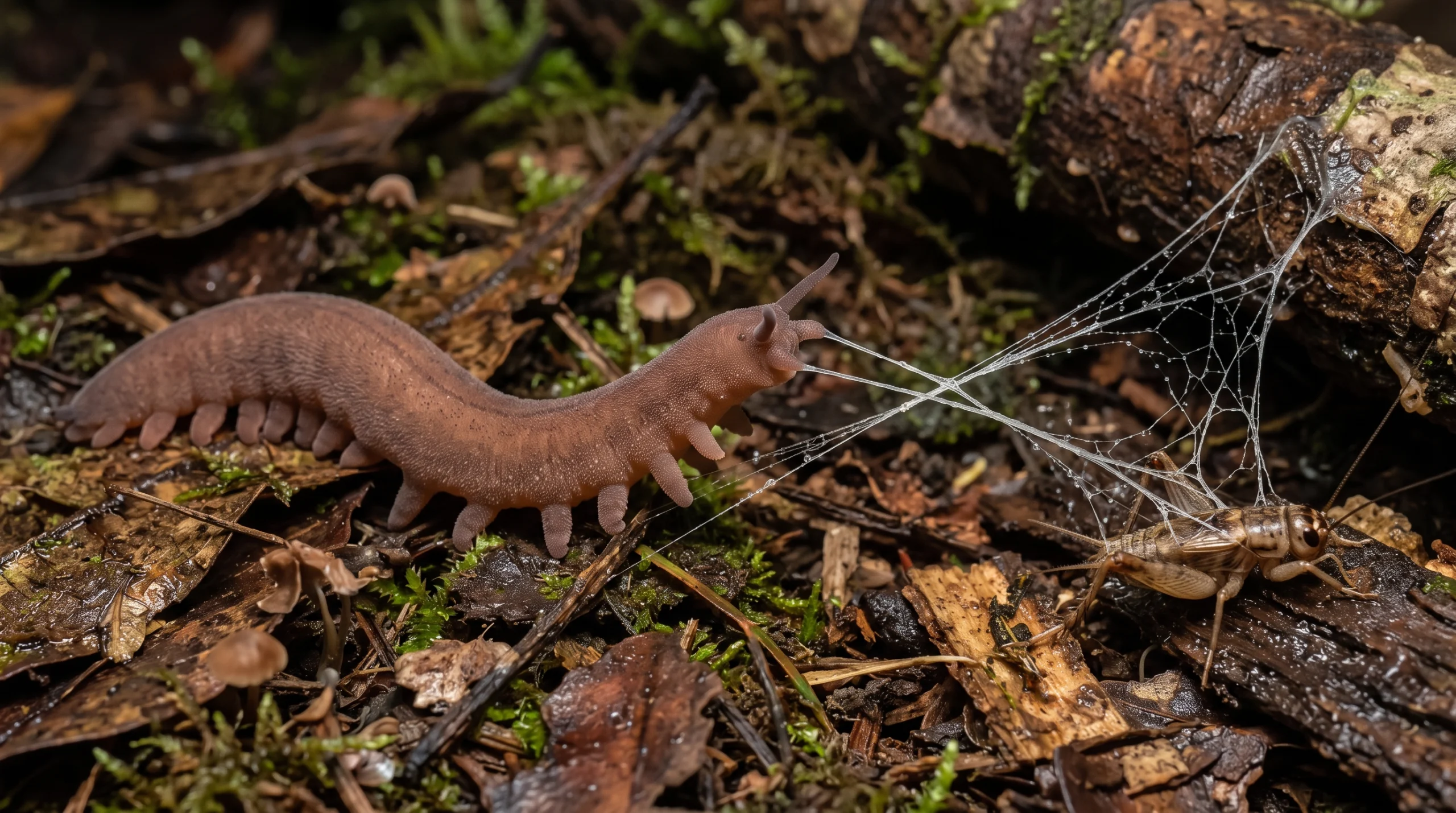
In damp leaf litter on a forest floor, a small arthropod begins to move. Nearby, a velvet worm advances on dozens of soft, stubby legs. It is not built for a high-speed chase.
Instead, two flexible structures beside its mouth suddenly become the center of the attack.
Sticky material shoots from both sides of the head. The streams do not remain as two simple straight lines. The flexible nozzles oscillate so quickly that their trajectories repeatedly sweep across one another. Slime spreads over the prey, where movement pulls the initially fluid material into adhesive fibers and an entangling network.
The prey’s attempts to escape can now make the situation worse by mechanically drawing more of the slime into strands.
Velvet worms, members of the phylum Onychophora, possess one of the most unusual prey-capture mechanisms among terrestrial invertebrates. Their attack combines large internal slime reservoirs, narrow ducts, paired oral papillae, pressure-driven flow, rapid passive oscillation and a remarkable mechanically responsive secretion.
Understanding how it works requires looking at both the animal and the physics of its slime.
Summary of Article
- Velvet worms are soft-bodied terrestrial predators belonging to the phylum Onychophora.
- Their capture slime leaves the body through paired oral papillae beside the mouth.
- During discharge, these flexible papillae can oscillate rapidly.
- The moving jets repeatedly sweep and cross, increasing the area covered by slime.
- The initially fluid secretion can be mechanically transformed into sticky fibrous strands.
- Immobilized prey is approached, restrained and pierced with the velvet worm’s jaws before feeding.
- High-speed experiments indicate that the rapid spraying pattern depends strongly on passive elastohydrodynamic instability rather than each movement being individually controlled by fast muscles.
What Exactly Is a Velvet Worm?
Velvet worms belong to Onychophora, a small phylum of terrestrial invertebrates separate from both insects and annelid worms.
Their bodies are elongated, soft and covered by a flexible cuticle with a distinctive velvety appearance. Along the trunk are pairs of fleshy limbs known as lobopods. These limbs end in claws but lack the hard, jointed construction characteristic of arthropod legs.
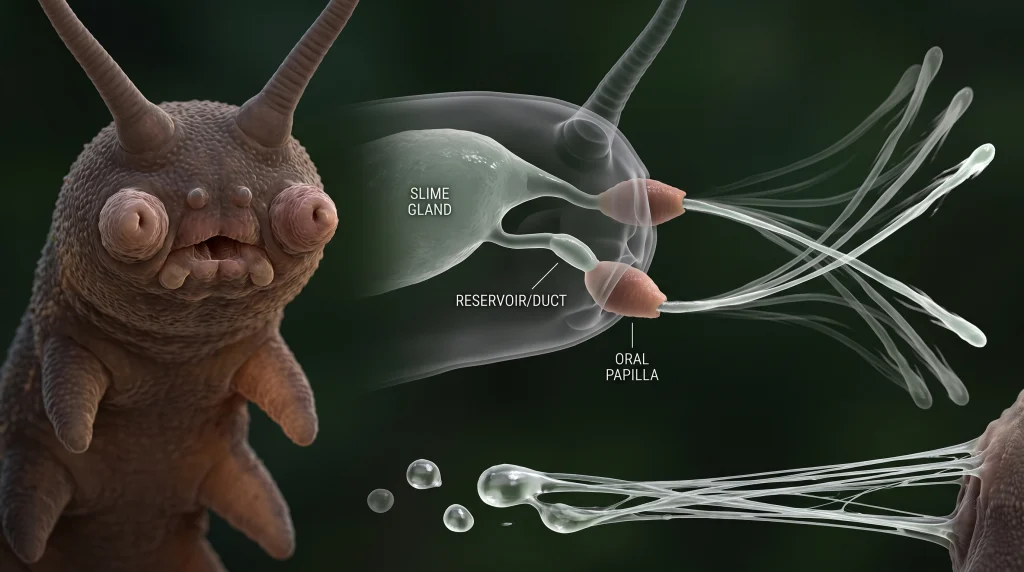
At the head are sensory antennae, a mouth containing specialized jaws and a pair of slime-producing oral papillae.
Living onychophorans occur primarily in humid tropical and temperate environments, especially in the Southern Hemisphere and around equatorial regions. Moisture is important because their soft bodies are vulnerable to water loss.
They are predators rather than ordinary soil “worms.”
Onychophorans are also important to evolutionary biology. Together with arthropods and tardigrades, they form part of the broader panarthropod lineage.
That does not make velvet worms a literal “missing link.” Modern onychophorans are living animals with their own long evolutionary history, not unchanged intermediates frozen between worms and insects.
How Velvet Worms Capture Prey
Velvet worms prey on other invertebrates.
Documented feeding behavior includes attacks on arthropods, with the animal approaching and assessing potential prey before deploying slime when restraint is required. Once the prey has been entangled, the velvet worm moves in and uses a pair of jaws inside the mouth to puncture it.
The basic sequence is:
DETECTION → APPROACH → SLIME DISCHARGE → ENTANGLEMENT → RESTRAINT → FEEDING
This strategy is particularly useful for an animal whose walking speed does not match the escape speed of many insects and other arthropods.
Rather than winning a chase, the velvet worm interferes with the prey’s ability to move.
The Paired Nozzles Beside the Mouth
The slime does not simply come out of the mouth.
Velvet worms possess a pair of specialized structures called oral papillae, or slime papillae, positioned on either side of the head.
Each functions as the terminal part of the slime-delivery system.
The papillae are flexible and can extend during discharge. Anatomical work used in a major biomechanics study showed that the relaxed papilla can have a folded, accordion-like configuration and contains regions with differing bending properties.
Their flexibility becomes crucial once slime begins moving through them rapidly.
Where the Slime Comes From
Inside the body are large slime glands with reservoir regions in which the material is stored.
These reservoirs connect through relatively narrow ducts to the oral papillae.
The geometry is important.
Biomechanical analysis described the system as functioning somewhat like a syringe connected to a narrow outlet. Contraction around the reservoir drives the material toward the narrower duct and into the papilla.
The resulting flow becomes much faster than the relatively slow muscular contraction that initiated it.
This distinction helps explain one of the most surprising features of the attack.
The Slime Is Fired as Two Jets
Because velvet worms have two oral papillae, the attack begins with paired streams rather than one central jet.
Muscular contraction generates the pressure needed to move slime from its reservoir through the delivery system.
Published high-speed measurements on specimens examined by Andrés Concha and colleagues found slime-jet velocities on the order of 3–5 meters per second during the recorded attacks. The squirts in those experiments were extremely brief, averaging roughly 0.064 seconds.
Those values come from the species and individuals measured in that experiment and should not automatically be treated as universal values for every onychophoran species.
What matters more broadly is the mechanism.
The jets leave rapidly enough to destabilize the flexible papillae through which they pass.
Why the Jets Cross
The spectacular crossing pattern does not appear to result from the animal consciously aiming one thread to the left, another to the right and then reversing direction dozens of times.
The actual mechanism is more interesting.
Concha and colleagues used high-speed video, anatomy, mathematical modeling and a physical model of the system to investigate the rapid oscillations.
They concluded that the moving fluid interacts with the elasticity of the oral papillae to generate an elastohydrodynamic instability.
In simpler language, fast-moving liquid destabilizes the flexible nozzle.
The papilla begins to oscillate.
As each papilla changes direction, so does its outgoing stream. Because the worm has two papillae, their sweeping trajectories repeatedly overlap and cross.
The result is far broader coverage than two fixed, narrow streams would provide.
A High-Speed Oscillating Spray
High-speed imaging revealed oscillations in the range of roughly 30–60 hertz in the animals examined.
That means the spraying structures can sweep from side to side tens of times per second.
The significance is not merely speed.
The oscillation spreads the secretion through space.
Instead of having to place a single perfectly aimed jet on a moving prey animal, the velvet worm creates a rapidly sweeping pattern across a broader target region.
The two moving streams can form repeated crossing paths and contribute to a disordered, net-like distribution of adhesive material over the prey.
This improves coverage without requiring a complicated series of individually commanded movements.
The Mechanics Are More Complex Than Simple Muscle Control
For many years, it seemed reasonable to assume that rapid muscular movements directly swung the papillae back and forth.
The biomechanics create a problem for that interpretation.
The oscillation occurs much faster than other observed movements of the animal and faster than would be expected from repeatedly alternating contraction of the relevant muscles.
The 2015 study instead proposed a system in which slower muscular activity pressurizes the slime reservoir while the geometry of the reservoir and duct accelerates the flow.
Once the rapidly moving slime enters the flexible papilla, the interaction of fluid forces and tissue elasticity generates the high-frequency motion passively.
This does not mean muscles are irrelevant.
Muscular activity is required to pressurize and operate the slime-delivery system, and the animal can orient itself and its papillae before discharge.
What appears to be passive is the extremely rapid oscillatory component of the spraying motion.
That distinction is essential.
Liquid Slime Becomes an Adhesive Network
The material stored inside a velvet worm is not a pre-formed bundle of dry fibers.
It begins as a highly hydrated secretion.
Research on onychophoran slime has shown that it contains protein-rich material with additional components including lipids. Work on Euperipatoides rowelli describes the wet slime as being predominantly water and containing protein-based structures organized with lipids at the nanoscale.
Once outside the animal, mechanical forces change the material.
Stretching, shear and the movements of struggling prey can draw the secretion into fibers.
Experiments on velvet worm slime have demonstrated that stiff biopolymeric fibers can be mechanically drawn from the fluid secretion. Remarkably, dried fibers can later be dissolved in water and new fibers formed from the recovered material under laboratory conditions.
This mechanically triggered transformation is one reason the slime has become interesting to biomaterials researchers.
It Does Not Simply “Dry Instantly”
Calling the process instant hardening is misleading.
The expelled secretion initially remains fluid, while mechanical stimulation promotes its transformation into fibrous material. Research has described progression toward rubber-like and later stiffer material as the network develops and dries.
Recent work has also investigated how salts and other components influence this rapid hardening process.
The chemistry is therefore substantially more complex than ordinary glue drying in air.
Why the Network Is So Effective
A single adhesive line could miss a moving leg or be broken as an arthropod twists away.
A crossing network creates multiple opportunities for contact.
As the prey struggles, limbs and body surfaces encounter additional strands. Mechanical movement also helps pull the slime into fibers.
That combination makes escape increasingly difficult.
The key is not simply enormous adhesive strength.
It is distribution.
The oscillating jets spread a mechanically responsive adhesive material over a relatively broad region, allowing the slime to wrap around and interfere with multiple moving parts of the prey.
What Happens After the Slime Hits
Immobilization is not the final stage of hunting.
The velvet worm approaches the restrained prey and uses its jaws.
Detailed anatomical and behavioral research shows that these jaws lie within the mouth and puncture the prey’s cuticle. The animal then uses digestive secretions as part of the feeding process before consuming liquefied tissues.
The jaws themselves are highly modified appendages and move in a way different from the side-to-side mandibles familiar from many insects.
The slime therefore performs primarily as a capture and restraint system.
It does not replace the feeding apparatus.
Slime Is a Valuable Biological Resource
Producing large quantities of specialized protein-rich material is not something an animal can treat as unlimited.
Historical feeding observations report that velvet worms can ingest slime associated with captured prey rather than simply abandoning all of it after an attack.
This behavior makes functional sense for a biologically valuable secretion, but claims about the exact energetic cost or universal recovery rate should be made cautiously because feeding behavior and slime investment can differ among species and situations.
What laboratory work clearly establishes is that the material itself has remarkable recyclability at a molecular level: dried fibers can be redissolved and drawn into fibers again.
Biochemical recyclability and behavioral re-ingestion are related ideas, but they should not be treated as the same process.
A Different Solution to Catching Fast Prey
Velvet worms are relatively slow-moving predators.
Many of their potential prey animals are not.
An adhesive attack provides a functional solution to that mismatch.
Instead of requiring the predator to accelerate faster than a cricket or other mobile arthropod, slime allows it to interfere with the prey from a short distance.
Once locomotion has been compromised, the velvet worm can approach.
Evolutionarily, this should not be described as nature deliberately “inventing a weapon for a slow animal.”
Natural selection can favor combinations of traits that improve prey capture and reproductive success. Across many generations, the unusual onychophoran combination of slime glands, flexible papillae, feeding anatomy and capture behavior became a highly specialized predatory system.
Common Mistakes When Talking About Velvet Worm Slime
Saying the Slime Comes From the Mouth
It is delivered through paired oral papillae beside the mouth, connected to internal slime glands.
Saying the Animal Shoots Spider Silk
Velvet worm slime can form strong proteinaceous fibers, but it is not spider silk.
The materials have different biological origins and formation mechanisms.
Saying the Jets Cross Because the Animal Carefully Aims Each Thread
The worm can orient the attack, but high-frequency sweeping is explained by fluid-driven instability in the flexible papillae rather than rapid voluntary aiming of every strand.
Calling Velvet Worms Insects
They are members of Onychophora, a separate animal phylum.
Saying the Slime Instantly Hardens Like Glue
The secretion begins as a fluid and undergoes mechanically triggered fiber formation followed by further hardening and drying.
Frequently Asked Questions
How does a velvet worm shoot slime?
Muscular contraction pressurizes slime stored in internal reservoirs. The material travels through ducts and exits through a pair of flexible oral papillae. Rapid flow destabilizes the papillae, producing the oscillating spray pattern documented with high-speed video.
Where does velvet worm slime come from?
It is produced and stored in specialized internal slime glands connected to the oral papillae.
Why do the slime jets cross?
The flexible papillae oscillate during high-speed discharge. Their moving trajectories cause the two jets to sweep repeatedly through overlapping paths.
Is velvet worm slime poisonous?
The primary demonstrated prey-capture function is adhesive immobilization, not poisoning. It should not be described as venom without evidence for a toxic delivery function.
Is velvet worm slime the same as spider silk?
No. Velvet worm slime is an initially fluid, mechanically responsive secretion that can form fibers. Spider silks are produced through different biological systems.
What do velvet worms eat?
They are predators of other invertebrates, especially arthropods. Documented prey varies among species and habitats.
How far can velvet worms shoot slime?
Distance varies with animal and circumstances. In the 2015 biomechanics experiments, one exceptionally long recorded discharge reached about 0.54 meters. That measurement should not be generalized as the normal range of every velvet worm.
Are velvet worms dangerous to humans?
Velvet worms are small invertebrate predators specialized for capturing other small animals. They are not regarded as dangerous predators of humans.
Why Velvet Worms Matter to Evolutionary Biology
Onychophorans occupy an important position in discussions of panarthropod evolution.
Their soft bodies, lobopod limbs, segmental organization, nervous system and appendages provide valuable comparative information for researchers studying the evolution of arthropods and their relatives.
The jaws are particularly interesting.
Developmental and anatomical evidence indicates that they represent highly modified segmental appendages, demonstrating how structures can become transformed for specialized functions during evolution.
Their slime system adds another layer.
Velvet worms are not merely important because some features resemble those of extinct lobopodians. They are living animals with highly derived predatory adaptations of their own.
Describing them simply as “living fossils” therefore hides much of the evolutionary story.
Conclusion
The velvet worm’s capture mechanism can be summarized as:
PREY DETECTED → SLIME PRESSURIZED → PAIRED JETS EJECTED → PAPILLAE OSCILLATE → JETS CROSS → ADHESIVE THREADS FORM → PREY ENTANGLED
Behind that sequence lies an unusual integration of biology and physics.
Large internal glands store a highly hydrated protein-rich secretion. Muscular contraction pushes it toward narrow ducts. Flexible oral papillae act as paired outlets. Rapid flow destabilizes those structures, producing oscillations far faster than could easily be explained by direct alternating muscular control.
The crossing jets spread the secretion across the prey.
Mechanical stress then helps turn fluid slime into adhesive fibrous strands, restricting movement until the velvet worm can approach and use its jaws and digestive system to feed.
It is therefore inaccurate to reduce the behavior to “a worm spitting glue.”
The velvet worm uses specialized anatomy, pressure-driven flow, passive elastohydrodynamic instability and a mechanically responsive biomaterial as one integrated hunting system.
For a small predator moving quietly through damp forest litter, it represents one of the most distinctive solutions to prey capture in the animal kingdom.
Internal Linking
These articles were verified as existing on Secrets of the Green Garden.
Natural anchor: Another predator that turns fluid dynamics into a hunting tool is the archerfish, which shapes a water jet to knock insects from vegetation above the surface.
Natural anchor: For another example of unusual predatory anatomy among invertebrates, explore how dragonfly nymphs use a highly specialized extendable mouthpart while hunting underwater.
The Fascinating Dragonfly Life Cycle
Natural anchor: Velvet worms are not insects, making this overview of the major insect orders useful for understanding exactly what separates true insects from other terrestrial invertebrates.
Authoritative External Sources
Concha, A., Mellado, P., Morera-Brenes, B., et al. — “Oscillation of the velvet worm slime jet by passive hydrodynamic instability,” Nature Communications (2015).
The central biomechanics study. It used anatomy, high-speed videography, theoretical modeling and an artificial physical system to demonstrate the role of elastohydrodynamic instability in the rapidly oscillating slime jet. It also provides the experimentally measured oscillation frequencies, discharge durations and jet velocities cited above.
Read the study in Nature Communications
Mayer, G., Oliveira, I. S., Baer, A., Hammel, J. U. & Gallant, J. — “Capture of Prey, Feeding, and Functional Anatomy of the Jaws in Velvet Worms (Onychophora),” Integrative and Comparative Biology (2015).
Supports the description of prey capture, oral slime delivery, feeding and jaw anatomy.
Baer, A., Schmidt, S., Mayer, G. & Harrington, M. J. — “Fibers on the Fly: Multiscale Mechanisms of Fiber Formation in the Capture Slime of Velvet Worms.”
Supports the mechanically induced conversion of fluid capture slime into stiff fibers and the unusual reversibility of fiber formation.
Baer and colleagues — “Mechanoresponsive lipid-protein nanoglobules facilitate reversible fibre formation in velvet worm slime,” Nature Communications (2017).
Supports the nanoscale lipid-protein organization of the slime and the reversible formation of mechanically drawn fibers.
Vanhecke and colleagues — “Encapsulated salts in velvet worm slime drive its hardening,” Scientific Reports (2022).
Supports current understanding of the transition from expelled viscous slime toward rubber-like and increasingly stiff fibrous material and investigates the physicochemical mechanisms responsible for rapid hardening.