
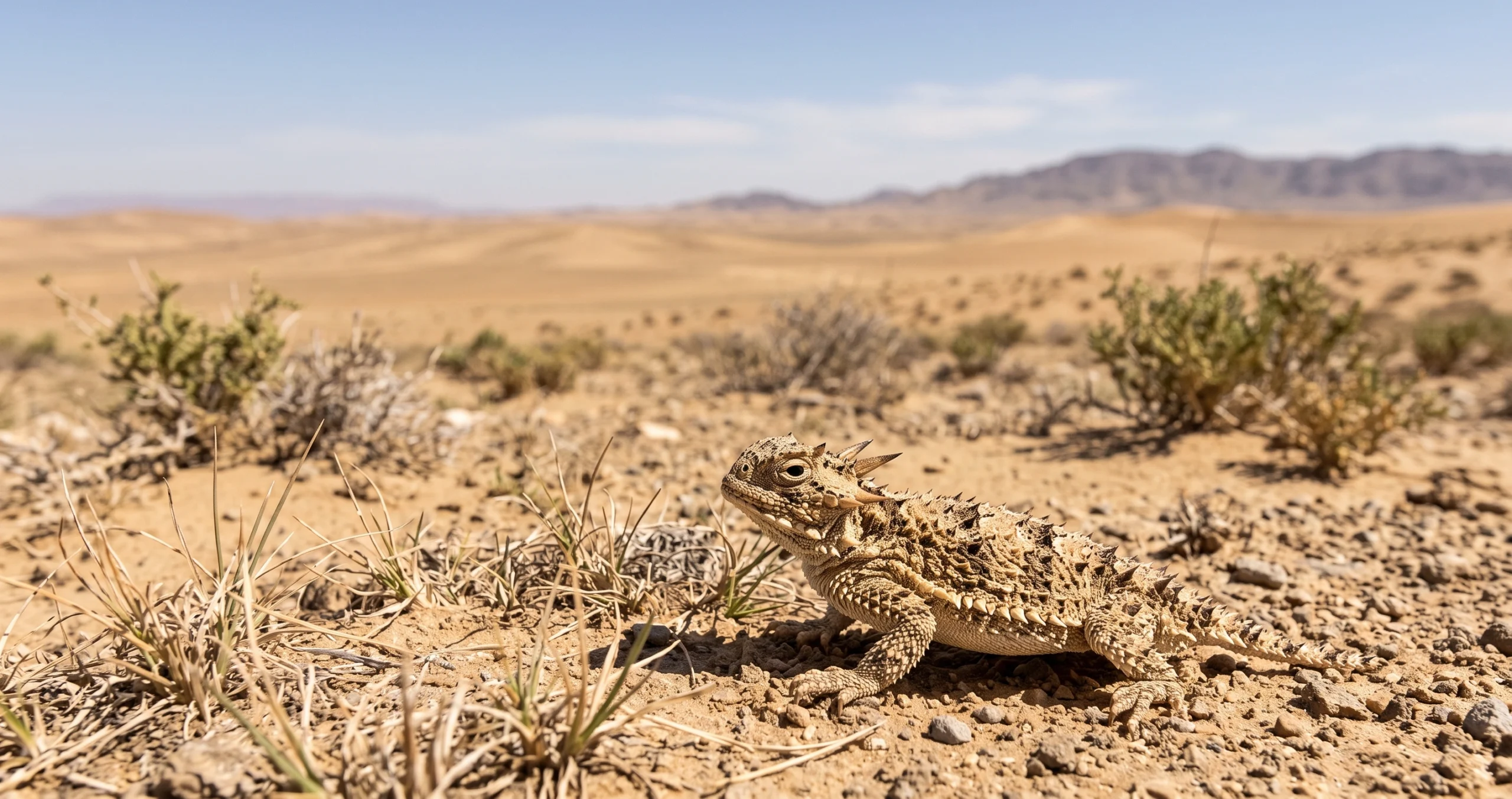
A predator corners a small horned lizard in the desert. Running may not work, and its spines have failed to discourage the attack. Then the lizard deploys one of the strangest defenses among vertebrates: blood suddenly sprays from around its eyes. The horned lizard blood defense is real, but it is not simply a gruesome attempt to frighten anything nearby. In species that use it, the mechanism is an unusually specialized anti-predator adaptation that appears particularly effective against canids such as coyotes, foxes, and dogs.
Even more remarkable, blood-squirting is only one part of a layered defense system. Horned lizards first rely on camouflage, remaining motionless, flattening themselves, inflating their bodies, and presenting formidable spines. The dramatic blood spray is often reserved for situations in which less costly strategies have failed.
Table of Contents
- What Are Horned Lizards?
- How the Horned Lizard Blood Defense Works
- Where Does the Blood Come From?
- Why the Defense Works Especially Well Against Canids
- Why Horned Lizards Don’t Spray Every Predator
- Camouflage: The First Line of Defense
- Spines and Body Inflation
- Freezing, Struggling, and Playing Dead
- Why Horned Lizards Need So Many Defenses
- Conservation Status and Threats
- Common Myths
- FAQ
- Conclusion
What Are Horned Lizards?
Horned lizards belong to the genus Phrynosoma and occur across much of North America, particularly in arid and semi-arid regions of the United States and Mexico.
Their appearance is unmistakable.
They have broad, flattened bodies, relatively short legs, rough scales, and prominent horns around the head. Their squat shape explains why people commonly call them “horned toads” or “horny toads,” although they are reptiles, not amphibians.
Many species specialize heavily on ants, particularly native harvester ants.
Instead of pursuing prey over long distances, a horned lizard can remain almost motionless and wait for ants or other insects to move within striking range. This lifestyle makes camouflage extremely useful for both hunting and avoiding predators.
But when camouflage fails, horned lizards have several remarkable backup plans.
How the Horned Lizard Blood Defense Works
The technical term for intentionally releasing blood as a defense is autohemorrhaging.
In horned lizards, the phenomenon is often described more specifically as ocular-sinus blood squirting because the blood is expelled from the region around the eyes.
It sounds catastrophic.
It isn’t.
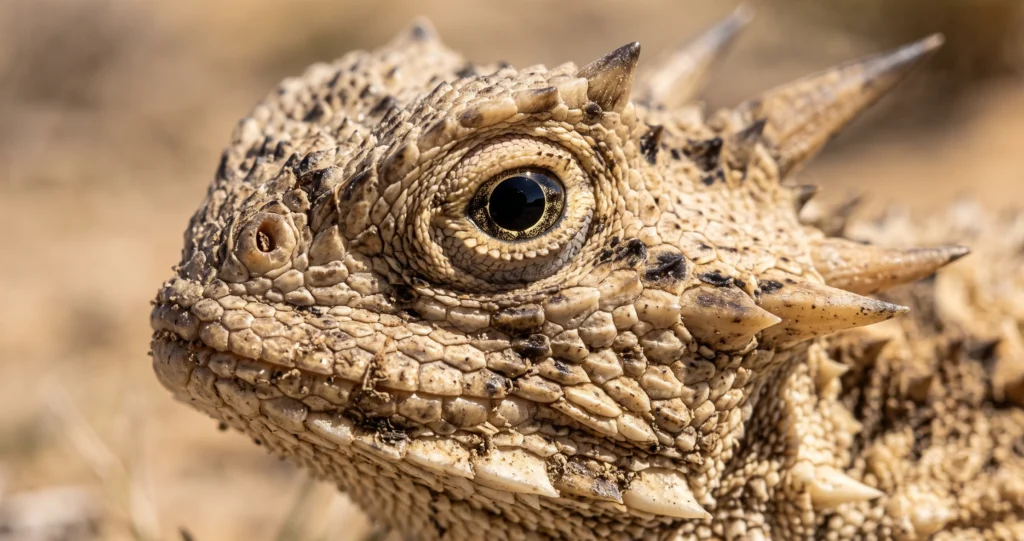
The horned lizard is not rupturing its eyeball or randomly damaging itself. Instead, species capable of this defense can deliberately manipulate blood pressure within specialized vessels and sinuses associated with the head and orbital region.
Pressure increases until blood is forced outward from the eye area.
The resulting stream can travel an impressive distance. National Park Service accounts report that some horned lizards can project blood as far as roughly three feet, or about one meter.
That gives the lizard a chance to hit the face or mouth of an attacking predator without needing to bite it.
Where Does the Blood Actually Come From?
One common misunderstanding is that horned lizards somehow store a special reservoir of defensive blood behind their eyeballs.
The process is more interesting.
The blood comes from the lizard’s own circulatory system.
Horned lizards possess vascular structures around the eye called orbital sinuses. During the defensive response, the animal can restrict normal blood drainage from the head while blood continues flowing into the region.
Pressure builds.
Eventually, tiny vessels associated with the eye region rupture or allow blood to escape under pressure, producing the characteristic stream.
The horned lizard blood defense is therefore controlled autohemorrhaging rather than an accidental injury.
Once the immediate danger passes, normal circulation can resume.
Because blood is a valuable biological resource, however, this strategy has costs. That helps explain why blood-squirting belongs near the end of the lizard’s defensive sequence rather than being its first response whenever something moves nearby.
Why the Horned Lizard Blood Defense Targets Canids
The most fascinating part of this defense is not simply that horned lizards spray blood.
It is that the response appears particularly useful against members of the dog family.
Coyotes, foxes, and domestic dogs are canids, and experimental and field observations have helped establish a strong connection between canid attacks and ocular blood-squirting behavior in horned lizards.
Why?
The answer appears to involve chemistry as much as surprise.
The blood of horned lizards seems to contain compounds that canids find highly unpleasant when the blood reaches their mouths.
A predator expecting an easy lizard suddenly encounters a strong, distasteful substance.
National Park Service descriptions of the greater short-horned lizard note that the blood has a foul taste and contains chemistry that is particularly noxious to coyotes and other canines.
That can completely change the predator’s behavior.
Instead of continuing to bite or swallow the lizard, the canid may drop it and focus on rubbing or cleaning its mouth.
Those few seconds can be enough.
The horned lizard can remain motionless, move toward cover, or otherwise escape while the predator is distracted.
Why Horned Lizards Don’t Spray Every Predator
If squirting blood is effective, it might seem logical for a horned lizard to use the trick against everything.
Evolution does not work that way.
Different predators respond differently to the same defense.
Horned lizards are hunted by snakes, birds of prey, roadrunners, other lizards, rodents, and mammalian carnivores. A tactic that works extremely well against a coyote may provide much less protection against a snake or hawk.
Research on horned lizard defensive behavior indicates that their responses vary depending on the predator. Their defense system is therefore better understood as a toolbox than a single universal weapon.
A snake trying to swallow a horned lizard, for example, faces a different mechanical problem from a coyote biting one.
Against some predators, becoming larger and spikier may be more useful than spraying blood.
Against others, avoiding detection altogether is the safest option.
Camouflage: The First Line of Defense
Long before the horned lizard blood defense becomes necessary, camouflage is doing most of the work.
Horned lizards often have colors and patterns that closely resemble the soil, stones, leaf litter, or desert surfaces where they live.
Individuals may appear gray, tan, reddish, yellowish, or brown depending on species and habitat.
Dark blotches break up the outline of the body.
Their flattened shape also reduces obvious shadows, making the lizard surprisingly difficult to notice when it presses itself against the ground.
The strategy becomes even more effective when combined with stillness.
Many predators are extremely sensitive to movement. A horned lizard that freezes against a visually similar background can remain almost invisible even when it is only a short distance away.
The National Park Service describes camouflage as a horned lizard’s primary protection from predators such as hawks, snakes, and coyotes.
That makes evolutionary sense.
The best predator encounter is often the one that never happens.
Spines Turn the Lizard Into Difficult Prey
If camouflage fails and a predator approaches, the horned lizard has another obvious defense.
Its body is covered with sharp scales and spines, while prominent horns project from the head.
These structures are not merely decorative.
A predator trying to swallow the lizard must deal with an unusually wide, rough, pointed package.
The horned lizard can make the problem worse deliberately.
When threatened, some species inflate their lungs and expand their bodies, becoming considerably larger.
The National Park Service reports that a threatened short-horned lizard may inflate to as much as twice its normal apparent size.
Inflation also makes the spines project more prominently.
A predator that could potentially swallow the relaxed animal now faces something broader, harder to manipulate, and considerably more uncomfortable.
Horned lizards may also lower their heads to present the crown of horns toward an attacker.
In a close struggle, those horns can become genuine physical weapons.
Freezing, Struggling, and Playing Dead
Horned lizards can use additional behaviors depending on species, predator, and circumstances.
Remaining absolutely motionless is among the most important.
Freezing complements camouflage and may prevent a predator from detecting the lizard in the first place.
When physical contact becomes unavoidable, a horned lizard may flatten itself firmly against the ground or push the sides of its body downward, making it harder for a predator to get its jaws underneath.
Inflation can follow.
Some horned lizards have also been reported using death-feigning or extreme immobility during predator encounters. This behavior should not be treated as universal across every Phrynosoma species, however.
Defense varies considerably within the genus.
The horned lizard blood defense itself is a perfect example. Not every horned lizard species possesses the same blood-squirting ability. Phylogenetic research has identified lineages within Phrynosoma in which anti-predator blood-squirting is absent.
Nature rarely provides one identical strategy for an entire group.
Why Horned Lizards Need So Many Defenses
Horned lizards are not built for sustained high-speed escape.
Their bodies are broad, flattened, and heavily armored rather than streamlined for long-distance running.
That does not mean they are defenseless.
Evolution has simply emphasized another approach.
First, avoid detection through camouflage and stillness.
If detected, make capture difficult by flattening against the ground.
If the predator persists, inflate and present the spines.
If a suitable predator continues the attack, deploy the horned lizard blood defense.
This sequence minimizes unnecessary costs.
It is similar to other extraordinary predator defenses found throughout nature, including the chemical spray of the bombardier beetle. Readers interested in another specialized defensive adaptation can see our article on how bombardier beetles fire a boiling chemical defense.
Both animals demonstrate the same evolutionary principle: survival does not always depend on being faster or stronger than a predator.
Sometimes it depends on being exceptionally unpleasant to attack.
A Surprising Connection to Their Diet
Horned lizards are specialists in more than defense.
Many consume large numbers of harvester ants, insects equipped with powerful mandibles and venomous stings.
That diet requires its own unusual adaptations.
Research on Texas horned lizards found that they possess physiological and feeding adaptations that help them handle dangerous ant prey. Their mouth and digestive structures produce abundant mucus that helps immobilize swallowed ants, while research has also identified resistance to harvester-ant venom.
This specialization has an important conservation consequence.
Protecting a horned lizard does not simply mean protecting the reptile.
Its habitat must also support the native ant communities on which it depends.
Conservation Status: Not All Horned Lizards Are Equal
There is no single conservation status that accurately describes every horned lizard.
The genus contains multiple species distributed across different regions, and their populations face different pressures.
Some remain relatively widespread.
Others have experienced significant regional declines or are protected at the state level.
Blainville’s horned lizard (Phrynosoma blainvillii), for example, is recognized as a Species of Special Concern in California. Research describes rangewide declines associated primarily with habitat conversion, historical collection, and invasive ants that displace the native ants on which the lizards depend.
Habitat loss is a recurring problem elsewhere.
Development can remove open, sparsely vegetated landscapes and alter soil conditions. Pesticide use can reduce native ant populations, removing a major food resource.
Invasive ants present another challenge because they can replace native harvester-ant communities without providing an equivalent food base.
Collection for the pet trade has historically contributed to pressure as well. Horned lizards are specialized wild animals and often fare poorly when removed from their natural habitats.
Conservation therefore requires protecting entire ecological relationships: native vegetation, appropriate soils, ant communities, and sufficiently connected habitat.
Common Myths About the Horned Lizard Blood Defense
Myth 1: Horned Lizards Shoot Blood From Their Eyeballs
The blood emerges from structures around the eyes, not from the interior of the eyeball itself.
The defense involves blood pressure and orbital vascular structures.
Myth 2: The Blood Is Venom
Horned lizard blood is not venom in the conventional sense.
The remarkable part is that components of the blood appear particularly distasteful to canid predators.
Myth 3: Every Horned Lizard Can Shoot Blood
Not all Phrynosoma species use ocular blood-squirting.
The ability varies among evolutionary lineages.
Myth 4: They Spray Blood Whenever They Are Frightened
Blood-squirting is generally one component of a larger defensive repertoire.
Camouflage, freezing, flattening, inflation, and spines may resolve the situation before autohemorrhaging becomes necessary.
Myth 5: Horned Lizards Are Toads
Despite the traditional nickname “horned toad,” they are true lizards.
Their broad, rounded bodies simply reminded early observers of toads.
Myth 6: Their Spines Are Only for Appearance
The spines can make horned lizards substantially more difficult for predators to manipulate and swallow.
Combined with body inflation, they form an effective mechanical defense.
FAQ
How does the horned lizard shoot blood from its eyes?
The horned lizard blood defense involves increasing pressure within vascular structures around the eyes. Blood is then expelled from the orbital region in a directed stream.
How far can a horned lizard spray blood?
Some species have been reported to project blood approximately three feet, or around one meter.
Does shooting blood hurt the horned lizard?
The behavior involves losing some blood, so it is not biologically free. However, species that perform it have evolved anatomical and physiological mechanisms that allow the response to function as a defensive strategy rather than simply representing uncontrolled injury.
Why does horned lizard blood repel coyotes?
Research and observations indicate that canids find components of the blood highly distasteful. A coyote or other canid that gets the blood in its mouth may interrupt its attack, giving the lizard an opportunity to survive.
Does the horned lizard blood defense work on birds?
It appears particularly adapted for deterring canid predators rather than functioning equally against every predator.
Against birds, snakes, and other enemies, camouflage, spines, inflation, or other defensive behaviors may be more important.
Can all horned lizards spray blood?
No.
Blood-squirting occurs in several horned lizard species, but evolutionary studies show that some lineages lack the behavior.
Are horned lizards endangered?
There is no single answer for the entire genus.
Conservation status differs by species and location. Some populations remain relatively secure, while others have undergone serious declines and receive regional protection.
What threatens horned lizards?
Important threats can include habitat destruction and fragmentation, loss of native ant prey, pesticide use, invasive ant species, and collection.
Because many horned lizards are dietary specialists, disruption of their prey communities can have consequences even where apparently suitable land remains.
Conclusion
The horned lizard blood defense is one of the most dramatic examples of how evolution can turn ordinary anatomy into an extraordinary survival mechanism.
These reptiles do not rely on blood-squirting alone.
Their first defenses are far less conspicuous. Cryptic coloration makes them disappear against soil and rocks. Remaining motionless prevents predators from noticing movement. Their flattened bodies make them difficult to grab, while inflation transforms their spines and horns into an even more formidable obstacle.
Only when those defenses fail may certain species escalate to ocular autohemorrhaging.
By manipulating circulation around the orbital region, the lizard can force a stream of its own blood outward toward an attacker. Against canid predators, the strategy has an additional advantage: the blood contains compounds that are intensely unpleasant to them.
A coyote that expected a small reptile suddenly receives a mouthful of something it wants to spit out.
That brief hesitation can decide whether the horned lizard survives.
Yet the remarkable defense should not distract from a more serious reality. Some horned lizard populations are declining because the habitats and native ant communities that sustain them are disappearing.
Protecting these reptiles means preserving more than one strange animal.
It means maintaining the desert and grassland ecosystems that produced one of nature’s most unusual defensive systems in the first place.
Internal Link Suggestions:
- How Bombardier Beetles Fire a Boiling Chemical Defense
Best placed in the section explaining how unusual defensive mechanisms can evolve as alternatives to speed or strength. - How Basilisk Lizards Run Across the Surface of Water
A natural contextual link when discussing unusual reptile adaptations and survival strategies.
External Dofollow Authoritative Sources:
- U.S. National Park Service — Short-Horned Lizard, Bandelier National Monument
https://www.nps.gov/band/learn/nature/hornedliz.htm - U.S. National Park Service — Greater Short-Horned Lizard, Grand Canyon-Parashant National Monument
https://www.nps.gov/para/learn/nature/greater-short-horned-lizard.htm - Oxford Academic — Enemies and Defense, Introduction to Horned Lizards of North America
https://academic.oup.com/california-scholarship-online/book/14987/chapter-abstract/169357724