
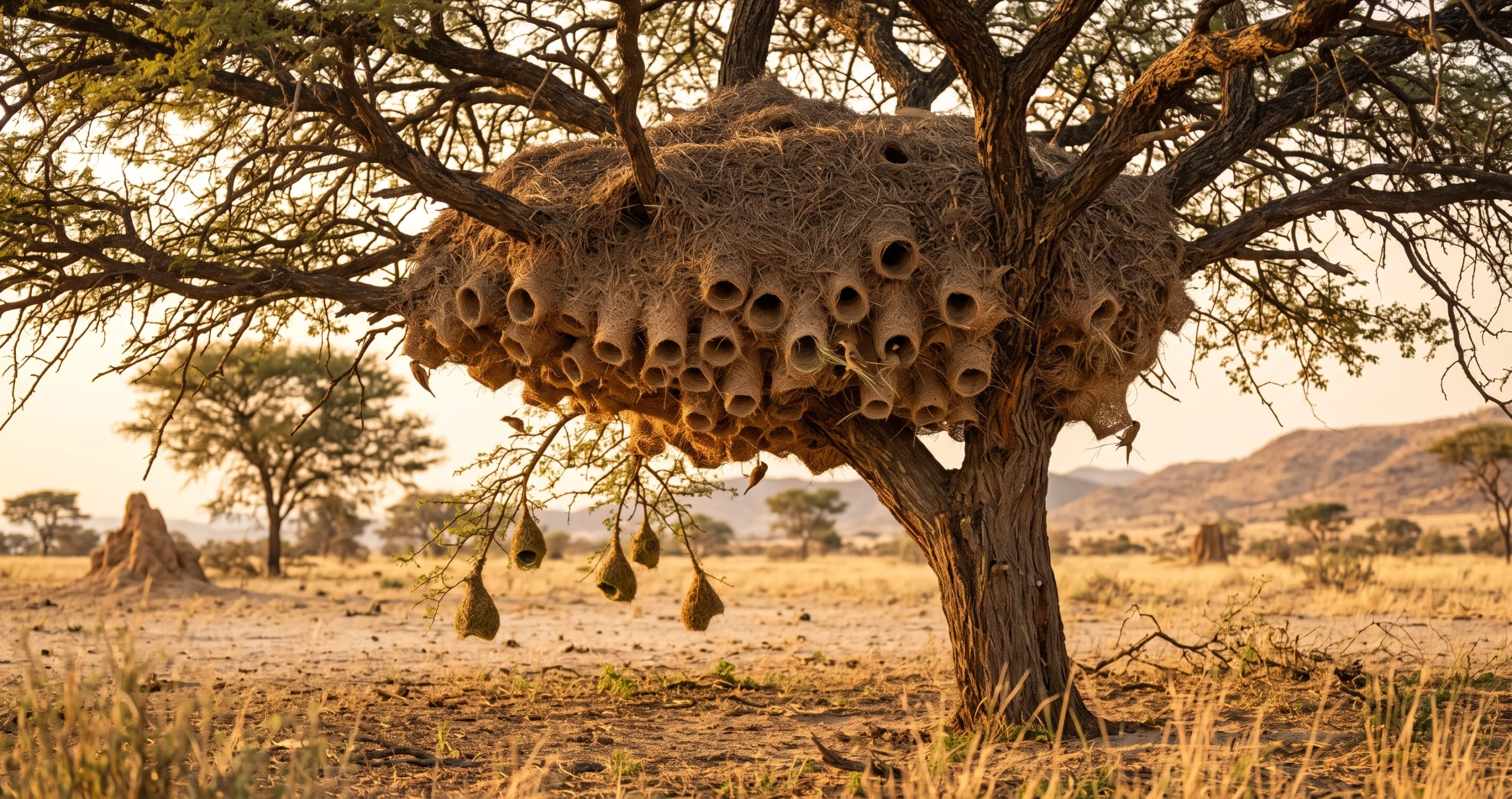
Across Africa and Asia, small birds transform flexible strips of grass into some of the most sophisticated structures built by any animal. Weaver bird nest building involves far more than piling vegetation together. Males of many weaver species manipulate, loop, tuck, and interlace plant fibers until they have created suspended chambers capable of surviving wind, rain, and the scrutiny of potential mates.
The engineering is impressive, but construction is only half the story. In several well-studied species, females inspect males’ nests before accepting a mate, and an apparently serviceable structure may still be rejected. Research also suggests that weaving is not simply a perfectly programmed instinct: experience, practice, material choice, and individual technique can influence how a bird builds.
Table of Contents
- What Makes a Weaver Bird Nest Different?
- Weaver Bird Nest Building Step by Step
- Do Weaver Birds Really Tie Knots?
- Is Nest Building Learned or Innate?
- Why Females Inspect and Reject Nests
- What a Nest May Reveal About Its Builder
- Weaver Nests Compared With Other Bird Architecture
- Common Myths About Weaver Birds
- Frequently Asked Questions
- Conclusion
What Makes a Weaver Bird Nest Different?
“Weaver bird” commonly refers to members of the family Ploceidae, a diverse group found mainly in sub-Saharan Africa, with species also occurring across parts of Asia. The family includes village weavers, baya weavers, masked weavers, sociable weavers, and many others.
Their architecture varies enormously.
Some species construct individual hanging nests shaped roughly like globes, flasks, or elongated pouches. Others create entrances extending downward into tubes, while sociable weavers build enormous communal structures occupied by many birds.
The materials can appear deceptively simple: grasses, strips of leaves, reeds, palm fibers, and other flexible vegetation.
What makes weaver bird nest building exceptional is how those materials are manipulated. Instead of relying primarily on mud or simply stacking twigs, many weavers interlace flexible fibers around one another to create a self-supporting structure.
A nest hanging from the end of a thin branch also presents an engineering challenge. It must remain attached while supporting the adults, eggs, and eventually growing chicks.
For males in species where nest construction contributes to courtship, there is another requirement: the structure must satisfy a female.
Weaver Bird Nest Building Step by Step
Construction begins with location.
Depending on the species, a male may choose a branch over water, a flexible palm frond, reeds, or another elevated support. Suspended locations can make nests difficult for some predators to reach.
The male then collects long pieces of suitable vegetation.
Fresh grass and leaf strips can be particularly useful because they are flexible enough to bend without immediately breaking. As plant fibers dry, the completed weave can become firmer.
One of the earliest and most important stages is anchoring material to the supporting branch.
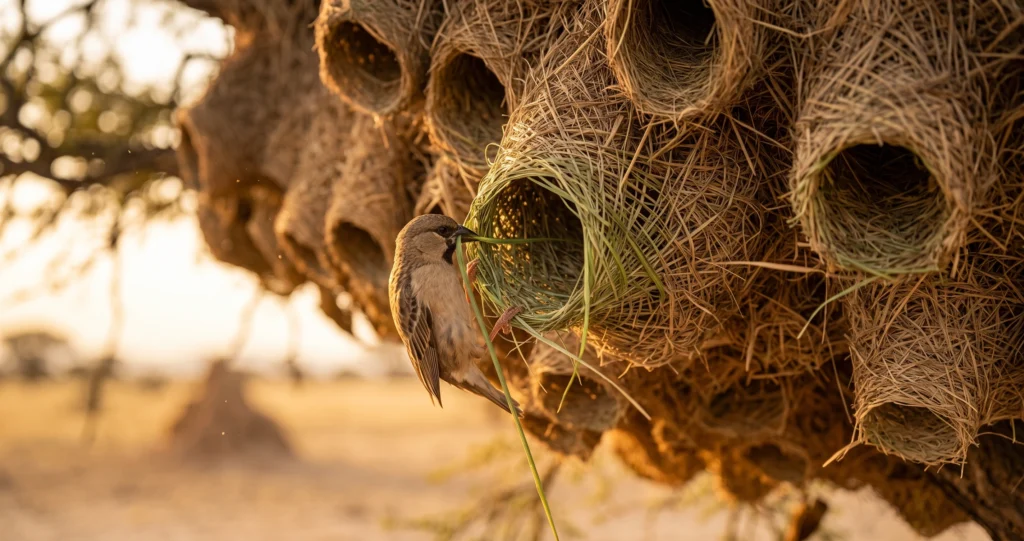
The bird uses its bill and feet together. It grips fibers, passes them around vegetation, pulls them through loops, and gradually establishes an attachment from which the rest of the nest can develop.
A ring or partial framework often emerges first in the hanging nests of well-known species such as the baya weaver. Additional fibers are then woven through this foundation.
The male repeatedly brings new material, threads it into the existing structure, pulls it into position, and changes his body orientation as he works.
He may build while hanging sideways or upside down.
Gradually, a three-dimensional chamber develops around the original framework. Walls become denser as more strips are added, while particular openings are preserved to create an entrance.
The result can contain hundreds of individual pieces of vegetation.
Do Weaver Birds Really Tie Knots?
Descriptions of weaver bird nest building frequently claim that the birds “tie knots.” There is some truth behind the phrase, but it can also oversimplify what the birds actually do.
A weaver does not tie a standardized human knot in the way a sailor might tie a bowline.
Instead, the bird performs combinations of looping, wrapping, threading, twisting, and tucking. A strip of vegetation may be passed around a supporting fiber and pulled through an existing loop so that friction and tension keep it in place.
Some of these structures can reasonably be described as knot-like.
The bill functions as the primary precision tool. Meanwhile, the feet allow the bird to hold its body against the nest, stabilize material, or hang in positions that leave the bill free to manipulate fibers.
This coordination becomes especially impressive when construction takes place on a flexible branch moving in the wind.
The structure does not depend on glue. Its stability largely emerges from the interactions among many woven plant fibers.
That makes the finished nest an example of biological engineering produced with remarkably limited equipment: a bill, two feet, flexible vegetation, and a great deal of repeated manipulation.
Is Weaver Bird Nest Building Learned or Innate?
One of the most interesting scientific questions is whether birds are born knowing exactly how to construct nests.
The old explanation often presented nest building as almost entirely instinctive. Under this view, a weaver simply follows an inherited behavioral program and produces essentially the same structure without needing meaningful practice.
Modern research paints a more complicated picture.
Birds undoubtedly possess inherited behavioral predispositions. A young weaver does not need to attend anything resembling a human engineering class before beginning construction.
But innate motivation does not mean every movement is predetermined.
Researchers can study nest-building behavior by observing individual birds across multiple construction attempts. They record factors such as which foot a bird uses, how materials are manipulated, the sequence of movements, material choices, mistakes, and changes associated with experience.
Experimental research on southern masked weavers has been especially revealing.
Work involving scientists from the University of Edinburgh and other researchers found considerable variation in how individual birds constructed nests. Birds did not always perform exactly the same sequence of actions, and experience appeared to influence aspects of their performance.
Researchers have also observed birds dropping less material as they gain experience.
Such findings support the idea that weaver bird nest building combines evolved predispositions with learning and practice.
This distinction matters far beyond weaver birds. Nest construction provides scientists with a natural system for investigating how complex animal behavior develops when instinct, physical coordination, environmental feedback, and experience interact.
The University of Edinburgh has reported research examining how weaver birds’ nest-building abilities challenge overly simple assumptions that bird architecture is governed entirely by fixed instinct.
How Researchers Study Nest-Building Skill
Studying a nest after completion reveals only part of the story.
To understand how birds actually construct one, researchers need to watch the process itself.
Video recordings allow scientists to examine individual movements repeatedly. Researchers can compare experienced and less-experienced builders, measure construction sequences, and determine whether techniques change between nests.
Material choice provides another experimental opportunity.
Different plant fibers vary in width, flexibility, stiffness, and strength. By examining what birds select and how efficiently they manipulate different materials, researchers can investigate whether experience changes construction decisions.
Individual differences are particularly informative.
If every male executed an identical inherited program, researchers would expect relatively limited behavioral variation. When individuals use different techniques or improve aspects of performance, learning becomes a stronger explanation.
That does not eliminate instinct.
Instead, weaver bird nest building demonstrates why scientists increasingly avoid treating “innate” and “learned” as mutually exclusive categories. Evolution can provide the motivation and behavioral foundations for building while experience refines execution.
Why Females Inspect and Reject Nests
In several weaver species, building a nest is part of male courtship.
A male may construct a nest and then display conspicuously when a female approaches. In species such as village and masked weavers, males can hang beneath their structures, flutter their wings, call, and attempt to attract a female’s attention.
The female may then inspect the nest.
She can enter or examine portions of the structure before deciding whether to accept the male and his construction. If she leaves without accepting it, the male may have to continue displaying, modify the nest, or eventually begin another.
This is where popular descriptions sometimes become exaggerated.
Females are not necessarily conducting a human-style structural inspection with a universal checklist. Nest choice is species-specific, and researchers must distinguish demonstrated preferences from assumptions about what a female “must” be evaluating.
Nevertheless, construction quality can matter.
A poorly attached or inadequately constructed nest could have direct consequences for reproduction. Nest location, structure, entrance characteristics, and the male himself may all contribute to female choice.
In some species, males build multiple nests during a breeding period.
Rejected nests therefore do not necessarily represent wasted behavior from an evolutionary perspective. Building repeatedly can provide additional opportunities to attract females while potentially giving males more construction experience.
What a Nest May Reveal About Its Builder
Why should females evaluate architecture when choosing a mate?
Nest construction is costly.
A male must locate suitable material, repeatedly fly between vegetation and the building site, manipulate hundreds of fibers, defend or maintain a territory in some species, and complete a structure that remains functional.
The finished nest could therefore provide information about the builder’s performance.
A male capable of producing a secure, well-positioned structure may demonstrate coordination, persistence, experience, or physical condition. However, researchers should be cautious about reducing female choice to a single rule such as “the best nest always wins.”
Courtship is rarely that simple.
Male coloration, displays, territory, nest location, local competition, predation risk, and other environmental factors may interact with nest characteristics.
The important evolutionary principle is sexual selection.
When females repeatedly prefer males possessing particular characteristics, those preferences can influence the evolution of both physical traits and behavior.
This makes weaver birds comparable to another extraordinary group of avian builders: bowerbirds. Read our article on how male bowerbirds build and decorate elaborate bowers to attract a mate for another example of architecture becoming part of courtship.
Weaver Nests Compared With Other Elaborate Bird Architecture
Weaver birds are exceptional builders, but birds have evolved many architectural solutions.
Sociable weavers provide perhaps the most dramatic contrast even within the weaver family. Instead of constructing only isolated hanging chambers, colonies create enormous communal nests that may remain occupied for years.
These structures contain numerous individual nesting chambers beneath a huge insulating roof of vegetation.
Ovenbirds use an entirely different material strategy. Some construct enclosed nests largely from mud, producing structures that resemble small clay ovens.
Swallows and martins also exploit mud. Small pellets are carried repeatedly to the nesting site and assembled into cups or enclosed chambers.
Tailorbirds solve the construction problem another way. They puncture large leaves and use plant fibers or other materials to fasten leaf edges together, creating a concealed cradle in which the actual nest can be placed.
Woodpeckers excavate architecture rather than assemble it.
They carve cavities into wood, creating protected chambers whose walls are provided by the tree itself.
Bowerbirds represent another category entirely. Their famous bowers are primarily courtship structures rather than nests for raising chicks.
These comparisons highlight what makes weaver bird nest building distinctive. Flexible vegetation is turned into architecture through repeated interlacing, with the bird itself functioning simultaneously as material collector, structural engineer, and construction worker.
Common Myths About Weaver Birds
Myth 1: Weaver birds build nests entirely by instinct
They possess powerful inherited tendencies to build, but evidence indicates that experience and learning can influence construction.
Young or inexperienced birds may not perform every aspect as efficiently as experienced builders.
Myth 2: Weaver birds tie human-style knots
Their techniques include looping, threading, wrapping, and knot-like manipulations.
Calling these actions “knot tying” is convenient, but it should not imply that birds reproduce standardized human knots.
Myth 3: Every female rejects most nests
Female inspection and rejection occur in several species, but weaver birds are diverse.
Their mating systems and nest-building behavior should not be generalized into one universal rule for the entire family.
Myth 4: Males build every weaver bird nest
Nest-building roles vary between species.
Male construction is particularly conspicuous in polygynous species where nests contribute to courtship, but other weaver species have different divisions of labor.
Myth 5: The largest nest attracts the female
Size alone is not a universal measure of attractiveness.
Structure, location, male display, species-specific preferences, and other characteristics can influence reproductive decisions.
Frequently Asked Questions
How do weaver birds build their nests?
Many species collect flexible grasses or leaf strips and manipulate them with their bills and feet. Fibers are looped, wrapped, threaded, and tucked together until a suspended chamber forms.
Do weaver birds actually tie knots?
Some of their fiber manipulations produce knot-like structures, particularly during attachment and weaving. However, describing the process as conventional human knot tying can be misleading.
How long does weaver bird nest building take?
Construction time varies with species, male experience, nest complexity, available materials, weather, and other conditions. Males may also construct multiple nests during a breeding season rather than stopping after completing one.
Why do female weaver birds reject nests?
Females of some species inspect male-built nests as part of mate selection. Characteristics of the structure, its location, and attributes of the displaying male can potentially contribute to acceptance or rejection.
Do weaver birds learn to build better nests?
Research suggests experience matters. Changes in material handling and construction performance indicate that building behavior includes a learned component rather than functioning entirely as an inflexible inherited program.
What materials do weaver birds use?
Grasses and strips of leaves are common, although materials vary by species and habitat. Fresh vegetation is often particularly useful because it can be manipulated while flexible.
Where do weaver birds live?
The greatest diversity occurs in sub-Saharan Africa, although members of the weaver family also occur in parts of Asia and surrounding regions.
Conclusion
A finished weaver nest can look almost impossibly sophisticated for something constructed without hands, tools, glue, or a drawn plan.
Yet weaver bird nest building becomes understandable when the process is examined step by step. Birds anchor flexible vegetation, manipulate fibers with their bills and feet, interlace additional material, and gradually transform individual strips into a stable three-dimensional structure.
Research has also overturned the simplistic idea that this ability must be either instinctive or learned.
Evolution provides weaver birds with powerful building predispositions, while experience can influence how effectively individuals handle materials and complete particular construction tasks. Every new nest can therefore be both an expression of inherited behavior and an opportunity for refinement.
Female choice adds another evolutionary dimension.
For species in which males construct nests as part of courtship, architecture becomes part of reproductive competition. A male is not merely creating somewhere for eggs and chicks—his construction can become one of the features through which a potential mate evaluates him.
From hanging woven chambers to enormous communal structures, weaver birds demonstrate that sophisticated architecture does not require human intelligence.
It can emerge through evolution, learning, physical skill, and repeated interaction with simple natural materials. A blade of grass may appear insignificant, but in the bill of a weaver bird, hundreds of such pieces can become one of nature’s most remarkable engineering achievements.
2 Internal Link Suggestions:
- How Male Bowerbirds Build and Decorate Elaborate Bowers to Attract a Mate — ideal contextual link because both articles examine bird construction, sexual selection, and female mate choice.
- How Birds-of-Paradise Use Ultra-Black Feathers to Win a Mate — useful supporting article for readers interested in the evolution of elaborate avian courtship displays.
3 External Dofollow Authoritative Sources:
- University of Edinburgh — research and university reporting on learning, experience, and nest-building behavior in weaver birds.
- Cornell Lab of Ornithology — authoritative ornithology resource covering bird behavior, ecology, and nesting.
- BirdLife International — global authority on bird species, habitats, ecology, and conservation.