
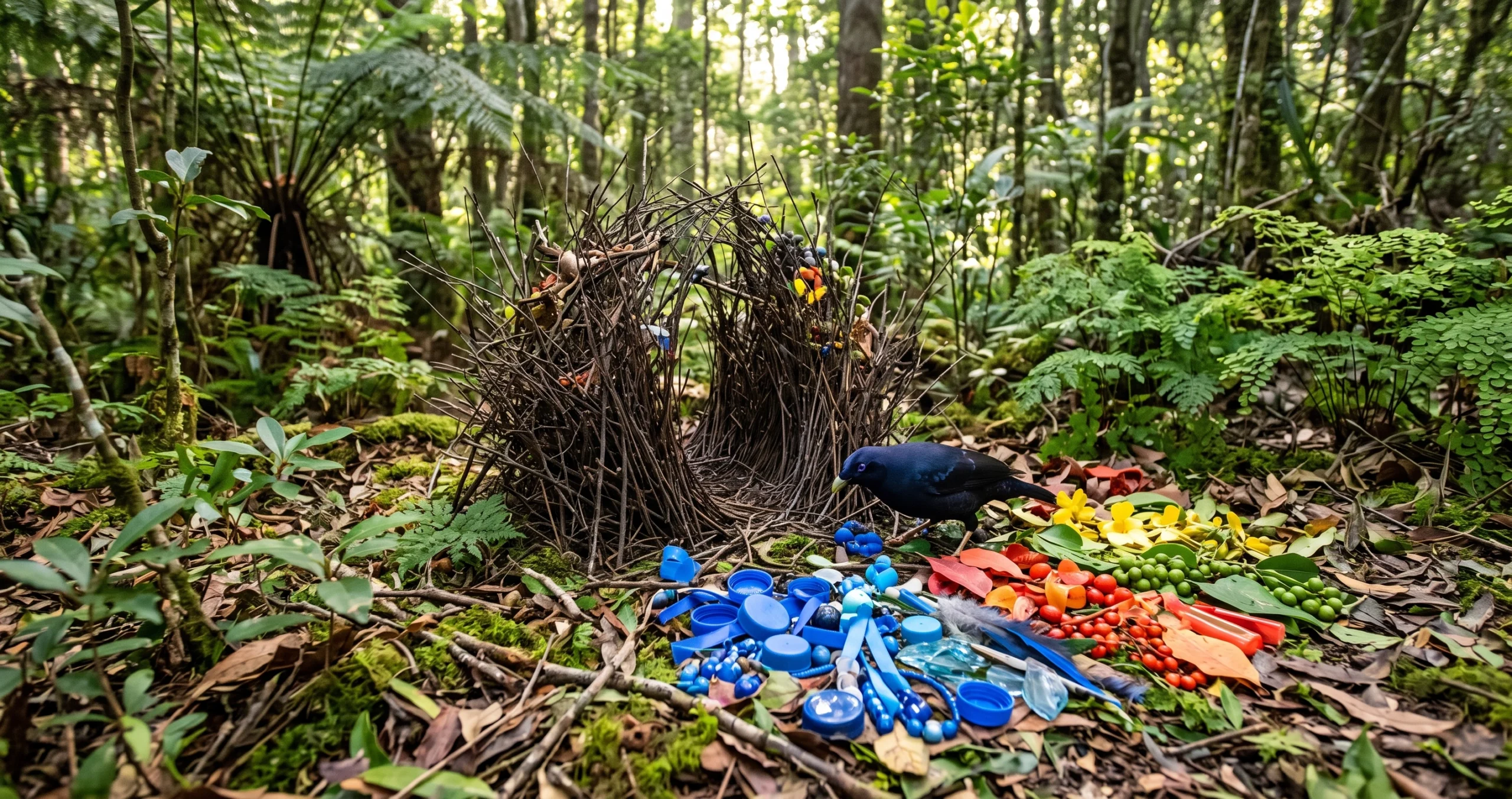
In the forests and woodlands of Australia and New Guinea, some male birds spend weeks constructing structures that look surprisingly like miniature art installations. This remarkable behavior, known as bowerbird bower building, is not about creating a nest. Instead, the male builds, decorates, rearranges, and carefully maintains a display arena designed primarily to impress visiting females.
Some bowers are simple cleared courts decorated with leaves. Others feature walls of upright sticks surrounded by shells, stones, berries, flowers, feathers, pieces of glass, and brightly colored human-made objects. In certain species, males even arrange decorations according to size, producing a visual illusion that changes how the display appears from the female’s viewing position.
Table of Contents
- What Is a Bower?
- Bowerbird Bower Building Across Different Species
- How Males Choose and Arrange Decorations
- The Forced-Perspective Illusion
- What Females Look for in a Mate
- Why Bowers May Signal Male Quality
- Bowerbirds Compared With Other Courtship Displays
- Common Myths About Bowerbirds
- Frequently Asked Questions
- Conclusion
What Is a Bower?
A bower is a courtship structure constructed primarily by a male bowerbird. It is important to distinguish a bower from a nest: females do not normally lay their eggs or raise chicks inside the male’s display structure.
Instead, the bower functions as a stage. A male maintains the structure and surrounding display court, while females visit and inspect both his construction and his courtship performance.
Bowerbirds belong to the family Ptilonorhynchidae, a group centered in Australia and New Guinea. The family contains numerous species with surprisingly different approaches to courtship architecture.
The diversity is one reason bowerbird bower building has attracted so much scientific attention. Rather than being one fixed instinct expressed identically by every species, bower construction has evolved into several distinct architectural traditions.
Bowerbird Bower Building Across Different Species
Scientists generally recognize several broad styles of bowers, including avenue bowers and maypole-type structures. Some species also create comparatively simple courts rather than the elaborate avenues most people associate with bowerbirds.
Perhaps the best-known architect is the satin bowerbird (Ptilonorhynchus violaceus). A male creates an avenue by pushing hundreds of sticks vertically into the ground, forming two parallel walls with a narrow passage between them.
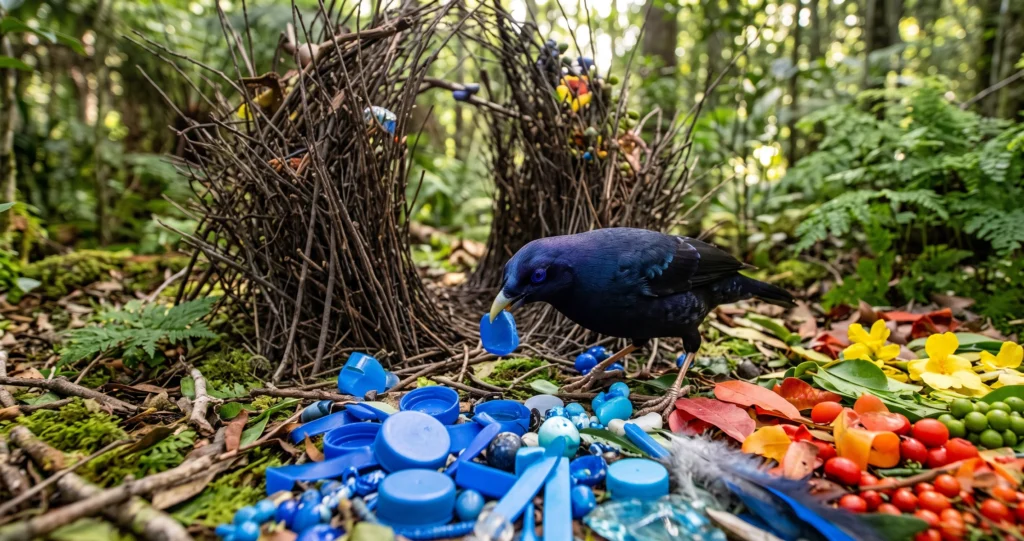
Around the entrance, he arranges decorations. Adult satin bowerbird males are particularly famous for collecting blue objects, including blue feathers, flowers, berries, shells, and increasingly pieces of plastic or other artificial material.
The great bowerbird (Chlamydera nuchalis) also constructs an avenue bower, but its decoration strategy can involve pale stones, shells, bones, glass, and other objects positioned around the court.
Other species take a radically different architectural approach.
Some build maypole bowers by piling sticks around a vertical sapling or similar central support. The resulting structure can resemble a small hut or tower surrounded by a carefully maintained display area.
MacGregor’s bowerbird, for example, is known for substantial maypole-style constructions. Vogelkop bowerbirds can produce extraordinarily elaborate hut-like structures and decorate their courts with organized collections of natural materials.
These differences show that bowerbird bower building is not merely about collecting attractive objects. Architecture, decoration, color selection, spatial organization, and court maintenance can all become species-specific components of courtship.
How Males Choose and Arrange Decorations
A successful bower can require constant maintenance.
Leaves fall onto the court. Decorations fade or decay. Rivals may steal objects or damage the structure. A male therefore repeatedly cleans, repairs, replaces, and rearranges his display throughout the breeding season.
Decoration preferences vary considerably between species.
One male may collect flowers, fruits, feathers, insect remains, snail shells, stones, or bones. Another may concentrate heavily on particular colors.
Satin bowerbirds are the classic example of color specialization. Mature males strongly favor blue decorations, creating a striking visual connection between their collections and their glossy blue-black plumage.
Human objects can become decorations when they happen to fit a bird’s preferences. Bottle caps, plastic fragments, glass, straws, clothespins, and other discarded objects have all appeared around bowers.
This has sometimes created the misleading impression that bowerbirds specifically prefer human possessions. They do not. Artificial materials simply provide new colors, shapes, and textures that can satisfy preferences that existed long before humans introduced plastic into their habitats.
Researchers studying bowerbirds also find evidence of competition between males. Decorations can be stolen from neighboring bowers, and bowers may occasionally be damaged by rivals.
Consequently, bowerbird bower building involves more than artistic construction. It exists within a competitive social environment where maintaining a valuable display can require substantial time and effort.
The Forced-Perspective Illusion
One of the most fascinating discoveries in bowerbird research involves the great bowerbird and its use of visual perspective.
Males arrange objects on the display court outside the avenue. Crucially, the objects are not always distributed randomly.
Research by John Endler and colleagues found that males tend to place smaller objects closer to the female’s viewing position and progressively larger objects farther away.
This creates what researchers describe as a forced-perspective effect.
From the female’s position inside the avenue, the differently sized objects can appear more similar in apparent size than they actually are. The arrangement produces a visually regular background against which the displaying male performs.
Experiments have provided particularly compelling evidence that this arrangement is intentional rather than accidental. When researchers disrupted the size gradient by rearranging court objects, males restored the pattern.
The work has made great bowerbirds one of the most intriguing examples of nonhuman animals manipulating visual perspective.
It would be excessive, however, to claim that a bowerbird understands perspective exactly as a human architect or artist does. Scientists can demonstrate what the birds construct and how they respond when their arrangements are disturbed, but determining the subjective mental experience behind that behavior is much harder.
This distinction is important when interpreting bowerbird bower building. The behavior is extraordinary without requiring human-like artistic reasoning.
What Females Look for in a Mate
A beautiful bower does not automatically guarantee mating success.
Female choice can involve several interacting characteristics, including the quality of the bower, decorations, male coloration, courtship movements, vocalizations, and the male’s behavior toward the female.
A visiting female may approach a bower and inspect it from within or near the avenue. The male then performs from the display court, presenting objects, moving rapidly, vocalizing, and positioning himself where she can observe him.
Courtship intensity matters because an overly aggressive performance could cause a female to leave. Males therefore appear to adjust aspects of their displays according to female responses.
Age and experience may also influence performance. Building and maintaining a sophisticated bower is a skill that can develop over time, and younger males may produce less impressive structures than experienced adults.
Female preference can therefore create powerful evolutionary pressure.
Generation after generation, males whose architecture, decorations, behavior, or combinations of traits are more attractive to females can gain greater mating opportunities. This process is a classic example of sexual selection.
For another striking case of sexual selection involving extraordinary visual adaptations, see our article on how birds-of-paradise use ultra-black feathers to win a mate.
Why Bowers May Signal Male Quality
Why should a female care about a collection of sticks and colored objects?
One possibility is that maintaining an impressive bower provides information about the male responsible for it.
Building takes time. Decorations must be located and transported. The display area must remain clean, and stolen or damaged objects may need replacement.
A male capable of maintaining a sophisticated display despite competition and environmental disruption may reveal aspects of his condition, experience, coordination, or persistence.
The relationship is not necessarily as simple as “better bower equals better genes.” Female choice can depend on multiple signals, and their relative importance differs among bowerbird species.
The broader principle is that elaborate courtship traits can evolve when females repeatedly prefer particular characteristics.
The Cornell Lab of Ornithology provides extensive educational resources explaining bird behavior, evolution, and the extraordinary diversity of avian courtship.
Bowerbirds Compared With Other Elaborate Courtship Displays
Bowerbirds are far from the only animals shaped by intense sexual selection.
Peacocks provide one famous example. Males display enormous trains covered with iridescent eyespots, allowing females to assess a conspicuous visual trait directly attached to the male.
Birds-of-paradise have evolved an even wider collection of visual displays. Some transform their apparent body shape by spreading specialized feathers, while others combine vivid plumage with precisely choreographed dances.
Manakins use movement and sound. Some species perform remarkably fast dances, snapping their wings or moving between display perches with extraordinary precision.
Bowerbirds are unusual because much of their courtship signal exists outside the body.
A male modifies his environment, creating a structure that can persist even when he temporarily leaves. Architecture becomes part of his reproductive display.
That makes bowerbird bower building especially interesting from an evolutionary perspective. The female is effectively evaluating both an animal and something that animal has constructed.
Common Myths About Bowerbirds
Myth 1: The bower is the bird’s nest
This is the most common misunderstanding.
The bower is primarily a courtship arena. After mating, the female builds a separate nest and takes responsibility for incubating the eggs and raising the young.
Myth 2: All bowerbirds collect blue objects
Blue collections are strongly associated with satin bowerbirds, but decoration preferences differ between species.
Other bowerbirds use combinations of flowers, berries, shells, stones, bones, feathers, leaves, insect remains, and objects of many different colors.
Myth 3: Bowerbirds decorate randomly
Many decorations are anything but random.
Males can show preferences for particular colors, object types, locations, and arrangements. The forced-perspective courts of great bowerbirds provide an especially striking example of structured organization.
Myth 4: Bowerbirds are simply copying humans
Bower construction evolved naturally through sexual selection.
The birds’ willingness to incorporate plastic, glass, or other manufactured materials reflects their existing attraction to certain visual properties, not imitation of human decorating behavior.
Myth 5: The female chooses the biggest bower
Size alone does not determine success.
Depending on the species, females can respond to construction quality, decoration, male appearance, courtship behavior, vocalizations, and other factors.
Frequently Asked Questions
Why do male bowerbirds build bowers?
Males construct bowers primarily as courtship displays. Females visit them and evaluate the structure together with the male’s decorations and behavioral performance before deciding whether to mate.
Do female bowerbirds help build the bower?
Generally, no. The male constructs and maintains his courtship bower, while females later build their own nests for eggs and chicks.
How long does bowerbird bower building take?
Construction and maintenance can continue throughout the breeding period. Even after the basic structure is complete, males repeatedly repair walls, clean courts, replace decorations, and reorganize objects.
Why do bowerbirds collect blue things?
The famous preference for blue is especially characteristic of male satin bowerbirds. Blue natural objects can be relatively uncommon, and the collected objects also complement the coloration of mature males.
Do bowerbirds steal from each other?
Yes. In some species, males steal attractive decorations from neighboring bowers and may interfere with rivals’ structures.
Are bowerbirds intelligent?
Their behavior demonstrates impressive abilities involving object selection, construction, spatial arrangement, learning, and courtship. Experiments involving forced perspective are particularly intriguing, although scientists should be cautious about interpreting these abilities as identical to human artistic understanding.
Where do bowerbirds live?
Bowerbirds are native primarily to Australia and New Guinea, with different species occupying habitats ranging from tropical rainforest to woodland and more open environments.
Conclusion
Few courtship systems demonstrate the creativity of evolution as vividly as bowerbird bower building.
Instead of relying exclusively on colorful feathers or physical strength, many male bowerbirds transform pieces of their environment into carefully maintained display arenas. Sticks become walls, stones and shells become decorations, and ordinary objects can become components of an elaborate visual performance.
The forced-perspective courts of great bowerbirds make this behavior even more remarkable. Males organize objects according to size and restore those arrangements when scientists disrupt them, demonstrating that seemingly decorative details can have sophisticated visual consequences.
Yet the female remains central to the entire evolutionary story. Her preferences determine which combinations of architecture, decoration, appearance, and performance are successful.
Over countless generations, those choices have helped produce everything from blue-decorated avenues to towering maypole structures.
A bower is therefore much more than a pile of sticks. It is architecture shaped by sexual selection—a physical record of competition, individual effort, female choice, and one of the most extraordinary courtship systems found in the bird world.
2 Internal Link Suggestions:
- How Birds-of-Paradise Use Ultra-Black Feathers to Win a Mate — highly relevant comparison of elaborate avian sexual selection and courtship.
- How a Cheetah’s Spine Works Like a Spring to Enable Its Top Speed — useful contextual link to the site’s broader wildlife adaptations content.
3 External Dofollow Authoritative Sources: