
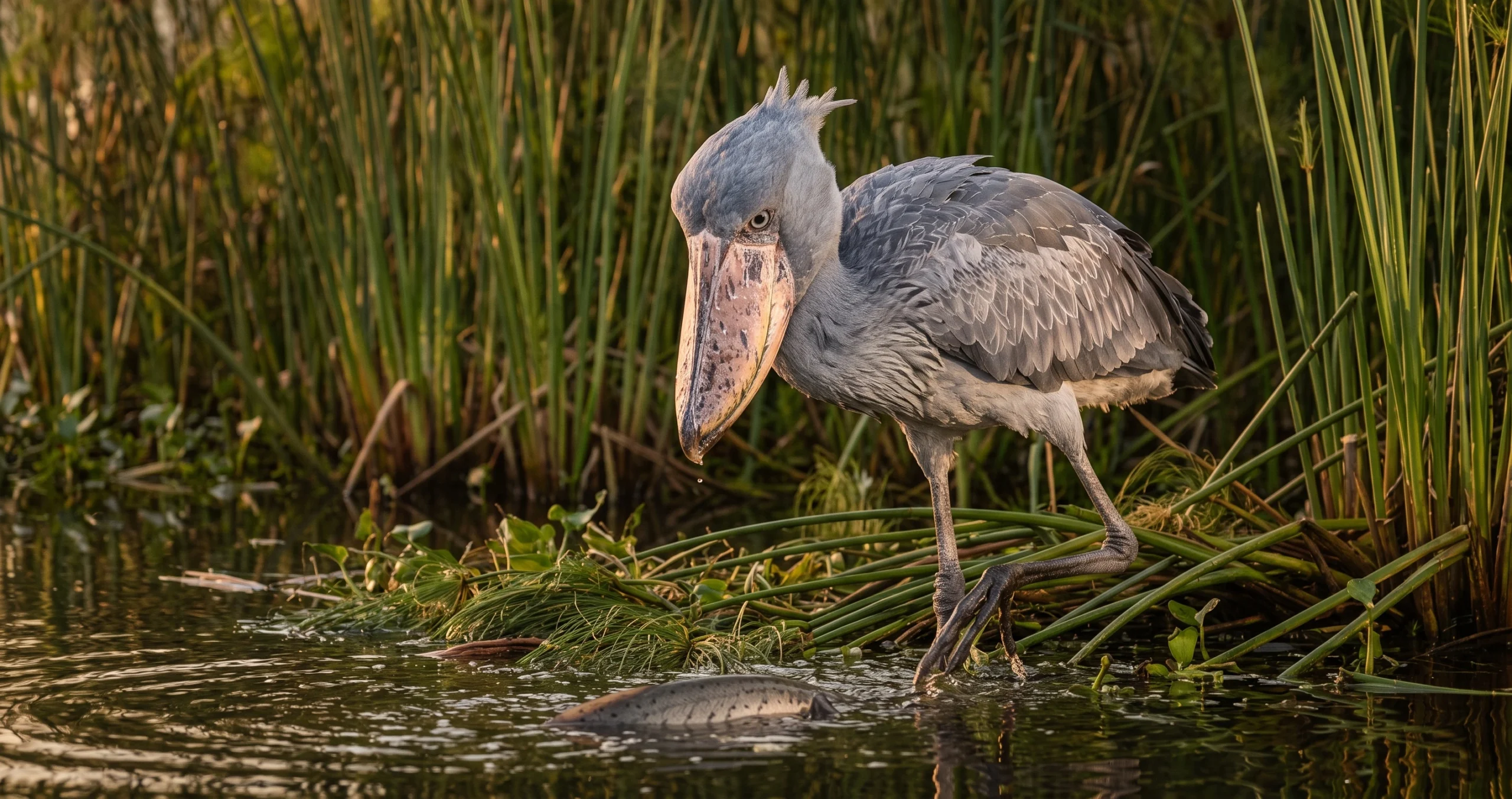
The shoebill hunting behavior is unlike that of almost any other bird. While many predators actively chase prey or constantly search for movement, the shoebill often does the opposite. It may stand completely motionless for long periods, watching the water with intense concentration before launching one of the fastest strikes in the bird world.
This patient hunting strategy has made the shoebill one of Africa’s most fascinating wetland predators. Its enormous bill, exceptional eyesight, powerful neck muscles, and ability to remain nearly invisible among dense marsh vegetation all contribute to its remarkable success.
Although the shoebill has become famous through wildlife documentaries and photography, much of its behavior remains difficult to study. The species inhabits remote freshwater swamps where observation is challenging, and many aspects of its ecology continue to be researched. Even so, scientists have developed a detailed understanding of how this unique bird captures prey and survives in one of Africa’s richest wetland ecosystems.
Table of Contents
- Meet the Shoebill
- What Makes Shoebill Hunting Behavior Unique?
- Anatomy Built for Ambush Hunting
- How Shoebills Catch Their Prey
- What Shoebills Eat
- Habitat and Daily Life
- Why Patience Is an Effective Hunting Strategy
- Ecological Importance
- Conservation Challenges
- What People Often Get Wrong
- Tips for Observing Shoebills Responsibly
- Frequently Asked Questions
- Conclusion
Meet the Shoebill
The shoebill (Balaeniceps rex) is one of the world’s most distinctive birds.
Native to freshwater wetlands in central and eastern Africa, it is instantly recognizable by its enormous shoe-shaped bill, towering height, gray plumage, and steady, deliberate movements.
Adults can stand well over four feet tall, making them among the largest wading birds on the continent.
Despite their imposing appearance, shoebills usually live solitary lives outside the breeding season.
Unlike many colonial waterbirds, they often hunt alone across extensive marshes where dense vegetation provides both concealment and access to aquatic prey.
What Makes Shoebill Hunting Behavior Unique?
The defining feature of shoebill hunting behavior is patience.
Rather than walking continuously through shallow water, shoebills frequently remain completely still.
Sometimes they stand for several minutes without taking a single step.
At other times, they slowly reposition before freezing again.
This strategy conserves energy while allowing prey to approach naturally.
Fish, amphibians, and other aquatic animals often become less cautious when no movement is detected nearby.
When the right opportunity appears, the bird suddenly transforms from motionless observer into an explosive predator.
The strike happens in a fraction of a second.
Researchers describe this hunting style as a classic example of ambush predation.
Anatomy Built for Ambush Hunting
Several specialized features make this hunting strategy remarkably effective.
The Massive Bill
The shoebill’s most famous feature is its oversized bill.
Broad, deep, and ending in a sharp hook near the tip, it functions like both a scoop and a gripping tool.
The wide bill allows the bird to seize large prey while also gathering surrounding vegetation and water during a strike.
After capturing prey, the shoebill often shakes away excess plants before swallowing its meal.
Powerful Neck Muscles
Supporting such a large bill requires exceptionally strong neck muscles.
These muscles generate the speed and force needed for rapid downward strikes while helping the bird lift surprisingly heavy prey from shallow water.
Long Legs
Long legs allow shoebills to move through marshes without disturbing the water excessively.
Their careful, measured steps reduce vibrations that might alert nearby fish.
Exceptional Eyesight
Like many visual predators, shoebills rely heavily on excellent vision.
Their forward-facing gaze provides precise depth perception, allowing accurate strikes even through shallow water and dense vegetation.
Specialized Plumage
The bird’s gray feathers blend remarkably well with papyrus, reeds, and marsh shadows.
This natural camouflage complements its motionless hunting style.
How Shoebills Catch Their Prey
A hunting sequence typically begins with careful observation.
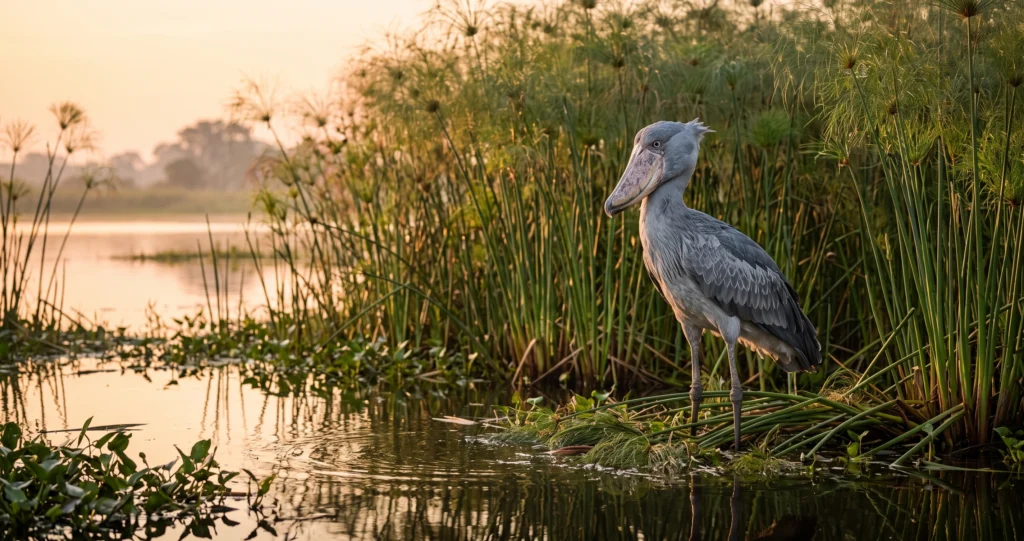
The bird selects a promising location where fish frequently surface or where vegetation creates narrow channels.
Instead of pacing constantly, the shoebill waits.
Its head remains slightly lowered.
The eyes stay focused on the water.
When prey moves into range, the bird lunges forward.
The head and bill accelerate rapidly downward.
Water, mud, plants, and prey are all scooped together in a powerful motion.
After the strike, the shoebill raises its head.
It then uses the bill to separate captured prey from surrounding vegetation.
If successful, the prey is repositioned headfirst before swallowing.
If the strike misses, the bird calmly resumes waiting rather than chasing prey across the marsh.
This method may appear slow, but it minimizes wasted energy and allows repeated hunting throughout the day.
What Shoebills Eat
Shoebills are opportunistic carnivores with a diet centered on aquatic animals.
Fish form the majority of their food.
One particularly important prey species in many wetlands is the African lungfish.
Shoebills also consume:
- Catfish
- Tilapia
- Eels
- Frogs
- Water snakes
- Juvenile crocodiles
- Small turtles
- Monitor lizards
- Occasionally small waterbirds
The exact diet varies depending on habitat, season, and prey availability.
Rather than specializing in only one species, shoebills take advantage of whatever suitable prey can be captured efficiently.
Habitat and Daily Life
Shoebills inhabit extensive freshwater wetlands across parts of South Sudan, Uganda, Rwanda, eastern Democratic Republic of the Congo, Zambia, Tanzania, and neighboring regions.
Preferred habitats include:
- Papyrus swamps
- Marshes
- Floodplains
- Shallow freshwater wetlands
- Slow-moving channels
- Floating vegetation mats
These habitats provide abundant prey while offering dense cover for ambush hunting.
Shoebills usually remain within relatively large home ranges.
Because food may be unevenly distributed, individuals often move between different feeding sites throughout the year.
Breeding pairs establish territories around nest sites, but outside the breeding season most birds remain solitary.
Why Patience Is an Effective Hunting Strategy
Remaining motionless may seem inefficient compared with active searching.
For the shoebill, however, patience provides several important advantages.
Conserving Energy
Large birds require significant energy.
Standing still uses far less energy than walking continuously through wetlands.
Avoiding Detection
Fish and amphibians often react strongly to movement.
By remaining almost perfectly still, the shoebill becomes part of the surrounding landscape.
Improving Accuracy
Waiting allows the bird to strike only when prey enters an ideal position.
Instead of making frequent unsuccessful attempts, it concentrates on high-probability opportunities.
Hunting Large Prey
Large fish require powerful, well-timed strikes.
Patience helps maximize the chances of capturing prey worth the effort.
Ecological Importance
Shoebills occupy the role of apex wetland predators within many freshwater ecosystems.
By feeding on fish, amphibians, reptiles, and other aquatic animals, they help maintain balanced food webs.
Healthy shoebill populations also indicate well-functioning wetlands.
Because these birds depend on intact marshes with stable water levels and abundant prey, their presence often reflects high-quality habitat.
Protecting shoebill habitat therefore benefits countless other species sharing the same wetlands, including fish, reptiles, amphibians, aquatic plants, and migratory birds.
Conservation Challenges
Although the shoebill remains one of Africa’s most iconic birds, it faces several conservation challenges.
Wetland loss is among the greatest threats.
Drainage for agriculture, expanding human settlements, and changes in water management reduce the size and quality of suitable habitat.
Disturbance around nesting sites can also affect breeding success.
Because shoebills reproduce relatively slowly, repeated nesting failures may influence local populations over time.
Illegal collection of chicks for the wildlife trade has affected some areas in the past, although legal protections and conservation efforts have increased in many regions.
Climate change may also alter water levels and seasonal flooding patterns that shape wetland ecosystems.
Conservation programs increasingly emphasize wetland protection, community involvement, ecological monitoring, and sustainable land management to safeguard remaining populations.
What People Often Get Wrong
Several misconceptions surround shoebills.
They are aggressive toward people.
Wild shoebills are generally shy and prefer avoiding human contact.
Their bill is too heavy to use effectively.
Despite its size, the bill is perfectly adapted for rapid, accurate strikes.
They only eat fish.
Fish dominate the diet, but shoebills also consume amphibians, reptiles, and other aquatic animals.
Standing still means they are inactive.
Remaining motionless is an active hunting strategy requiring concentration and precise timing.
They are closely related to storks.
Modern scientific classification places shoebills closer to pelicans than to storks, despite superficial similarities in body shape and behavior.
Tips for Observing Shoebills Responsibly
Shoebills are among Africa’s most sought-after birdwatching species.
Responsible observation helps protect both birds and their habitat.
- Visit wetlands with experienced local guides.
- Keep a respectful distance from feeding or nesting birds.
- Use binoculars or spotting scopes instead of approaching closely.
- Remain quiet to avoid interrupting natural hunting behavior.
- Never attempt to attract a shoebill with food.
- Stay on designated boats or observation routes where required.
- Support protected wetland reserves and community-based conservation initiatives.
Patience often rewards observers with a chance to witness the bird’s remarkable hunting technique without causing disturbance.
Frequently Asked Questions
Why do shoebills stand still for so long?
Remaining motionless allows prey to approach naturally while conserving energy and increasing the accuracy of each strike.
What is the shoebill’s favorite prey?
African lungfish are an important food source in many wetlands, but shoebills also eat catfish, tilapia, frogs, snakes, and other aquatic animals depending on availability.
Can shoebills fly well?
Yes. Despite their large size, shoebills are capable fliers that travel between feeding and nesting areas using broad wings and slow, powerful wingbeats.
Are shoebills endangered?
The species faces conservation concerns due to habitat loss, disturbance, and other human pressures. Conservation status should always be checked using the latest IUCN assessment because it can change as new information becomes available.
Where can shoebills be seen in the wild?
They occur in freshwater wetlands across parts of central and eastern Africa, particularly in large papyrus swamps and marshes.
Conclusion
The shoebill hunting behavior demonstrates that successful predators do not always rely on speed or constant pursuit. Through extraordinary patience, specialized anatomy, exceptional vision, and precisely timed strikes, the shoebill has become one of the most effective ambush hunters in Africa’s freshwater wetlands. Its enormous bill, powerful neck, and ability to remain almost perfectly motionless allow it to capture prey that many other birds would struggle to catch.
At the same time, the future of this remarkable hunter depends on the continued protection of healthy marshes and floodplains. Conserving wetlands not only safeguards shoebills but also preserves the rich biodiversity of some of Africa’s most productive ecosystems, ensuring that future generations can continue observing one of nature’s most patient and fascinating hunters.
Suggested Internal-Link Opportunities
Since I cannot verify your website’s exact URLs, consider linking naturally to existing or future articles covering:
- How Western Grebes Run Across Water During Courtship
- How Male Sandgrouse Carry Water to Their Chicks
- How Greater Sage-Grouse Perform Their Booming Courtship Displays
- Wetland Bird Adaptations
- Birds With Extraordinary Hunting Strategies
- African Freshwater Wildlife
Recommended Authoritative External Sources
- Cornell Lab of Ornithology – Birds of the World (Shoebill species account)
- IUCN Red List – Shoebill (Balaeniceps rex) assessment
- Smithsonian National Zoo & Conservation Biology Institute – Bird biology resources
- Peer-reviewed journals such as The Auk, Journal of Avian Biology, Ostrich, and Waterbirds for research on shoebill ecology and behavior
- BirdLife International – Shoebill conservation and species factsheets