
Table of Contents
- Introduction
- What Makes Bird-of-Paradise Feathers So Extraordinary?
- The Science Behind Ultra-Black Feathers
- How Researchers Discovered and Measured the Light-Absorption Effect
- Why Ultra-Black Feathers Improve Courtship Displays
- The Spectacular Courtship Dance and Female Mate Choice
- How Birds-of-Paradise Compare to Other Examples of Extreme Sexual Selection
- Why These Birds Matter to Science
- Common Myths About Birds-of-Paradise
- Frequently Asked Questions
- Conclusion
The dazzling colors of tropical birds have fascinated people for centuries, but one of the greatest surprises in modern biology involves something that appears to have almost no color at all. The remarkable bird of paradise feathers found in several species include patches so incredibly black that they absorb nearly all incoming light, making nearby iridescent colors appear even brighter. Rather than relying solely on pigments, these birds have evolved microscopic feather structures that manipulate light in ways once thought possible only with advanced engineered materials.
Scientists now know these “ultra-black” feathers play a critical role during courtship, helping males create breathtaking visual illusions that influence female mate choice. Combined with elaborate dances, vibrant plumage, and highly choreographed performances, these specialized feathers demonstrate how sexual selection can drive some of nature’s most extraordinary adaptations.
Understanding how birds-of-paradise evolved these remarkable feathers provides insight into evolution, optics, animal behavior, and even materials science.
If you enjoy learning about unusual wildlife adaptations, you may also like our article explaining Why Periodical Cicadas Wait Exactly 17 Years to Emerge here on secretsofthegreengarden.com.
What Makes Bird-of-Paradise Feathers So Extraordinary?
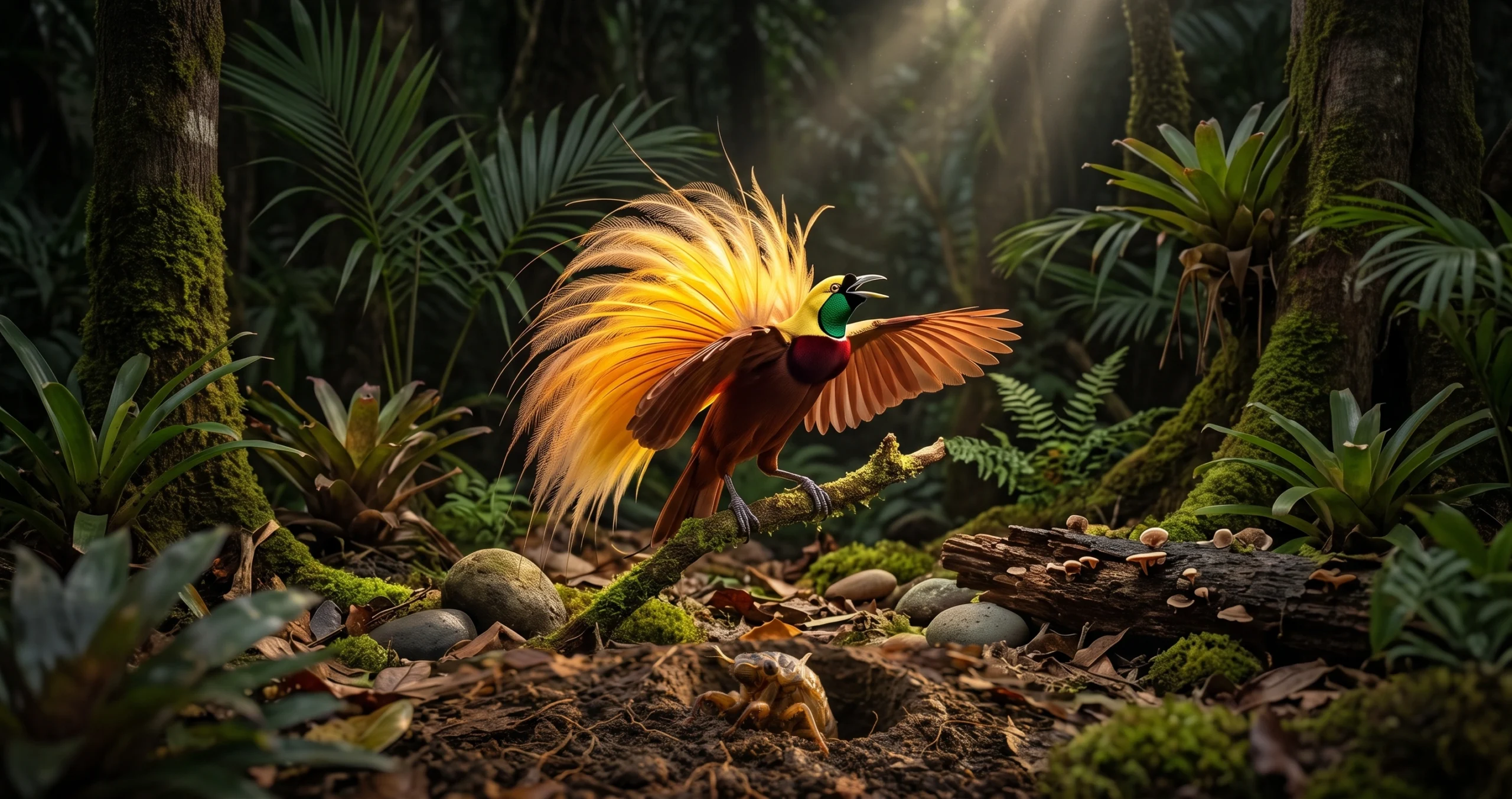
Birds-of-paradise are native primarily to New Guinea and nearby islands, where dozens of species have evolved spectacular courtship displays.
Many males possess brilliant blues, emerald greens, fiery oranges, glowing yellows, and metallic purples.
Yet some of the most important feathers are not colorful at all.
Instead, they appear almost impossibly black.
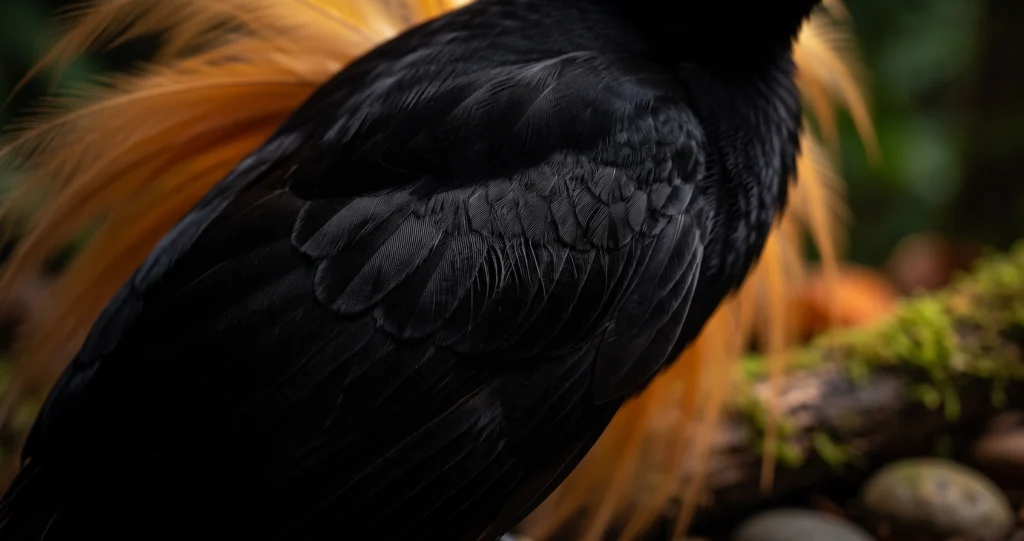
These ultra-black patches absorb approximately 99% or more of visible light, creating an optical effect that makes neighboring colors appear to float against a featureless background.
To the human eye—and likely to female birds—these regions resemble dark voids rather than ordinary feathers.
Unlike typical black feathers, which owe their appearance mainly to pigments such as melanin, ultra-black feathers achieve their appearance largely through microscopic surface architecture.
The Science Behind Ultra-Black Feathers
Bird of Paradise Feathers Manipulate Light
At first glance, the feathers seem simply black.
Under powerful microscopes, however, an entirely different world appears.
The feather surface contains densely packed microscopic barbules arranged in highly complex three-dimensional patterns.
Instead of reflecting incoming light directly outward, these tiny structures scatter light repeatedly through multiple internal reflections.
Each reflection increases the likelihood that light energy will eventually be absorbed by melanin before escaping.
As a result, remarkably little light reaches the observer’s eyes.
Scientists describe this phenomenon as structural absorption rather than pigment alone.
The effect resembles certain engineered ultra-black coatings developed for telescopes and precision optical instruments, although birds evolved this solution millions of years earlier.
More Than Just Dark Pigment
Many black animals contain abundant melanin.
Crows, ravens, panthers, and black bears all owe much of their coloration to this pigment.
Birds-of-paradise take the process much further.
Without the specialized feather microstructure, melanin alone could not produce such extreme darkness.
The combination of pigment and microscopic architecture creates an optical illusion in which feather texture almost disappears entirely.
This visual trick dramatically enhances the neighboring iridescent plumage displayed during courtship.
How Researchers Discovered and Measured the Light-Absorption Effect
For decades, biologists admired birds-of-paradise without fully understanding why certain feather patches appeared unusually dark.
The breakthrough came when researchers combined scanning electron microscopy with sophisticated optical measurements.
High-resolution electron microscopes revealed intricate barbule structures unlike those found in ordinary bird feathers.
Scientists then used spectrophotometers to measure reflectance across the visible light spectrum.
Instead of reflecting several percent of incoming light—as ordinary black feathers typically do—ultra-black feathers reflected only tiny fractions of a percent.
Measurements showed some species absorbing more than 99% of visible light.
Computer simulations confirmed that the feather architecture itself dramatically increased light trapping before absorption.
This discovery represented one of the most striking examples of naturally evolved optical engineering.
Why Ultra-Black Feathers Improve Courtship Displays
The extraordinary darkness serves an important purpose.
During courtship, males position themselves carefully relative to sunlight and the female’s viewing angle.
Ultra-black feathers effectively erase visual boundaries around brilliantly colored patches.
Instead of seeing ordinary feathers, females perceive intensely glowing color surrounded by deep darkness.
Researchers believe this contrast exaggerates brightness and saturation.
The optical illusion may make males appear healthier, more vibrant, and more visually impressive than competitors.
Sexual selection often favors individuals capable of producing stronger signals.
In birds-of-paradise, evolution refined not only color but also the manipulation of light itself.
The Spectacular Courtship Dance and Female Mate Choice
Feathers alone do not guarantee reproductive success.
Male birds-of-paradise perform elaborate dances that rank among the most complex courtship displays in the animal kingdom.
Different species have evolved remarkably different routines.
Some hop rhythmically along branches.
Others fan ornamental plumes into dramatic circles.
Some hang upside down.
Others transform their bodies into shapes that scarcely resemble birds at all.
Throughout these performances, males continuously orient themselves toward the female.
Every movement highlights specialized feather regions designed to maximize visual impact.
Females observe these displays carefully.
Courtship may last several minutes before a female decides whether to mate or reject the performer.
Researchers believe females evaluate multiple characteristics simultaneously.
Dance precision.
Feather quality.
Body condition.
Display location.
Behavioral consistency.
Only the highest-quality males generally achieve repeated mating success.
This strong female choice drives continual evolutionary refinement across generations.
How Birds-of-Paradise Compare to Other Examples of Extreme Sexual Selection
Birds-of-paradise represent one of evolution’s clearest examples of sexual selection, but they are far from alone.
Many species evolve extraordinary features because they improve reproductive success rather than survival.
Peacock Tails
Male peafowl grow enormous trains covered with colorful eyespots.
These spectacular feathers attract females but make escaping predators more difficult.
The evolutionary advantage comes through increased mating opportunities rather than improved survival.
Irish Elk Antlers
The extinct Irish elk possessed antlers spanning over 11 feet (3.5 meters).
Such massive structures likely evolved largely through competition for mates despite enormous energetic costs.
Stalk-Eyed Flies
Males develop dramatically elongated eye stalks.
Females often prefer males with wider eye spacing, driving continual exaggeration across generations.
Elephant Seal Battles
Male elephant seals fight intensely for breeding territories.
Only dominant males secure access to large harems, producing powerful selection for enormous body size.
Satin Bowerbirds
Instead of modifying their bodies alone, male satin bowerbirds build elaborate decorated structures called bowers.
Females inspect these carefully before selecting mates.
Like birds-of-paradise, visual presentation strongly influences reproductive success.
Why These Birds Matter to Science
The study of birds-of-paradise extends well beyond ornithology.
Materials scientists investigate their feather structures when developing improved anti-reflective surfaces.
Optical engineers study natural light-trapping mechanisms for applications in imaging systems and solar energy.
Evolutionary biologists examine how female preferences shape anatomical innovation.
Behavioral ecologists analyze communication strategies involving color, movement, and visual perception.
Few animals illustrate the power of sexual selection as dramatically as birds-of-paradise.
Nature repeatedly demonstrates engineering solutions that inspire modern technology.
Common Myths About Birds-of-Paradise
Myth 1: Their feathers are black because of unusual pigments.
Reality:
Ultra-black appearance results primarily from microscopic feather architecture working alongside melanin.
Myth 2: Every bird-of-paradise has ultra-black feathers.
Reality:
Only certain species possess the highly specialized feather structures responsible for extreme light absorption.
Myth 3: Bright colors alone determine female choice.
Reality:
Females evaluate dance quality, feather condition, posture, display behavior, and overall health—not just coloration.
Myth 4: These birds spend all day dancing.
Reality:
Courtship displays occupy only part of their daily activities.
The rest of their time involves feeding, resting, defending territories, and avoiding predators.
Myth 5: Their feathers glow naturally.
Reality:
The feathers do not produce light.
Instead, ultra-black regions increase the perceived brightness of adjacent iridescent colors through optical contrast.
Why Protecting Birds-of-Paradise Matters
Most birds-of-paradise inhabit tropical rainforests, ecosystems facing ongoing pressures from deforestation, habitat fragmentation, and climate change.
Protecting these forests safeguards not only remarkable birds but also thousands of other plant and animal species sharing the same habitats.
Conservation efforts benefit biodiversity, local communities, and global climate stability.
Organizations such as BirdLife International continue monitoring populations and supporting habitat protection throughout the region.
Frequently Asked Questions
Why are ultra-black feathers so dark?
Their microscopic feather structures trap incoming light through repeated internal reflections before it can escape.
Do all birds-of-paradise have ultra-black feathers?
No. Only certain species possess these specialized feather microstructures.
How dark are ultra-black feathers?
Some reflect less than 1% of visible light, making them among the darkest natural materials ever measured.
Why do females prefer males with these feathers?
The ultra-black background makes neighboring iridescent colors appear dramatically brighter during courtship displays, potentially signaling superior quality.
Are birds-of-paradise endangered?
Many species remain relatively stable, while others face increasing threats from habitat loss. Conservation priorities vary by species and location.
Conclusion
The extraordinary bird of paradise feathers that create ultra-black plumage demonstrate one of evolution’s most remarkable achievements. Rather than relying solely on pigment, these birds manipulate light itself through microscopic feather structures that absorb nearly every visible ray. This remarkable adaptation transforms already colorful courtship displays into breathtaking visual performances capable of influencing female mate choice.
Combined with intricate dances, precise positioning, and millions of years of sexual selection, ultra-black feathers reveal how evolution can shape beauty through physics as much as biology. Beyond their ecological importance, birds-of-paradise continue inspiring discoveries in optics, materials science, and evolutionary research, reminding us that some of nature’s most sophisticated technologies evolved long before humans began studying them.
2 Internal Link Suggestions:
- https://secretsofthegreengarden.com/why-periodical-cicadas-wait-exactly-17-years-to-emerge/
- https://secretsofthegreengarden.com/sea-otters-keep-personal-tools-for-years-heres-how-and-why/
3 External Dofollow Authoritative Sources:
- American Museum of Natural History: https://www.amnh.org/
- Cornell Lab of Ornithology – All About Birds: https://www.allaboutbirds.org/
- BirdLife International: https://www.birdlife.org/