

Table of Contents
- Introduction
- Understanding the Periodical Cicada Life Cycle
- Why 17 Years? The Prime-Number Predator-Avoidance Theory
- Periodical vs. Annual Cicadas: What’s the Difference?
- What Triggers the Synchronized Emergence?
- The Incredible Underground Life of Cicada Nymphs
- Why Emerging Together Is a Winning Survival Strategy
- What Gardeners Should Know About Cicada Emergence Years
- Common Myths About Periodical Cicadas
- Frequently Asked Questions
- Conclusion
The periodical cicada life cycle is one of the most extraordinary biological phenomena on Earth. While most insects complete their lives within weeks or months, periodical cicadas spend either 13 or 17 years hidden underground before emerging in astonishing numbers for just a few weeks of adult life. This synchronized appearance has fascinated scientists for centuries and continues to raise questions about evolution, survival, and the remarkable precision of nature.
Unlike annual cicadas, which appear every summer, periodical cicadas follow one of the longest and most predictable life cycles known among insects. Their emergence is so synchronized that millions—or even billions—of insects may suddenly appear across forests, neighborhoods, and gardens within the same region. Researchers believe this unusual timing is not random but instead represents a highly successful evolutionary strategy that helps the insects survive overwhelming predation.
Understanding why periodical cicadas wait exactly 17 years reveals not only a fascinating story of insect biology but also valuable information for gardeners preparing for emergence years.
If you’re interested in unusual animal adaptations, you may also enjoy our article on Sea Otters Keep Personal Tools for Years — Here’s How and Why here on secretsofthegreengarden.com.
Understanding the Periodical Cicada Life Cycle
The periodical cicada life cycle begins when adult females lay eggs inside slender tree branches shortly after mating.
Using a specialized egg-laying structure called an ovipositor, females cut narrow slits into young twigs and deposit dozens of eggs.
After approximately six to ten weeks, tiny nymphs hatch and immediately fall to the ground.
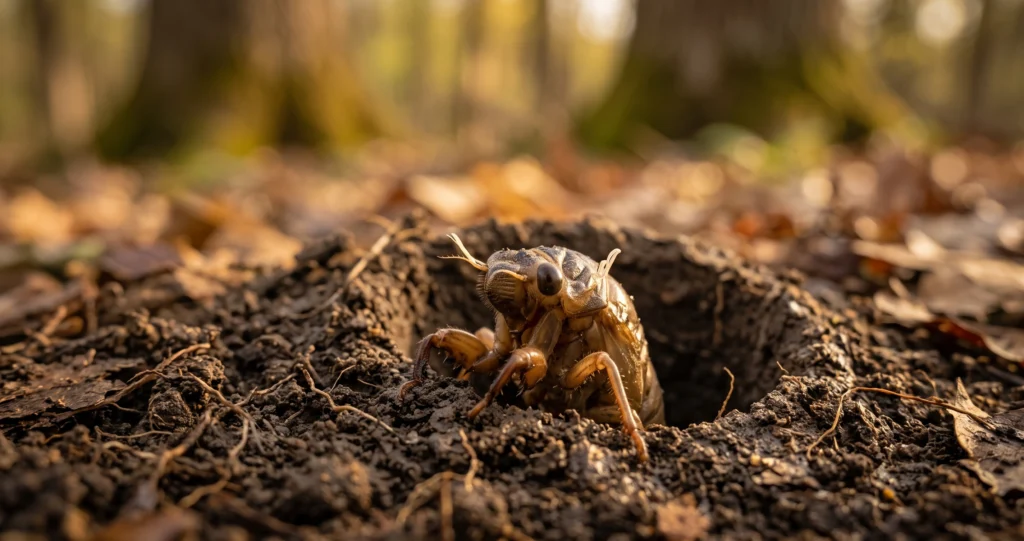
They quickly burrow into the soil, where they begin one of the longest juvenile stages in the insect world.
For the next 13 or 17 years—depending on the species—the nymphs remain underground, feeding slowly on fluids extracted from tree roots.
During this time, they molt several times while growing steadily beneath the surface.
Unlike many insects that undergo rapid development, periodical cicadas mature at an exceptionally slow pace, making their eventual emergence one of nature’s most dramatic events.
Why 17 Years? The Prime-Number Predator-Avoidance Theory
The Periodical Cicada Life Cycle and Prime Numbers
One of the leading explanations for the unusual timing involves mathematics.
Specifically, it involves prime numbers.
Prime numbers are divisible only by one and themselves.
The number 17 is prime, as is 13—the other major life cycle observed in North American periodical cicadas.
Scientists propose that prime-number emergence reduces overlap with predators that have shorter, repeating life cycles.
Imagine a predator whose population peaks every two, three, four, five, or six years.
If cicadas emerged every 12 years, those cycles would frequently coincide.
By emerging every 17 years instead, overlaps become far less common.
This reduces the likelihood that predators evolve life cycles specifically synchronized with cicada appearances.
Although the prime-number hypothesis may not explain every aspect of cicada evolution, mathematical models strongly support its potential advantages.
It remains one of the most elegant examples of how evolution and mathematics may intersect.
Predator Satiation: Safety in Massive Numbers
Prime numbers are only part of the story.
Another equally important strategy is known as predator satiation.
When billions of cicadas emerge simultaneously, predators simply cannot eat them all.
Birds, squirrels, raccoons, turtles, snakes, foxes, fish, and countless other animals feast on cicadas during emergence years.
Despite enormous losses, enough insects survive to reproduce successfully because predators become full long before consuming the entire population.
Instead of avoiding predators completely, periodical cicadas overwhelm them with sheer abundance.
This strategy has proven remarkably successful over millions of years.
Periodical vs. Annual Cicadas: What’s the Difference?
Many people assume every cicada follows the famous 17-year schedule.
In reality, most cicadas seen each summer are annual species.
Annual cicadas typically require only two to five years to develop underground.
However, because different individuals mature at different times, some adults emerge every year.
This creates the impression that annual cicadas have one-year life cycles.
Periodical cicadas behave very differently.
Entire populations mature together.
Every member of the same brood emerges within roughly the same few weeks after spending exactly 13 or 17 years underground.
Their black bodies, bright red eyes, and orange wing veins also distinguish them from many larger green annual cicadas.
Understanding this distinction helps explain why some summers produce extraordinary cicada swarms while others do not.
What Triggers the Synchronized Emergence?
Remarkably, periodical cicadas do not emerge simply because a calendar reaches 17 years.
Instead, environmental conditions determine the precise timing.
The primary trigger appears to be soil temperature.
When temperatures approximately eight inches below the surface consistently reach about 64°F (18°C), mature nymphs begin digging upward.
Warm spring rains often accelerate emergence by softening the soil.
Within just a few nights, millions of insects may climb onto tree trunks, fences, shrubs, and buildings.
They then undergo their final molt, shedding their nymphal exoskeletons and transforming into winged adults.
This synchronized timing maximizes opportunities for mating while enhancing predator satiation.
The Incredible Underground Life of Cicada Nymphs
Although adult cicadas live only about four to six weeks, nearly their entire existence occurs underground.
Nymphs feed gently on xylem fluids from tree roots.
These fluids contain relatively few nutrients, contributing to the insects’ extremely slow development.
The underground environment protects them from many predators while providing stable temperatures.
Throughout their juvenile years, nymphs gradually enlarge through repeated molts.
Scientists still investigate exactly how cicadas track the passing years.
Some evidence suggests they may monitor seasonal changes in tree root chemistry as plants grow and become dormant each year.
This internal biological clock remains one of the most fascinating mysteries surrounding the periodical cicada life cycle.
Why Emerging Together Is a Winning Survival Strategy
Evolution rarely rewards coincidence.
Every feature of periodical cicadas appears carefully shaped by natural selection.
Emerging simultaneously creates multiple advantages.
Males form enormous singing choruses that help females locate potential mates.
High population density increases successful reproduction.
Predator satiation ensures many adults survive despite heavy predation.
The synchronized schedule also reduces opportunities for specialized predators to evolve alongside them.
Few insects demonstrate such remarkable coordination across entire regional populations.
What Gardeners Should Know About Cicada Emergence Years
For gardeners, emergence years often bring concern.
Fortunately, mature trees usually tolerate cicadas very well.
The primary damage occurs when females lay eggs in young twigs.
These small cuts may cause branch tips to wilt or break, a condition sometimes called “flagging.”
Healthy established trees generally recover without difficulty.
Young ornamental trees, newly planted fruit trees, and recently transplanted shrubs deserve more attention.
Protect Young Trees
Fine mesh netting placed over young trees before egg-laying begins provides excellent protection.
The mesh should have openings no larger than about one-quarter inch.
Remove the covering after adult activity ends.
Delay New Tree Planting
If possible, postpone planting valuable young trees until after the emergence season has finished.
This avoids exposing tender branches during peak egg-laying.
Avoid Unnecessary Insecticides
Because cicada emergence lasts only a few weeks, chemical treatments are usually unnecessary.
Insecticides often harm beneficial insects while providing limited long-term benefit.
The University of Illinois Extension recommends physical protection rather than widespread pesticide use.
Leave Mature Trees Alone
Large established trees rarely require intervention.
They have evolved alongside cicadas for thousands of years.
Minor twig pruning after emergence may be all that is needed.
Common Myths About Periodical Cicadas
Myth 1: Periodical cicadas are locusts.
Reality:
They are true cicadas, not locusts. The nickname “17-year locust” is historically inaccurate.
Myth 2: They destroy healthy forests.
Reality:
Healthy mature forests generally tolerate cicada egg-laying with little lasting damage.
Myth 3: Cicadas bite or sting people.
Reality:
Periodical cicadas do neither. They are harmless to humans and pets.
Myth 4: Every cicada emerges every 17 years.
Reality:
Many cicada species emerge annually or follow different development schedules.
Only specific North American species are periodical cicadas.
Myth 5: They invade homes.
Reality:
Adult cicadas prefer outdoor vegetation and rarely enter buildings unless attracted accidentally by lights or open windows.
Why Periodical Cicadas Matter to Ecosystems
Although brief, periodical cicada emergences provide enormous ecological benefits.
Their bodies become food for hundreds of wildlife species.
After they die, decomposing cicadas return valuable nutrients to forest soils.
Their egg-laying naturally prunes small branches, sometimes stimulating new plant growth.
Even the tunnels left by departing nymphs improve soil aeration and water infiltration around tree roots.
These periodic events enrich entire ecosystems far beyond the insects themselves.
Additional information about cicada ecology is available through the Smithsonian National Museum of Natural History:
Frequently Asked Questions
Why do periodical cicadas wait 17 years?
Scientists believe the long life cycle reduces overlap with predator cycles while allowing predator satiation through synchronized emergence.
What triggers emergence?
The primary trigger appears to be soil temperatures reaching approximately 64°F (18°C) about eight inches below the surface.
Are periodical cicadas harmful?
They are harmless to people, pets, and most mature trees.
Young trees may benefit from temporary protective netting during emergence years.
How long do adult cicadas live?
Adults usually survive for about four to six weeks, during which they mate, lay eggs, and die.
Should gardeners use pesticides?
Generally, no. Physical barriers protect vulnerable young trees more effectively while avoiding unnecessary impacts on beneficial insects.
Conclusion
The remarkable periodical cicada life cycle remains one of nature’s greatest evolutionary mysteries. Spending either 13 or 17 years underground before emerging in extraordinary synchrony, these insects combine mathematical timing, predator satiation, and precise environmental cues into a survival strategy unlike almost any other in the animal kingdom.
For gardeners, understanding cicada emergence removes much of the uncertainty surrounding these rare events. While young trees may require temporary protection, established landscapes usually recover with little lasting impact. Rather than viewing periodical cicadas as destructive pests, it is more accurate to recognize them as remarkable participants in healthy forest ecosystems whose brief appearances have shaped North American landscapes for millions of years.
2 Internal Link Suggestions:
- https://secretsofthegreengarden.com/sea-otters-keep-personal-tools-for-years-heres-how-and-why/
- https://secretsofthegreengarden.com/how-hummingbirds-survive-the-night-using-torpor-and-fly-backwards/
3 External Dofollow Authoritative Sources:
- University of Connecticut Cicada Project: https://cicadas.uconn.edu/
- University of Illinois Extension: https://extension.illinois.edu/
- Smithsonian National Museum of Natural History: https://naturalhistory.si.edu/