
Table of Contents
- Introduction
- The Anatomy Behind Cheetah Spine Speed
- How the Flexible Spine Works Like a Spring
- Why Longer Strides Matter More Than Faster Leg Movement
- Semi-Retractable Claws: Built-In Running Spikes
- The Tail: Nature’s High-Speed Rudder
- How Cheetahs Compare to Other Fast Land Animals
- Why Cheetahs Can’t Maintain Top Speed for Long
- Common Myths About Cheetah Speed
- Practical Lessons from Nature’s Fastest Runner
- Frequently Asked Questions
- Conclusion
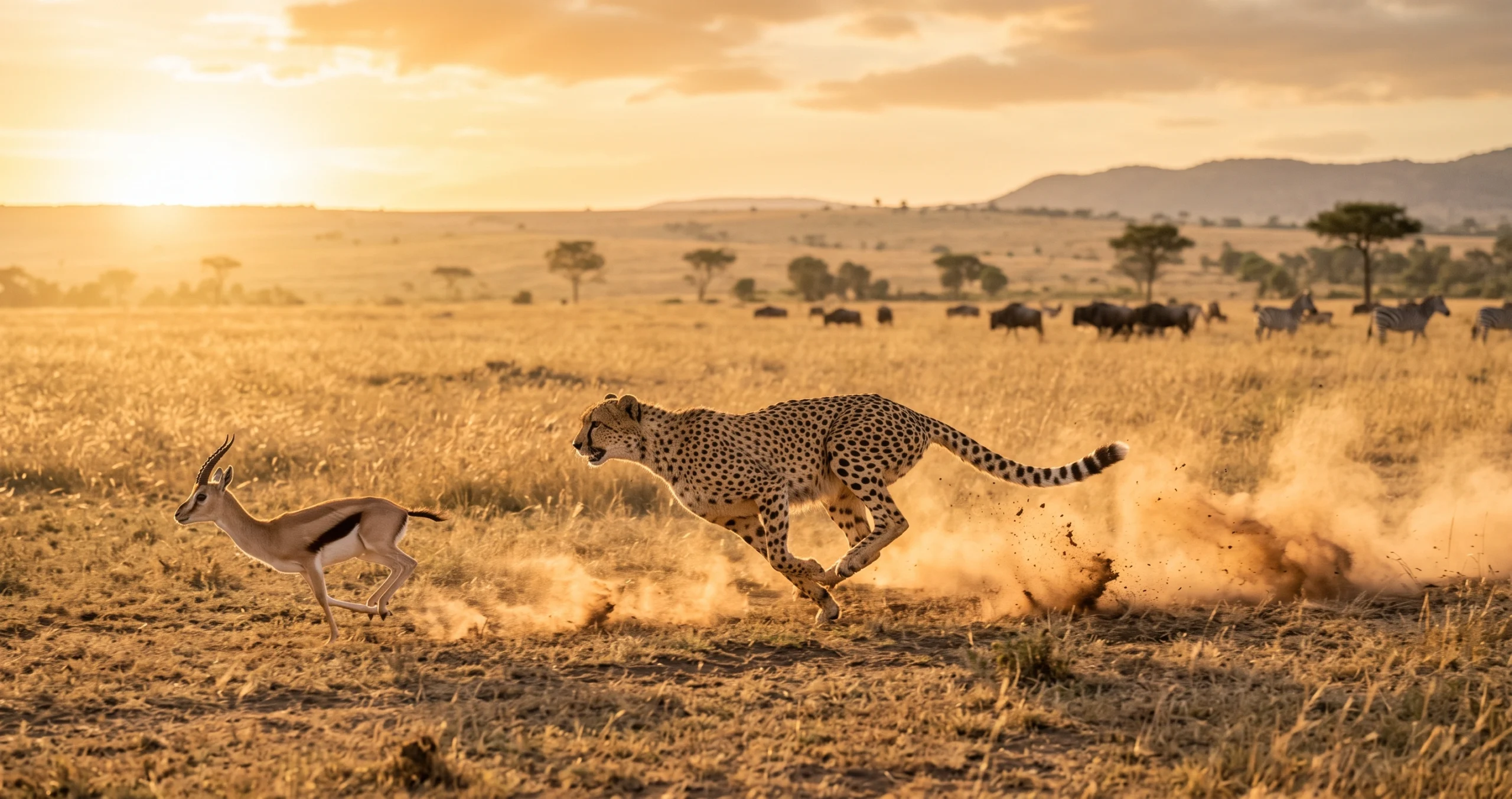
The secret behind incredible cheetah spine speed isn’t found in the legs alone. While many people assume powerful muscles are responsible for making cheetahs the fastest land animals on Earth, the real engineering marvel lies in their remarkably flexible spine. Acting much like a compressed spring, the cheetah’s backbone stores and releases energy during every stride, allowing the animal to reach breathtaking speeds of up to 70 mph (113 km/h) over short distances.
Every part of the cheetah’s body contributes to this extraordinary performance. Its flexible spine, semi-retractable claws, lightweight frame, oversized lungs, and long balancing tail work together as a highly specialized system built for explosive acceleration rather than endurance. Understanding how these adaptations function offers an incredible glimpse into one of evolution’s most sophisticated athletic designs.
If you’re fascinated by remarkable wildlife adaptations, you may also enjoy reading our article on how vampire bats practice reciprocal altruism and remember social partners at secretsofthegreengarden.com.
The Anatomy Behind Cheetah Spine Speed
Unlike most large cats, cheetahs are designed almost entirely around speed.
Everything about their body reduces weight while maximizing forward propulsion. Their narrow waist, deep chest, long limbs, lightweight skull, and exceptionally flexible vertebral column create a machine optimized for rapid acceleration.
Most mammals have flexible spines, but cheetahs take this characteristic to an extreme. The joints between their vertebrae allow much greater bending than those of lions, tigers, or leopards.
This flexibility dramatically increases stride length, which is ultimately the biggest contributor to the cheetah’s incredible speed.
How the Flexible Spine Works Like a Spring
Cheetah Spine Speed Depends on Elastic Motion
The backbone functions similarly to a compressed spring.
As the cheetah gathers its legs underneath its body during a stride, the spine flexes dramatically, storing elastic energy inside muscles, tendons, and connective tissues.
Moments later, the spine extends forcefully, releasing that stored energy and launching both the front and rear legs much farther apart than would otherwise be possible.
Instead of relying solely on muscle strength, the animal continuously recycles mechanical energy with every stride.
This process makes movement more efficient while generating tremendous forward momentum.
During full-speed sprints, the cheetah’s body alternates between two remarkable positions.
When fully contracted, all four feet are tucked beneath the torso.
When fully extended, the body stretches almost like a bow, with the front and rear legs reaching far beyond the body’s normal length.
This dramatic extension nearly doubles the distance covered in a single stride.
Longer Strides Beat Faster Steps
Many people assume speed comes primarily from moving the legs faster.
While stride frequency certainly matters, stride length plays an even larger role.
A human sprinter may reach stride lengths around 2.5 meters.
A racing greyhound can exceed 6 meters.
An adult cheetah can achieve strides approaching 7 to 8 meters (23 to 26 feet) during maximum acceleration.
Rather than taking vastly more steps than other animals, cheetahs simply cover far more ground with each one.
The flexible spine is the main reason this becomes possible.
Semi-Retractable Claws: Built-In Running Spikes
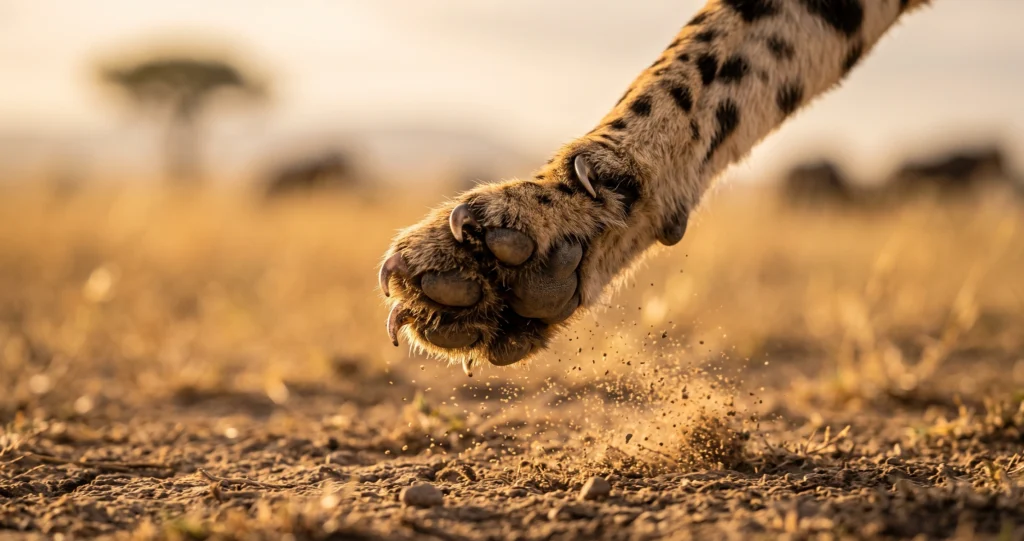
Unlike lions and leopards, cheetahs cannot completely hide their claws.
Although technically semi-retractable, the claws remain partially exposed almost all the time.
Far from being a disadvantage, this adaptation dramatically improves traction.
The claws grip loose dirt, grass, and uneven terrain similarly to the spikes worn by elite track athletes.
This extra grip prevents slipping during explosive acceleration while allowing powerful push-offs at every stride.
The large central paw pad also contains textured ridges that increase friction against the ground.
Combined with muscular forelimbs, these features help the cheetah maintain stability while accelerating from zero to remarkable speeds in only a few seconds.
The Tail: Nature’s High-Speed Rudder
A cheetah’s tail measures roughly half the length of its body.
Rather than simply trailing behind, it functions as an active balancing system.
When pursuing agile prey such as gazelles, sudden turns become unavoidable.
At speeds exceeding 60 mph, even slight changes in direction create enormous rotational forces that could destabilize the animal.
The tail counteracts these forces.
Swinging it in one direction shifts angular momentum, allowing the body to pivot rapidly without losing balance.
This works much like a tightrope walker’s balancing pole or a racing motorcycle rider leaning through a curve.
Without this dynamic counterweight, the cheetah would likely tumble during high-speed turns.
How Cheetahs Compare to Other Fast Land Animals
Several animals rank among Earth’s fastest runners, yet they achieve speed using different strategies.
Cheetah
The cheetah combines an exceptionally flexible spine, lightweight skeleton, semi-retractable claws, and oversized respiratory system.
It specializes in explosive acceleration over short distances.
Maximum speed:
Approximately 70 mph (113 km/h)
Pronghorn
North America’s pronghorn is slower than a cheetah at peak speed but far superior in endurance.
Its large lungs and highly efficient cardiovascular system allow it to maintain fast running for much longer periods.
Maximum speed:
Around 55 mph (88 km/h)
Springbok
Springboks rely on elastic tendons and explosive leaps called pronking.
Although extremely fast, their spinal flexibility is less specialized than that of cheetahs.
Maximum speed:
Around 55 mph (88 km/h)
Greyhound
Greyhounds also possess highly flexible backs and long strides.
In fact, their galloping pattern resembles that of cheetahs more closely than many other mammals.
Maximum speed:
Around 45 mph (72 km/h)
Horse
Thoroughbred racehorses achieve impressive speeds using powerful hindquarters and long limbs rather than extreme spinal flexibility.
Maximum speed:
Around 44 mph (71 km/h)
Why Cheetahs Can’t Sustain Top Speed for Long
Despite being unmatched in short sprints, cheetahs tire remarkably quickly.
Most high-speed chases last only 20 to 30 seconds.
Rarely do they exceed one minute.
The main limitation is overheating.
Running at maximum intensity produces tremendous amounts of metabolic heat.
The muscles consume oxygen rapidly while generating heat faster than the body can safely dissipate it.
A cheetah’s breathing rate can exceed 150 breaths per minute after a sprint.
Its heart rate rises dramatically as well.
If a chase continues too long, body temperature climbs toward dangerous levels.
Continuing to run risks heat stroke, muscle damage, and even death.
Because of this, cheetahs often abandon pursuits that last too long, even if prey remains nearby.
This explains why stealth and close-range acceleration are just as important as raw speed.
Instead of chasing prey across miles, cheetahs stalk within striking distance before unleashing an explosive sprint.
For more information about cheetah physiology and conservation, the Smithsonian’s National Zoo offers an excellent overview:
https://nationalzoo.si.edu/animals/cheetah
Common Myths About Cheetah Speed
Myth 1: Cheetahs are fast because they have the strongest muscles.
Reality:
Powerful muscles help, but the flexible spine, elastic tendons, lightweight skeleton, and long stride contribute just as much.
Myth 2: Cheetahs can outrun any animal over long distances.
Reality:
Many animals, including pronghorns and wolves, can sustain high speeds much longer than cheetahs.
Myth 3: Every cheetah reaches 70 mph.
Reality:
Top speed depends on age, terrain, physical condition, and whether the animal has enough space to accelerate fully.
Many hunting chases occur below maximum speed.
Myth 4: Their claws work exactly like other cats.
Reality:
Cheetah claws remain partially exposed, improving grip much like running cleats.
Myth 5: Speed alone guarantees successful hunts.
Reality:
Many hunts fail because prey changes direction suddenly, detects the cheetah early, or escapes into rough terrain.
Success depends on stealth, timing, acceleration, and agility working together.
Practical Lessons from Nature’s Fastest Runner
The cheetah demonstrates that exceptional performance rarely comes from one feature alone.
Instead, multiple systems work together in harmony.
Its spine provides elastic energy.
Its claws maximize traction.
Its tail controls balance.
Its lungs deliver oxygen.
Its lightweight frame minimizes unnecessary mass.
Engineers studying high-speed robotics, prosthetics, and athletic performance frequently look to these biological principles for inspiration.
Nature often solves complex engineering challenges long before humans do.
For additional information on mammalian locomotion and biomechanics, the American Society of Biomechanics provides educational resources:
https://asbweb.org/
Frequently Asked Questions
How fast can a cheetah actually run?
Healthy adult cheetahs can reach speeds approaching 70 mph (113 km/h), although most hunting sprints occur at somewhat lower speeds.
Why is the cheetah’s spine so flexible?
Specialized vertebrae and connective tissues allow the backbone to bend dramatically, increasing stride length and storing elastic energy.
Do cheetahs always run at full speed?
No. Maximum speed requires significant energy and creates rapid overheating, so cheetahs reserve it for the final stages of a hunt.
Why don’t lions run as fast?
Lions evolved for strength, ambush hunting, and overpowering large prey rather than sustained high-speed pursuit. Their heavier bodies and stiffer spines limit maximum speed.
Can humans build robots based on cheetahs?
Yes. Researchers studying robotics and biomechanics often use cheetahs as models for improving balance, agility, and efficient running.
Conclusion
The remarkable cheetah spine speed that allows the world’s fastest land animal to outrun nearly every other predator depends on much more than powerful legs. Its extraordinarily flexible backbone works like a biological spring, storing and releasing energy with every stride to produce unmatched stride length and explosive acceleration.
Supporting adaptations—including semi-retractable claws that grip the ground, a muscular tail that acts as a high-speed rudder, and a body built for lightweight efficiency—transform the cheetah into one of evolution’s greatest engineering achievements. Yet these same specializations come with limits. Overheating prevents prolonged sprints, reminding us that even nature’s fastest athlete must balance speed with survival.
The cheetah remains a striking example of how multiple adaptations, working together as one integrated system, can create extraordinary performance that continues to inspire scientists, engineers, and wildlife enthusiasts alike.
2 Internal Link Suggestions:
- https://secretsofthegreengarden.com/vampire-bats-practice-reciprocal-altruism-and-they-remember-who-owes-them/
- https://secretsofthegreengarden.com/how-elephants-grieve-and-what-science-has-discovered/
3 External Dofollow Authoritative Sources:
- Smithsonian’s National Zoo – Cheetah: https://nationalzoo.si.edu/animals/cheetah
- San Diego Zoo Wildlife Alliance – Cheetah Facts: https://animals.sandiegozoo.org/animals/cheetah
- American Society of Biomechanics: https://asbweb.org/