
Introduction
At first glance, a mantis shrimp doesn’t look like one of the ocean’s greatest marvels. Most species are only a few inches long, hiding quietly inside burrows among coral reefs or rocky seabeds. But beneath that colorful shell lies one of nature’s most astonishing combinations of speed, strength, and vision.
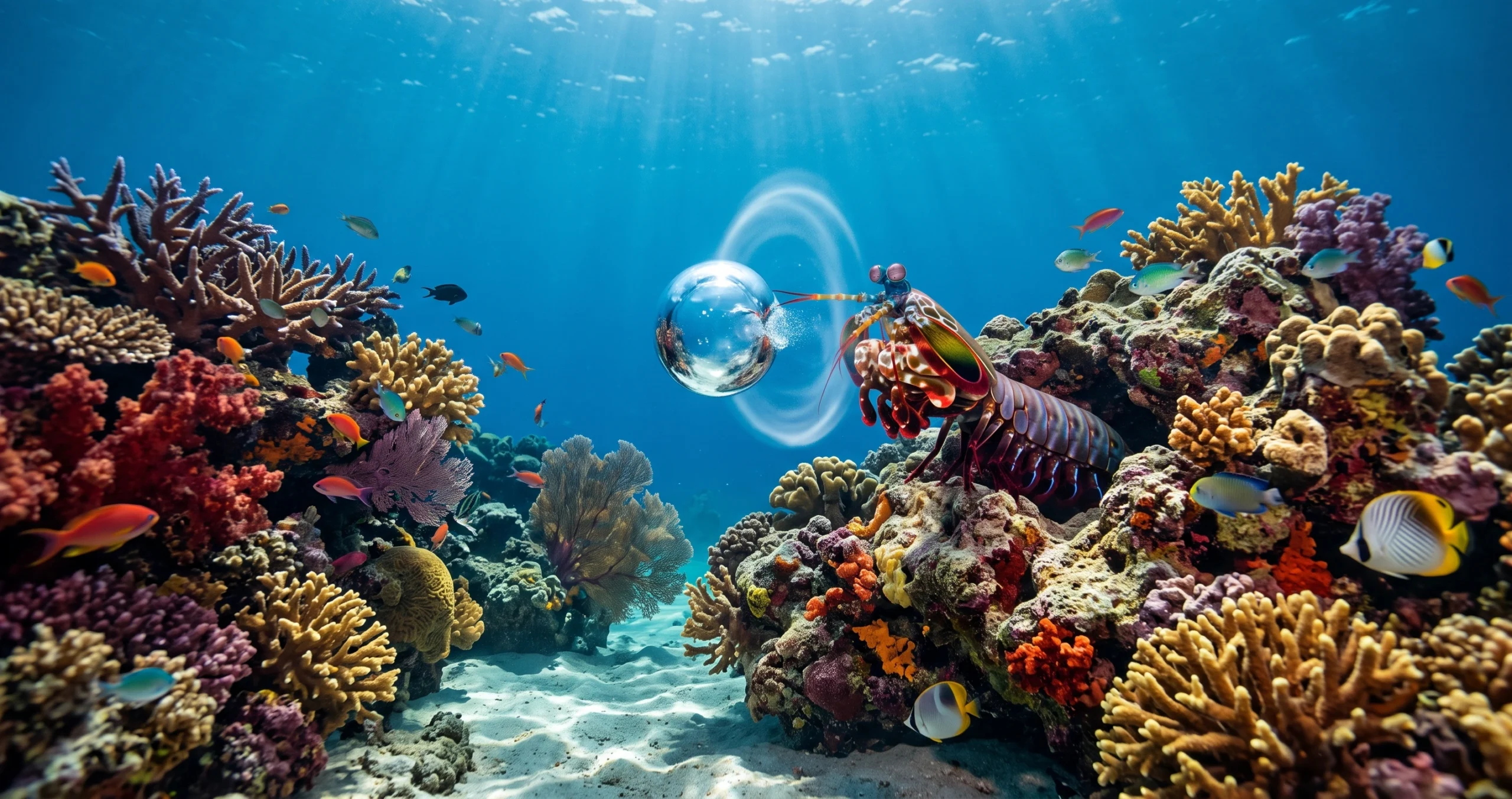
A mantis shrimp can launch its specialized club-like appendage with such incredible acceleration that it rivals the speed of a bullet leaving some firearms. The strike is so powerful that it creates cavitation bubbles capable of producing a second shockwave powerful enough to damage prey even after the initial impact.
Its eyes are equally extraordinary. While humans rely on three types of color-sensitive photoreceptors, mantis shrimp possess between 12 and 16 different classes of photoreceptors, allowing them to detect ultraviolet light, polarized light, and a far broader range of wavelengths than we can see. Yet surprisingly, recent research suggests they may not actually perceive color in the way scientists once believed.
These remarkable adaptations have made mantis shrimp one of the most studied marine animals in biomechanics, optics, neuroscience, and evolutionary biology. Far from being just another colorful reef creature, they continue to challenge our understanding of how animals interact with the world around them.
In this guide, we’ll explore the incredible physics behind the mantis shrimp’s famous punch, unravel the mystery of its unusual vision, separate scientific fact from internet myths, and discuss what reef aquarium owners should know before considering one of these fascinating crustaceans.
What Is a Mantis Shrimp?
Despite the name, mantis shrimp are neither true shrimp nor mantises.
They belong to a distinct order of crustaceans known as Stomatopoda, which evolved separately from shrimp, crabs, and lobsters hundreds of millions of years ago.
More than 450 species have been identified worldwide, living primarily in tropical and subtropical oceans.
Most inhabit:
- Coral reefs
- Rocky coastlines
- Sandy seabeds
- Seagrass beds
Mantis shrimp generally fall into two major hunting groups:
Smashers
Smashers possess heavily reinforced club-like appendages.
They use these to break open:
- Snails
- Crabs
- Clams
- Other hard-shelled prey
The famous peacock mantis shrimp belongs to this group.
Spearers
Spearers have sharp, barbed appendages instead of clubs.
They ambush:
- Fish
- Soft-bodied crustaceans
- Worms
Although both are formidable predators, smashers are responsible for the incredible strikes that have captured scientists’ attention.
The Physics Behind the Ocean’s Fastest Punch
The mantis shrimp’s strike is one of the fastest movements ever recorded in the animal kingdom.
A Biological Spring-Loaded Weapon
Unlike humans, who rely primarily on muscle power, mantis shrimp store energy before striking.
Specialized muscles slowly load elastic structures inside the appendage, similar to compressing a spring.
A locking mechanism holds this energy until release.
When triggered, the stored energy is released almost instantly.
This system allows the appendage to move far faster than muscle contraction alone could achieve.
Incredible Acceleration
Researchers have measured astonishing performance figures.
A smashing appendage can reach:
- Speeds of approximately 50 mph (80 km/h)
- Accelerations exceeding 10,000 g in some measurements
- Peak accelerations around 100,000 meters per second squared
For comparison, a Formula 1 car accelerates at roughly 1.5–2 g, while astronauts during launch experience only a few g.
The mantis shrimp’s strike occurs in just a few thousandths of a second.
Cavitation: The Invisible Second Punch
Perhaps even more remarkable than the impact itself is what happens immediately afterward.
As the appendage moves through water at tremendous speed, pressure drops dramatically behind it.
This creates tiny vapor-filled cavities known as cavitation bubbles.
Almost instantly, those bubbles collapse.
When they implode, they generate:
- A powerful secondary shockwave
- Brief flashes of light known as sonoluminescence
- Localized temperatures reaching thousands of degrees for tiny fractions of a second
The collapsing bubbles can crack shells even if the initial strike misses slightly.
In other words, prey may receive two impacts:
- The physical blow.
- The shockwave from collapsing cavitation bubbles.
This remarkable phenomenon explains why mantis shrimp can shatter shells far larger than expected for their size.
The Strangest Eyes in the Animal Kingdom
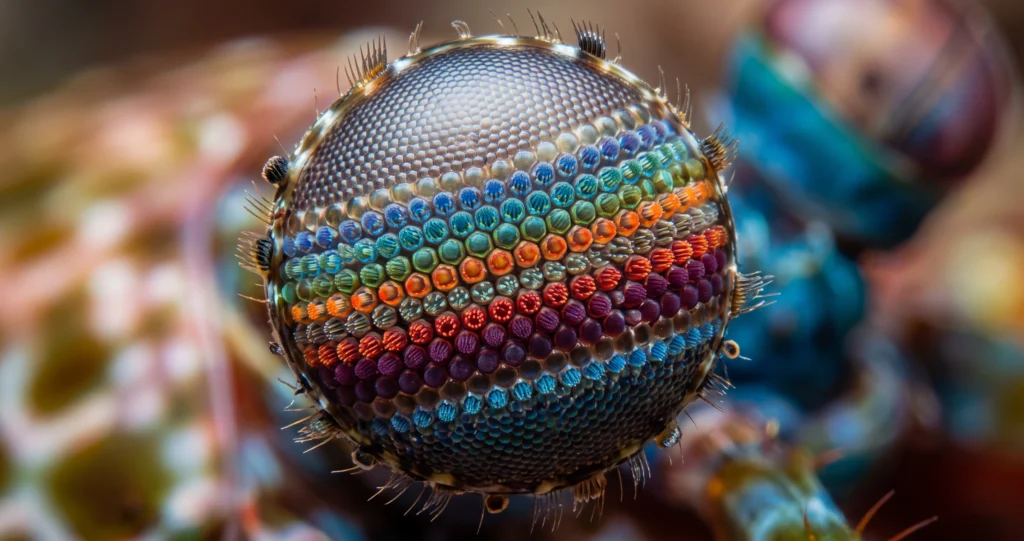
If the punch weren’t enough, mantis shrimp possess perhaps the most complex eyes known among animals.
Each eye moves independently and contains three functional regions that together provide an extraordinary view of the world.
12–16 Types of Photoreceptors
Humans use three color-sensitive cone cells.
Most birds possess four.
Mantis shrimp have between 12 and 16 photoreceptor classes depending on the species.
These receptors detect:
- Visible colors
- Ultraviolet light
- Polarized light
- Circularly polarized light in some species
For years, scientists assumed this meant mantis shrimp experienced unimaginably rich color vision.
The truth appears more complicated.
The Scientific Debate: Do More Photoreceptors Mean Better Color Vision?
This is one of the most fascinating questions in sensory biology.
The Original Assumption
Early researchers believed that having many photoreceptors allowed mantis shrimp to distinguish an enormous number of colors with exceptional precision.
The idea became popular in documentaries and online articles.
What New Research Suggests
Behavioral experiments have challenged this assumption.
Rather than comparing signals from many photoreceptors the way humans do, mantis shrimp may use each receptor as a direct detector for specific wavelength ranges.
This system may actually allow them to identify colors more quickly but with lower discrimination between very similar shades.
In other words, their visual system appears optimized for speed rather than producing detailed color perception like humans experience.
Scientists continue studying exactly how their nervous system processes visual information, and the topic remains an active area of research.
Current evidence suggests their vision is specialized—not necessarily superior—to human color vision.
Why Such Extraordinary Vision Evolved
Living on coral reefs requires rapid decision-making.
Mantis shrimp use vision for:
- Finding prey
- Avoiding predators
- Recognizing mates
- Identifying rivals
- Navigating complex habitats
Their ability to detect polarized light may also improve contrast underwater, where light behaves differently than it does in air.
This specialized vision likely provides advantages that go far beyond simple color recognition.
Can a Mantis Shrimp Really Break Aquarium Glass?
Stories about mantis shrimp smashing aquariums have circulated online for years.
The reality is more nuanced.
Large smashing species are certainly capable of damaging thin glass, especially small tanks made with lightweight panels.
However, modern aquariums constructed with thicker glass or acrylic are generally safe when appropriately designed.
The greatest risks involve:
- Thin nano tanks
- Poor-quality glass
- Improper transport containers
Most responsible aquarists successfully keep mantis shrimp without broken tanks.
Practical Tips for Reef Aquarium Owners
Mantis shrimp can make fascinating display animals, but they require specialized care.
Choose an Appropriate Aquarium
Acrylic tanks are often recommended because they resist impact better than thin glass.
For larger smashing species, avoid very small or fragile aquariums.
Provide Deep Burrows
Most mantis shrimp naturally spend much of their lives inside tunnels.
Suitable shelters include:
- PVC pipe sections
- Live rock caves
- Burrowing substrate
A secure hiding place reduces stress.
Avoid Community Reef Tanks
Many mantis shrimp prey upon:
- Small fish
- Snails
- Hermit crabs
- Shrimp
- Crabs
Housing them with expensive reef invertebrates often leads to losses.
Species-only aquariums are generally the safest option.
Feed a Varied Diet
Appropriate foods include:
- Shrimp
- Clams
- Mussels
- Marine fish
- Crabs
Hard-shelled foods help maintain the smashing appendages in some species.
Never Handle Them Directly
Although serious injuries are uncommon, a large mantis shrimp can deliver painful strikes.
Use specimen containers rather than bare hands during maintenance.
Common Myths About Mantis Shrimp
Myth: They Can Punch Like a Bullet
Their appendages reach remarkable speeds, but comparisons with bullets are oversimplified. While the strike is among the fastest movements in nature, it is not literally equivalent to a bullet in every physical measure.
Myth: They See Millions More Colors Than Humans
Having more photoreceptors does not automatically mean richer color perception. Current evidence suggests their visual system prioritizes rapid recognition over detailed color discrimination.
Myth: Every Mantis Shrimp Can Break Glass
Only some large smashing species pose a risk to thin aquariums. Most individuals cannot shatter properly built tanks.
Myth: They’re Aggressive Toward Humans
Mantis shrimp are defensive rather than aggressive. They usually remain inside burrows unless threatened or hunting.
Frequently Asked Questions
How hard does a mantis shrimp punch?
Large smashing species can generate impacts powerful enough to crack mollusk shells, break crab exoskeletons, and create cavitation shockwaves. Their strikes rank among the fastest movements recorded in animals.
Why do mantis shrimp create cavitation bubbles?
Their appendages move so rapidly that pressure behind the strike briefly drops below the vapor pressure of water, creating bubbles that collapse almost instantly and generate a secondary shockwave.
How many colors can mantis shrimp see?
Scientists cannot answer this precisely. They possess 12–16 photoreceptor classes, but current research suggests they process color differently from humans rather than simply seeing “more colors.”
Are mantis shrimp good aquarium pets?
They can thrive in species-specific aquariums with proper housing, stable water quality, secure burrows, and an appropriate diet. They are generally unsuitable for mixed reef communities.
Are mantis shrimp dangerous?
To humans, they pose little danger when handled responsibly. However, large species can deliver painful strikes, so direct handling should be avoided.
Conclusion
The mantis shrimp is a remarkable reminder that evolution often produces solutions beyond our imagination. Its spring-loaded strike demonstrates some of the most extreme biomechanics found in nature, harnessing stored energy to generate accelerations that few animals can match. The resulting cavitation bubbles create a second, invisible impact, making an already formidable weapon even more effective.
Equally fascinating are its extraordinary eyes. While once believed to possess the most advanced color vision in the animal kingdom, modern research paints a more nuanced picture. Rather than simply seeing more colors than humans, mantis shrimp appear to have evolved a visual system optimized for rapid recognition in the dynamic, light-filled environment of coral reefs. Their vision continues to challenge scientists and expand our understanding of how different brains interpret the world.
Whether admired by marine biologists, underwater photographers, or aquarium enthusiasts, mantis shrimp remain among the ocean’s most extraordinary animals. As researchers continue investigating their biomechanics, optics, and nervous systems, these colorful crustaceans are likely to keep surprising us with discoveries that reshape what we know about life beneath the waves.
External Authoritative Sources
- University of Queensland – Research on mantis shrimp biomechanics and vision: https://www.uq.edu.au/
- Patek, S. N., Korff, W. L., & Caldwell, R. L. (2004). Deadly strike mechanism of a mantis shrimp. Nature. https://www.nature.com/articles/nature02368
- Thoen, H. H., How, M. J., Chiou, T. H., & Marshall, J. (2014). A different form of color vision in mantis shrimp. Science. https://www.science.org/doi/10.1126/science.1245824