

Dolphins are among the most intelligent marine animals, known for their complex social behaviors and remarkable communication abilities. Unlike humans, dolphins rely heavily on sound to navigate, hunt, and interact. Their communication system includes echolocation clicks and unique signature whistles that allow them to identify, locate, and interact with each other with incredible precision.
How Dolphins Use Echolocation
Echolocation is a biological sonar system used by dolphins to “see” with sound. By emitting high-frequency clicks, dolphins can detect objects, prey, and obstacles in their environment, even in complete darkness. These clicks reach frequencies up to 200,000 Hz, which is approximately ten times beyond the range of human hearing. This extraordinary capability enables dolphins to map their surroundings and locate prey with remarkable accuracy.
The production of these sounds occurs in the dolphin’s phonic lips, located in the forehead area. Over time, these sound-producing structures remain highly functional, allowing dolphins to maintain their echolocation abilities throughout their lives.
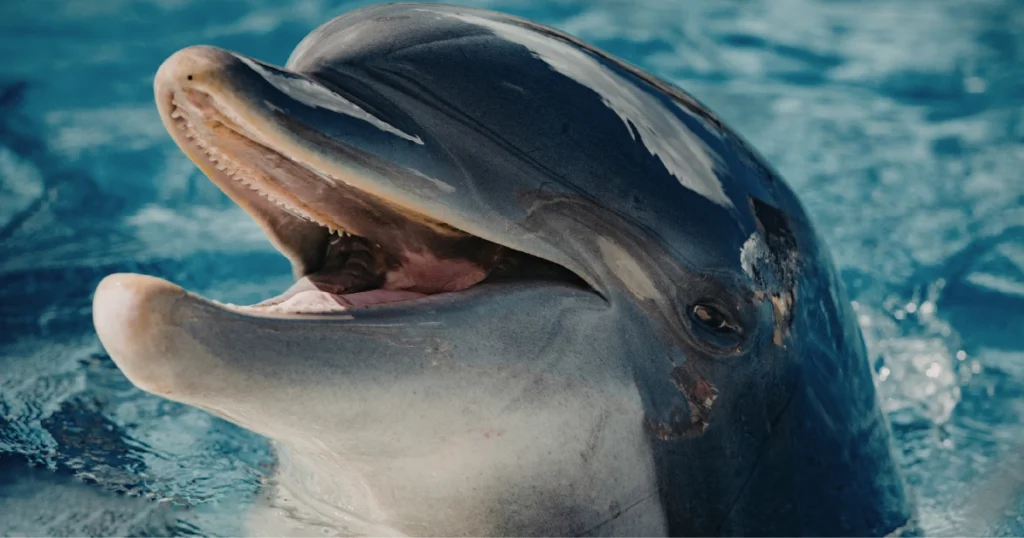
Signature Whistles: The Dolphin “Name”
Beyond echolocation, dolphins use signature whistles to recognize each other. Each dolphin develops a unique whistle early in life, functioning much like a name. Members of a pod can remember these whistles for over 20 years, demonstrating long-term social memory. Dolphins can even learn the signature whistles of others, allowing them to call specific companions intentionally. This system forms the foundation of their intricate social interactions.
Key Features of Dolphin Signature Whistles:
- Unique to each individual
- Recognizable by other pod members
- Can be learned and mimicked by close companions
- Facilitates social bonding and coordination
The Complex Anatomy Behind Dolphin Communication
Dolphin communication relies on specialized anatomical structures that support both sound production and reception:
- Blowhole: Primary pathway for expelling and modulating air during vocalization.
- Melon: A fatty structure in the forehead that focuses and directs sound waves during echolocation.
- Phonic Lips: Located in the nasal passages, these produce the high-frequency clicks used in echolocation.
- Vestibular Sac: Helps in sound reception and underwater hearing.
- Lower Jawbone: Conducts incoming sound vibrations to the middle ear, enabling precise hearing.
These anatomical adaptations allow dolphins to produce a wide range of sounds and interpret acoustic signals with remarkable clarity.
How Dolphins Use Sound Socially
Communication is not only essential for hunting but also for maintaining social cohesion. Dolphins rely on sound to coordinate group activities, signal distress, locate pod members, and engage in playful interactions. The ability to recognize and respond to specific whistles strengthens social bonds and supports cooperative behaviors.
Social Implications:
- Group coordination during hunting
- Strengthening family and pod relationships
- Recognizing and avoiding threats
- Sharing environmental information efficiently
Conclusion
Dolphin communication exemplifies the sophistication of non-human intelligence. Through echolocation and signature whistles, dolphins navigate their environment, socialize, and ensure survival. Understanding these systems provides insight into their cognitive abilities and highlights the importance of acoustic research in marine biology.
FAQ
1. How do dolphins produce echolocation clicks?
Dolphins use their phonic lips in the nasal passage to create high-frequency clicks, which are focused through the melon to locate objects underwater.
2. Can dolphins recognize individual companions?
Yes, each dolphin develops a unique signature whistle, effectively serving as a personal identifier, and other dolphins can remember these whistles for decades.
3. Why is the melon important in dolphin communication?
The melon acts as an acoustic lens, focusing sound waves during echolocation and improving precision in detecting objects and prey.
4. Do all dolphins use the same frequency range for echolocation?
While echolocation is common to most dolphin species, frequencies can vary depending on species, environment, and the task at hand.
5. How does social communication benefit dolphin pods?
Signature whistles and other vocalizations facilitate social bonding, coordination during hunts, and overall pod cohesion, enhancing survival and reproductive success.