
INTRODUCTION
If you have a large, mature tree in your yard, you likely have a problem spot directly beneath it — a zone of compacted soil, dense root competition, deep shade, and drought that defeats most ordinary plants within a single season.
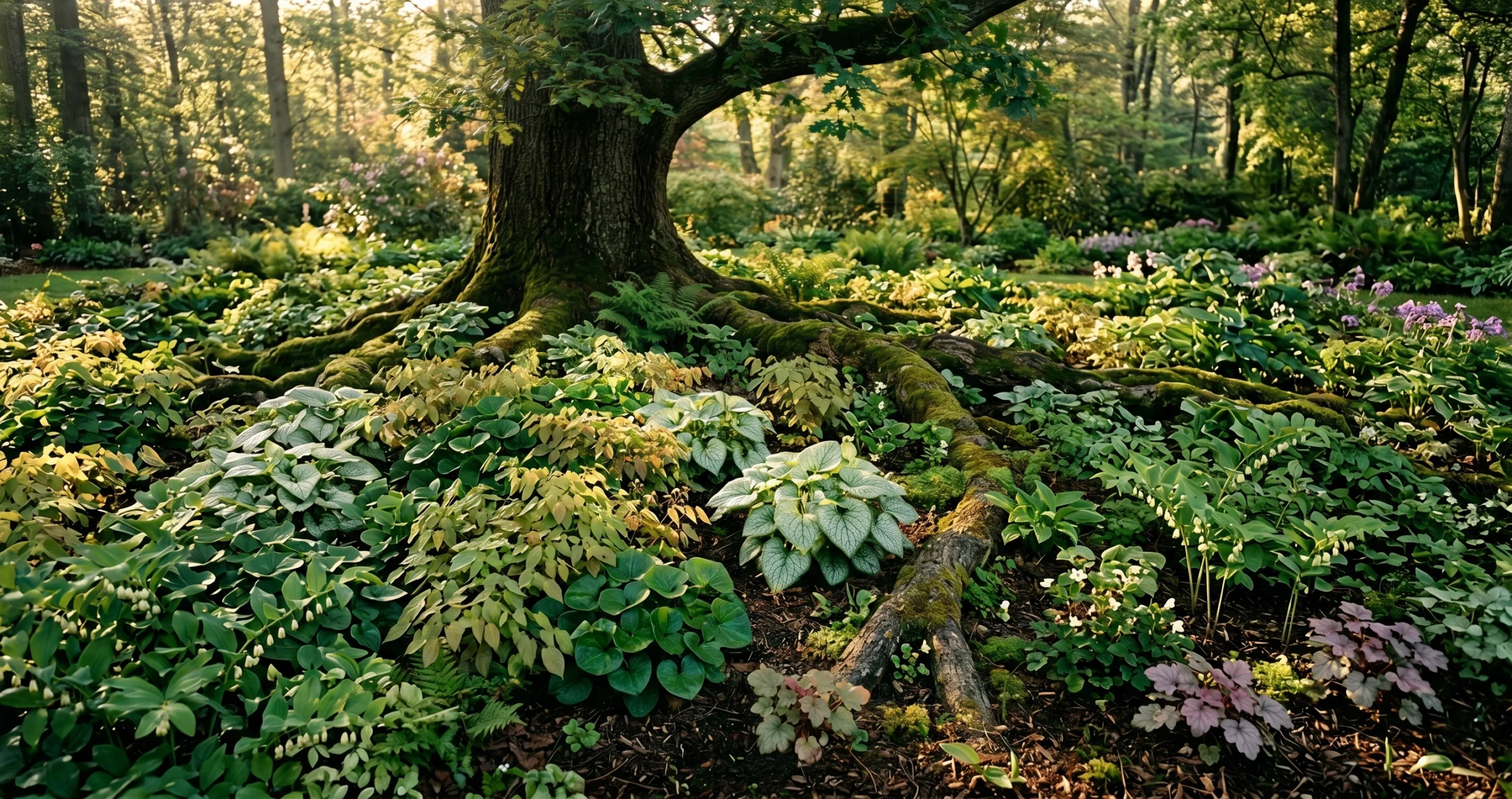
This is one of the most challenging planting environments in any residential garden. But it is not impossible. The right plants don’t just survive these conditions — they were shaped by millions of years of evolution to thrive in exactly this kind of woodland understory.
This guide covers nine proven plants for dry shade under trees, explaining what makes each one uniquely suited to the environment, how to establish them successfully, and what to expect in the first two seasons.
WHY PLANTING UNDER TREES IS SO DIFFICULT
Before selecting plants, it helps to understand why most plants fail under large trees.
Root competition: Mature tree roots extend far beyond the drip line and colonize the top 12 to 18 inches of soil — the same zone where most garden plants feed and anchor.
Moisture deficit: Tree canopies intercept rainfall before it reaches the ground, and tree roots absorb what does reach the soil. The area beneath a mature tree can receive as little as 20 to 30 percent of the precipitation that falls on the surrounding yard.
Light limitation: A dense canopy can reduce light levels to two or three percent of full sun — well below the minimum for most ornamentals.
Soil compaction: Years of surface root growth and organic matter accumulation create a tough, compacted surface that new plants struggle to penetrate.
THE 9 BEST PLANTS FOR DRY SHADE UNDER TREES
- Epimedium (Epimedium spp.)
Epimedium is arguably the single most reliable plant for dry shade under trees. It is nearly impossible to kill once established, tolerates drought that would kill hostas, and produces delicate spring flowers in shades of yellow, white, pink, and purple. Its rhizomatous root system spreads slowly outward, gradually filling the space without becoming invasive. Some species are fully evergreen. Water regularly for the first season — after that, epimedium is largely self-sufficient even in dry shade. - Liriope (Liriope muscari)
Liriope forms dense, grasslike clumps that remain green through winter in most climates. It produces purple or white flower spikes in late summer attractive to bees. It handles root competition extremely well and adapts to both moist and dry soil. Varieties range from compact 12-inch clumps to spreading 18-inch mounds. Works particularly well as edging along the outer edge of a tree’s root zone. - Brunnera (Brunnera macrophylla)
Brunnera is prized for its large, heart-shaped leaves with silver or white markings — varieties like ‘Jack Frost’ and ‘Looking Glass’ are particularly striking. It produces small forget-me-not-style blue flowers in early spring. It adapts well to seasonal dryness once established, and benefits from the deep shade a tree canopy provides in hot climates. - Wild Ginger (Asarum canadense)
Native wild ginger is a slow-growing, low-spreading ground cover that forms a dense, weed-suppressing mat over time. Native to eastern North American woodlands, it evolved under exactly the conditions found beneath large deciduous trees. The kidney-shaped leaves are dark green and attractive throughout the growing season. Slow spread makes it ideal for smaller root zones. - Hellebore (Helleborus spp.)
Hellebores bloom in late winter and early spring — often while snow is still on the ground. They produce nodding, cup-shaped flowers in cream, purple, pink, burgundy, and near-black over leathery, evergreen foliage. They thrive in the dry summer conditions under deciduous trees, going semi-dormant when the canopy is at its densest. Hellebores self-seed freely in favorable conditions. - Coral Bells (Heuchera spp.)
Modern Heuchera varieties offer dramatic foliage in burgundy, caramel, silver, and lime green. They produce small, airy flowers on tall stems in summer attractive to hummingbirds. Coral Bells prefer consistent moisture but handle periodic dryness in shade. Amend the planting hole with compost in highly compacted root zones. - Wood Fern (Dryopteris spp.)
Wood ferns are the workhorses of the shade garden — highly adaptable, tolerating both wet and dry conditions, requiring almost no maintenance once established. Their arching, vase-shaped fronds add vertical texture. Many Dryopteris species are semi-evergreen to evergreen in mild climates. They establish slowly but become increasingly drought-tolerant after the first two seasons. - Solomon’s Seal (Polygonatum spp.)
Solomon’s Seal produces arching stems with alternating leaves and small, dangling white flowers in late spring. A native woodland plant with graceful, elegant appearance. It spreads by rhizome at a manageable pace, gradually filling an area over several years. Pairs beautifully with ferns, hellebores, and hostas. - Lamium (Lamium maculatum)
Lamium is a fast-spreading, semi-evergreen ground cover with silver-marked leaves and pink or white flowers in spring. One of the most aggressive colonizers on this list — excellent for quickly covering large, bare root zones. Varieties like ‘White Nancy’ and ‘Beacon Silver’ are particularly attractive. Can spread aggressively in moist, rich soil, so monitor it in favorable conditions.
HOW TO ESTABLISH PLANTS IN A TREE ROOT ZONE
Success under a tree depends almost entirely on the establishment phase.
Amend planting pockets individually rather than tilling the entire area — tree root damage is a serious risk. Dig small holes, add compost directly into each hole, and plant.
Water thoroughly at planting and continue supplemental irrigation for the first full season. Once root systems develop, most of these species become genuinely self-sufficient.
Avoid deep mulch directly against tree trunks. A 2 to 3 inch layer of shredded bark or leaf mulch between plants helps retain moisture during establishment without causing crown rot.
Do not use fertilizers high in nitrogen in a tree root zone — they encourage the tree’s roots to grow more aggressively into the planting area.
WHAT TO EXPECT IN SEASONS ONE AND TWO
The first season under a tree is primarily about root establishment, not visible growth. Many of these plants will appear to do very little above ground while their roots expand and adjust. This is normal.
By season two, most of these plants will begin spreading noticeably. By season three, the area should have developed into a cohesive, low-maintenance understory planting that requires little more than an annual cleanup.
FREQUENTLY ASKED QUESTIONS
Can I plant hostas under trees?
Hostas are often recommended for shade but struggle with the dry conditions of a tree root zone. They can work if you provide supplemental irrigation throughout the summer. The plants on this list are more reliably self-sufficient.
Should I remove tree roots before planting?
Never cut major tree roots within the drip line. Small surface roots can be carefully worked around. Damaging large roots can cause structural instability and open the tree to disease.
How long until the area looks full?
Most of these plants take two to three seasons to fill in noticeably. Fast spreaders like Lamium can fill a large area within two seasons; slow spreaders like Wild Ginger may take five.
Can I combine multiple species from this list?
Yes — layering creates a more naturalistic, interesting understory. Combine upright structure (Solomon’s Seal, Wood Fern) with spreading ground covers (Epimedium, Lamium) for depth and texture.
CONCLUSION
The dry shade beneath a large tree is not a gardening failure — it’s an opportunity for a specialized planting that most gardeners overlook entirely. The nine plants in this guide were selected for their proven ability to survive drought, root competition, and low light simultaneously.
Start with two or three species, give them consistent water in the first season, and allow two to three years to develop. The result will be one of the most low-maintenance and visually distinctive corners of your entire garden.