
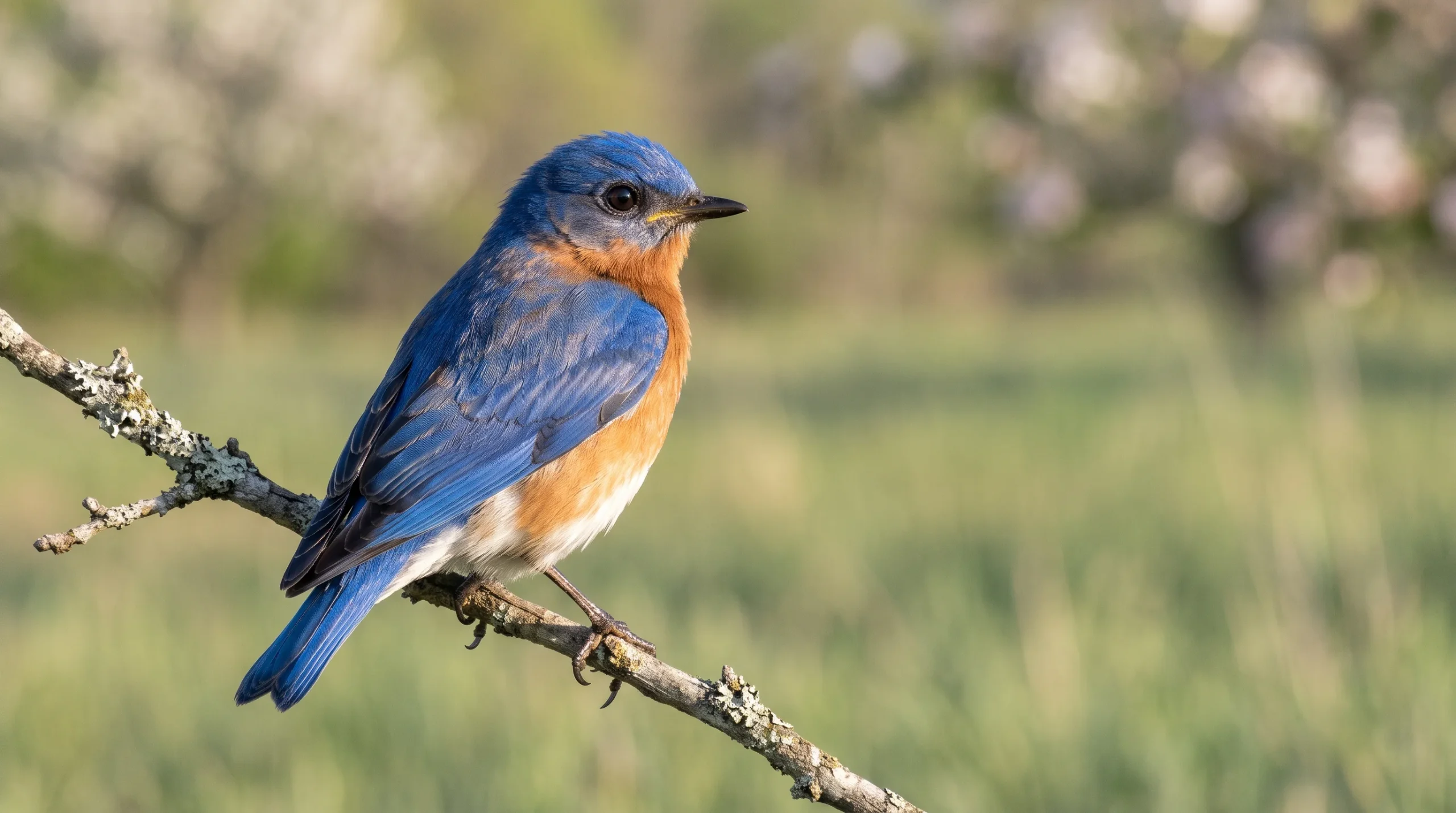
The morning sun catches a flash of electric blue on a weathered fence post. An Eastern Bluebird sits almost motionless, watching the grass below. Suddenly, it drops from its perch, snatches an insect, and returns to its lookout.
For a bird so familiar in American meadows and backyards, the Eastern Bluebird holds some remarkable surprises.
Its brilliant blue feathers, for example, contain no blue pigment. Their color emerges from microscopic structures that interact with light. Its hunting behavior is equally specialized, while its nesting habits depend on cavities the bird cannot excavate for itself.
These are only a few of the fascinating Eastern Bluebird facts that reveal how this small songbird survives.
From changing seasonal diets to unusual courtship displays, the Eastern Bluebird (Sialia sialis) offers a window into the extraordinary adaptations of everyday wildlife.
Table of Contents
- Their Brilliant Blue Feathers Contain No Blue Pigment
- Eastern Bluebirds Hunt From Elevated Lookout Posts
- Their Diet Changes Dramatically With the Seasons
- They Cannot Excavate Their Own Nest Cavities
- Their Courtship Includes a Nest-Site Display
- Eastern Bluebirds May Raise More Than One Brood
- Some Eastern Bluebirds Remain Through Winter
- Male and Female Bluebirds Wear Different Shades
- A Wildlife-Friendly Yard Can Support Bluebirds
- Frequently Asked Questions
Their Brilliant Blue Feathers Contain No Blue Pigment
The most striking feature of an Eastern Bluebird is also one of its most surprising.
The blue color is produced by feather structure rather than blue pigment.
The science behind the blue
A bluebird’s feathers contain microscopic arrangements of keratin and air spaces. These structures interact with incoming light, scattering certain wavelengths more effectively than others.
The resulting structural coloration makes the feathers appear blue.
This is not quite the same as a tiny mirror reflecting blue light. The feather’s internal organization influences how light travels and scatters, while underlying pigments help absorb some of the remaining light.
Together, these effects create the vivid blue appearance.
Why the color changes with lighting
A male Eastern Bluebird may look intensely blue in direct sunlight but much duller beneath heavy clouds.
The difference comes partly from illumination and viewing conditions.
Under transmitted light, when light passes through a feather rather than reflecting toward the observer, the feather can appear brownish instead of bright blue.
The bird’s rusty-orange breast works differently. Its warm coloration comes primarily from pigments rather than the microscopic structures responsible for the blue.
This contrast between structural and pigment-based coloration makes Eastern Bluebird plumage especially interesting.
Eastern Bluebirds Hunt From Elevated Lookout Posts
An Eastern Bluebird perched on a fence is not necessarily resting.
It may be hunting.
A patient hunting strategy
Bluebirds frequently watch open ground from fence posts, low branches, wires, and other exposed perches.
When they spot potential prey, they drop toward the ground, capture it, and often return to a perch.
This behavior is particularly noticeable in grassy fields and open meadows.
Their prey includes beetles, grasshoppers, crickets, caterpillars, spiders, and other small invertebrates.
Why open habitat matters
Short vegetation makes moving insects easier to detect.
An open field with scattered trees or fence posts can provide both feeding opportunities and convenient observation points.
Dense woodland generally offers fewer of these open hunting conditions.
Birdwatching tip: Watch a bluebird quietly from a distance near an open grassy area. Repeated movements between a perch and the ground often reveal its hunting routine.
The bird’s ability to use elevated lookout points helps explain why open countryside and lightly wooded habitats are so important to the species.
Their Diet Changes Dramatically With the Seasons
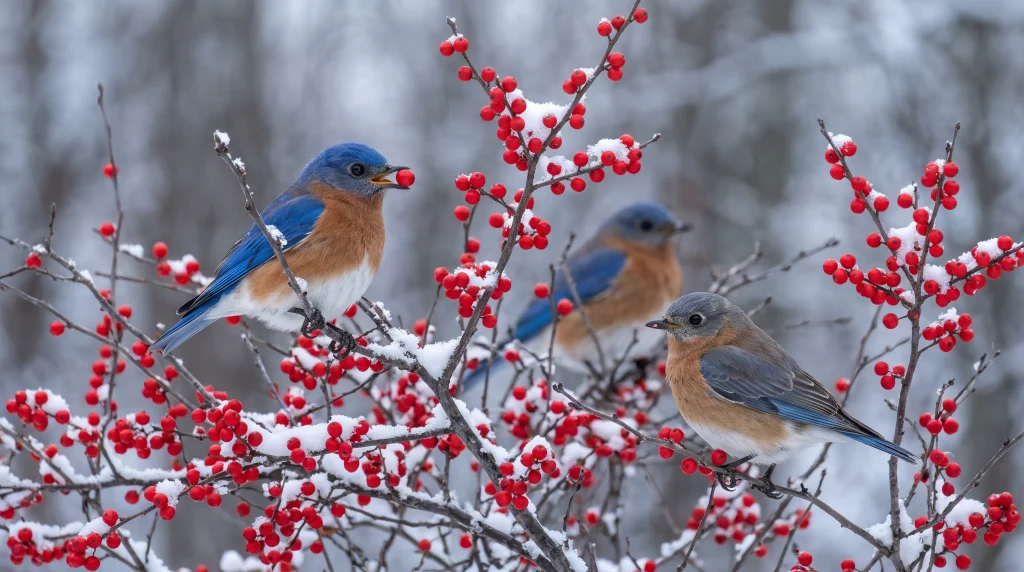
Eastern Bluebirds are not strictly insect-eating birds.
Their feeding habits shift as the seasons change.
Spring and summer: Insects take center stage
During warmer months, insects and other invertebrates make up an important part of the diet.
These foods provide nutrients needed during breeding and while raising growing nestlings.
Bluebirds hunt in grasslands, gardens, and other open areas where insects are accessible.
Fall and winter: Fruit becomes more important
As colder weather reduces insect activity, Eastern Bluebirds often rely more heavily on fruit.
Depending on their location, they may eat:
- Dogwood berries
- Sumac fruits
- Holly berries
- Juniper berries
- Other available native fruits
The balance between insects and fruit varies by region, weather, and local food availability.
Even in winter, bluebirds may capture insects during mild periods.
The importance of native fruiting plants
Native shrubs and trees can provide valuable food when insects become scarce.
For gardeners, this makes fruit-producing vegetation an important component of bird-friendly landscaping.
Plants that support insects during the growing season and produce fruit later in the year can offer benefits across multiple seasons.
They Cannot Excavate Their Own Nest Cavities
Unlike woodpeckers, Eastern Bluebirds are not equipped to carve nesting holes into solid wood.
Instead, they depend on cavities that already exist.
Secondary cavity nesters
Eastern Bluebirds are classified as secondary cavity nesters.
They may use natural tree cavities, abandoned woodpecker holes, and properly designed nest boxes.
This dependence on existing cavities makes suitable nesting habitat especially important.
A landscape may contain abundant food but still lack appropriate places for bluebirds to raise their young.
Who builds the nest
The female performs most of the actual nest construction.
She typically arranges grasses, pine needles, and other suitable plant materials into a relatively neat cup inside the cavity.
The male may inspect and display around potential nest sites, but the female is primarily responsible for building the nest.
The value of responsible nest boxes
Well-designed nest boxes can provide additional nesting opportunities in appropriate habitat.
However, dimensions, entrance size, placement, and monitoring practices matter.
Poorly positioned boxes may expose birds to unnecessary risks or attract competing species.
Regional recommendations from established bluebird conservation organizations are the best starting point for selecting and installing a nest box.
Their Courtship Includes a Nest-Site Display
Eastern Bluebird courtship involves more than colorful feathers.
Males also perform behaviors associated with potential nesting cavities.
Showing off a possible home
A male may perch near a suitable cavity, flutter his wings, and repeatedly enter and leave the opening.
He may also carry nesting material toward the site.
These behaviors are part of the courtship process and can help draw a female’s attention to a potential nesting location.
Although the male may carry grasses or other material during the display, the female generally undertakes the nest’s construction.
A display with practical consequences
Courtship behavior is closely connected to the availability of suitable nesting places.
A male occupying an area with accessible food and nesting opportunities may have an advantage in attracting a mate.
For observers, these displays can be particularly interesting during the early breeding season.
Repeated activity around a cavity does not always mean eggs are already present. It may simply indicate that the birds are inspecting or selecting a nesting site.
Eastern Bluebirds May Raise More Than One Brood
For some Eastern Bluebirds, the breeding season involves more than a single nesting attempt.
Multiple nesting cycles
Depending on climate, location, and seasonal conditions, a pair may raise two or sometimes three broods during one breeding season.
Breeding generally begins earlier in warmer southern regions than in northern parts of the range.
The number of successful broods depends on factors such as food availability, weather, and nesting success.
Raising the young
Female bluebirds incubate the eggs, while both parents contribute to feeding nestlings after hatching.
Adults repeatedly bring insects and other suitable invertebrates to the nest.
Once young birds leave the cavity, they remain dependent on parental care for a period as they develop their ability to find food.
In some circumstances, older offspring may remain nearby while their parents begin another nesting attempt.
Why monitoring matters
Nest boxes should be monitored according to established conservation guidance.
Appropriate monitoring can help identify problems while minimizing disturbance.
Avoid opening boxes unnecessarily during sensitive periods or making untested changes to their design.
Successful nesting depends on suitable habitat, adequate food, and protection from avoidable hazards.
Some Eastern Bluebirds Remain Through Winter
A bright bluebird against a snowy landscape may seem unexpected.
Yet Eastern Bluebirds are not universally migratory.
Migration varies across their range
Some populations move south as winter approaches, while others remain near their breeding territories.
Movement patterns differ across geographic regions and may also vary with local conditions.
Food availability, winter temperatures, and shelter all influence where birds can survive.
Winter feeding and shelter
During cold weather, bluebirds often gather around areas containing suitable fruiting plants.
They may also use protected cavities or other sheltered locations during harsh conditions.
Winter survival can be challenging when prolonged cold weather reduces access to food.
Family groups beyond summer
Some young bluebirds from later broods may remain associated with their parents into the colder months.
Small groups of bluebirds can sometimes be seen feeding together in winter.
These seasonal behaviors demonstrate that migration is not a simple all-or-nothing characteristic of the species.
The same bird that nests in a summer meadow may spend winter nearby or travel to a more favorable region.
Male and Female Bluebirds Wear Different Shades
Eastern Bluebirds show noticeable differences in plumage between adult males and females.
Identifying the male
Adult males typically have:
- Bright blue upperparts
- Blue wings and tail
- A rusty-orange breast and sides
- A pale lower belly
Their vivid coloration is especially noticeable in good sunlight.
Identifying the female
Adult females generally display:
- More muted blue-gray upperparts
- Blue wings and tail
- A subdued orange-brown breast
- A pale belly
Females can still appear beautifully blue, particularly when their wings and tail catch the light.
Young bluebirds look different
Juveniles have spotted or scalloped markings that distinguish them from adults.
These markings become less noticeable as the birds mature.
Lighting can complicate identification. A male in deep shade may appear surprisingly dull, while a female in bright sunlight may show stronger blue tones than expected.
Observing several features together is more reliable than judging color intensity alone.
A Wildlife-Friendly Yard Can Support Bluebirds
A yard does not need to be large or elaborate to contribute to local bird habitat.
However, Eastern Bluebirds have particular requirements.
Maintain suitable open spaces
Bluebirds often favor open areas with scattered trees, shrubs, and lookout perches.
A lawn edge, meadow, or lightly wooded garden may provide useful feeding habitat when insects are available.
Grow plants that support insects
Native flowering plants and grasses can help sustain insect populations.
These insects provide food for bluebirds and many other wildlife species.
Reducing unnecessary pesticide applications can also help preserve prey availability.
Include seasonal fruit sources
Native dogwoods, hollies, junipers, and other regionally appropriate fruiting plants may provide food during fall and winter.
Choose species suited to local conditions rather than assuming every fruiting shrub benefits bluebirds equally.
Install and maintain nest boxes responsibly
Where habitat is appropriate, a properly designed bluebird nest box may provide a useful nesting site.
Follow regional guidance for placement, predator protection, and monitoring.
Nest boxes require maintenance and should not be treated as completely hands-off garden decorations.
Protect existing habitat
Retaining safe natural nesting opportunities, maintaining diverse vegetation, and avoiding unnecessary disturbance can support a healthier backyard ecosystem.
Providing these resources does not guarantee that Eastern Bluebirds will occupy a property.
Still, a thoughtful combination of food, shelter, and suitable nesting habitat can improve the opportunities available to them.
Frequently Asked Questions About Eastern Bluebirds
1. Why do Eastern Bluebirds look blue without blue pigment?
Their blue appearance comes from microscopic structures inside their feathers that scatter light. This phenomenon is known as structural coloration.
2. What do Eastern Bluebirds eat in winter?
They often rely more heavily on fruit, including dogwood berries, sumac, holly, and juniper berries. They may also eat insects when conditions allow.
3. Do Eastern Bluebirds use birdhouses?
Yes. Eastern Bluebirds readily use appropriately designed nest boxes placed in suitable open habitat. Proper installation, predator protection, and monitoring are important.
4. Do Eastern Bluebirds migrate?
Some populations migrate seasonally, while others remain in their breeding regions throughout winter. Their movements vary geographically and with environmental conditions.
5. How can gardeners attract Eastern Bluebirds naturally?
Gardeners can maintain open feeding areas, grow native plants that support insects, include native fruiting shrubs, reduce unnecessary pesticide use, and provide properly maintained nest boxes.
Conclusion
The next time an Eastern Bluebird lands on a fence post in the morning sunlight, its brilliant feathers may reveal only a small part of its remarkable biology.
Behind that flash of blue lies a sophisticated interaction between feather structure and light. Its patient hunting strategy, dependence on existing nest cavities, seasonal feeding habits, and flexible winter movements reveal a bird carefully adapted to changing environments.
These Eastern Bluebird facts also demonstrate why healthy habitats matter. Open spaces, abundant insects, native fruiting plants, and safe nesting opportunities all contribute to the species’ survival.
Sometimes the most extraordinary wildlife stories belong to the birds we see almost every day.
External Sources
1. Cornell Lab of Ornithology — Eastern Bluebird Identification
Identification, physical measurements, plumage differences, and feeding behavior.
2. National Audubon Society — Eastern Bluebird Field Guide
Migration, courtship, breeding behavior, and conservation information.
3. American Bird Conservancy — Eastern Bluebird
Hunting strategies, nest-site displays, and cavity-nesting behavior.
4. North American Bluebird Society — Fact Sheets and Nest Box Plans
Practical guidance for nest-box construction, placement, monitoring, and predator protection.