
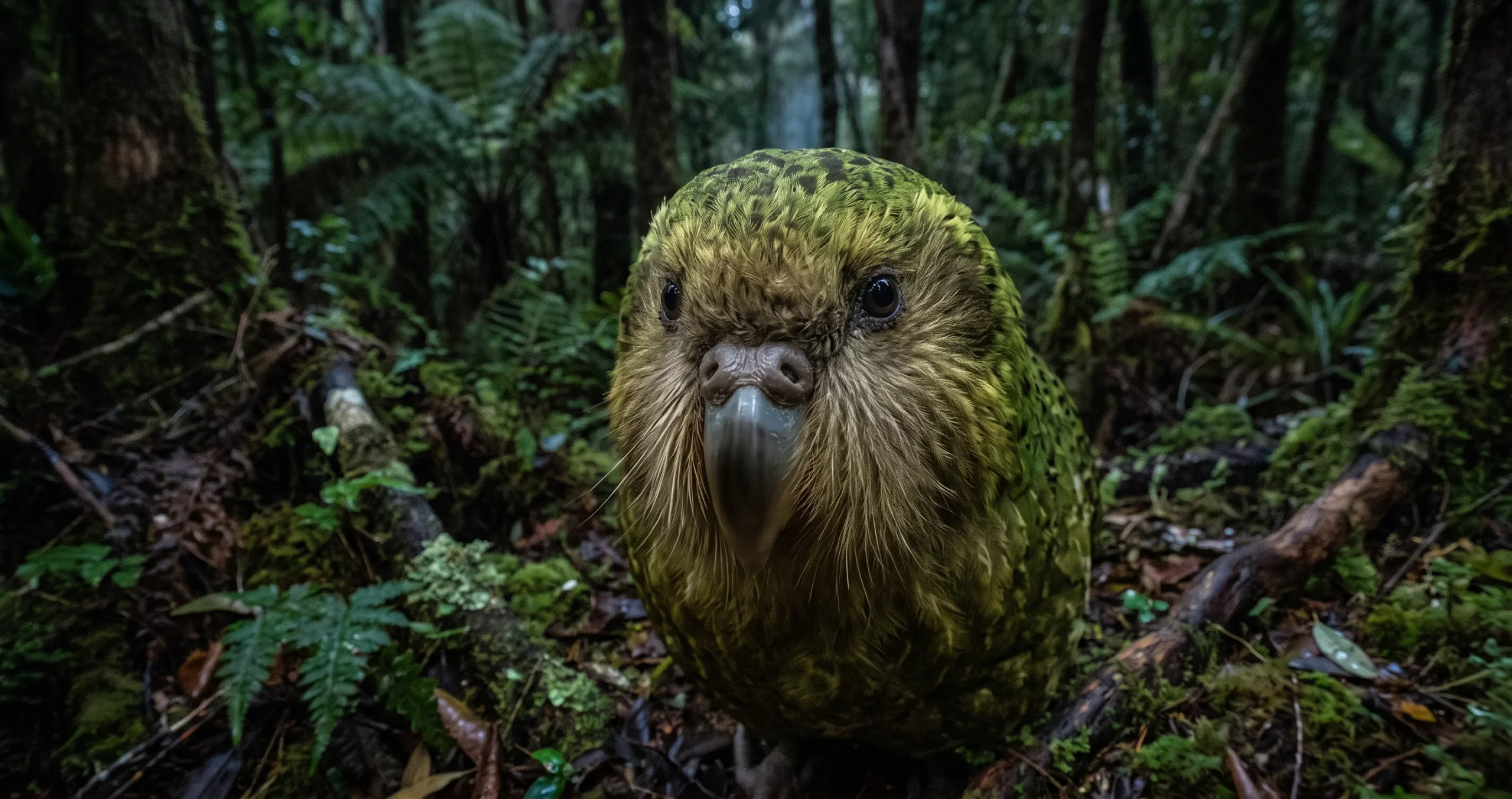
New Zealand’s extraordinary kākāpō has reached a conservation milestone that would have seemed almost impossible three decades ago. The kakapo record breeding season of 2026 produced 90 chicks that survived to the point of being officially added to the population, helping lift the total number of living kākāpō to 325.
That number is especially remarkable considering where the species stood in 1995. At the time, conservationists knew of only 51 surviving birds, including just 20 females. Today, the population is more than six times larger, although the species remains highly threatened and dependent on careful conservation management.
The comeback belongs to one of the strangest parrots on Earth: a nocturnal, flightless, unusually heavy bird that climbs trees, walks through forests at night, and breeds only when environmental conditions line up.
Table of Contents
- Meet the kākāpō
- Why kākāpō cannot fly
- Life after dark
- How the kākāpō nearly disappeared
- The population crash to 51 birds
- How the Kākāpō Recovery Programme works
- The 2026 kakapo record breeding season
- Why 90 chicks matter so much
- The unusual breeding system of kākāpō
- Common myths about kākāpō
- What happens next
- FAQ
- Conclusion
Meet the World’s Heaviest Parrot
The kākāpō (Strigops habroptilus) is found naturally only in New Zealand. It looks vaguely like a giant green parrot crossed with an owl, thanks to its moss-colored plumage, rounded body, large feet, and facial feathers that form an owl-like disc.
It also holds a remarkable distinction: the kākāpō is the world’s heaviest living parrot species. New Zealand’s Department of Conservation notes that males can weigh up to about 4 kilograms, or nearly 9 pounds.
That does not necessarily make it the longest parrot. Species such as the hyacinth macaw are considerably longer from head to tail. Kākāpō simply carry much more body mass.
Their unusual physique makes sense when viewed through the evolutionary history of New Zealand.
Before humans arrived, New Zealand had no native terrestrial mammalian predators comparable to cats, stoats, or foxes. Kākāpō evolved in an ecosystem where being able to launch rapidly into the air was not essential for survival.
Over evolutionary time, they became heavy, powerful ground-dwellers.
A Parrot That Cannot Fly
Kākāpō have wings, but they cannot use them for powered flight. Instead, the wings help with balance, particularly while climbing or descending through vegetation.
The birds are surprisingly capable climbers. Using their powerful feet and claws, kākāpō can climb high into trees, including large rimu trees. DOC reports that they can reach heights of around 20 meters.
On the ground, they can travel several kilometers in a night.
This combination of climbing ability, strong legs, and flightlessness worked remarkably well in prehistoric New Zealand. Unfortunately, the same evolutionary strategy became dangerous when new predators arrived.
A Parrot Built for the Night
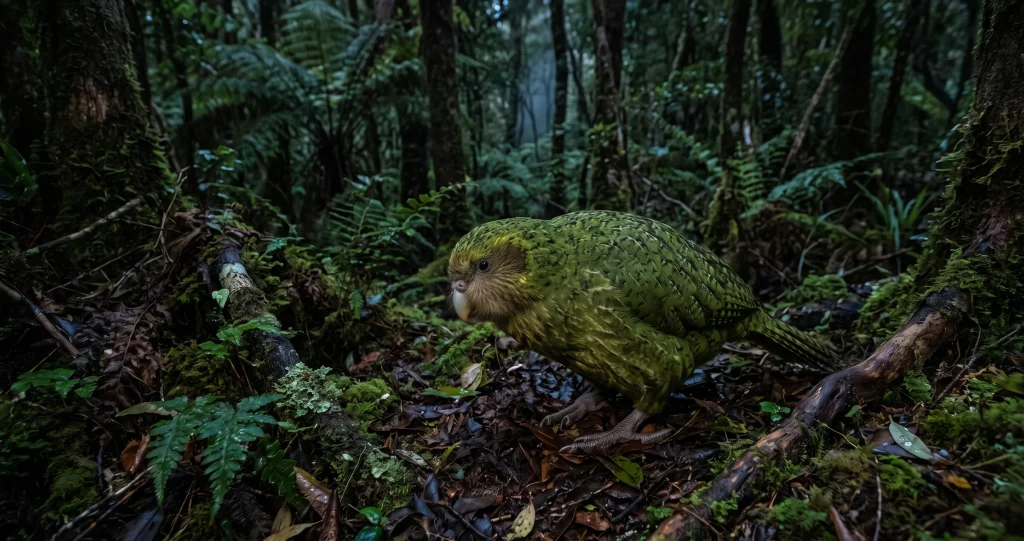
Kākāpō are primarily nocturnal. During daylight hours they generally rest in sheltered locations on the ground or in trees, becoming active after dark to forage.
Their green-and-yellow mottled feathers provide excellent camouflage among moss, ferns, and forest vegetation.
When threatened, a kākāpō may freeze rather than immediately flee. Against visually hunting predators, remaining motionless and blending into vegetation could be an effective strategy.
But mammalian predators changed the rules.
Cats and stoats can hunt using scent and are capable of locating an animal even when it remains perfectly still. The kākāpō’s old defenses suddenly became serious disadvantages.
How the Kākāpō Nearly Disappeared
Kākāpō were once widespread across New Zealand.
Their decline began after human settlement. Early Polynesian settlers hunted the birds, while introduced kiore, or Pacific rats, created an additional source of predation.
The situation became far worse following European settlement.
Large areas of native forest were cleared, reducing habitat and food resources. Meanwhile, cats, stoats, and additional rat species were introduced. Possums and deer also altered forest ecosystems and competed for vegetation.
Flightlessness made kākāpō particularly vulnerable.
Adults could be killed by cats and stoats, while eggs and chicks were vulnerable to rats and other predators. Because kākāpō reproduce slowly, losses could not simply be replaced by rapid breeding.
By the middle of the 20th century, the situation looked bleak.
Wildlife teams carried out dozens of expeditions through remote Fiordland searching for survivors. Between 1949 and 1973, only six birds were captured during more than 60 expeditions, and every one was male.
Then came an extraordinary discovery.
The Population That Changed Everything
In 1977, researchers discovered a significant population of kākāpō on Rakiura/Stewart Island.
Most importantly, females were eventually confirmed there.
For a species whose known surviving individuals had appeared to be entirely male, finding breeding females fundamentally changed its prospects.
But the newly discovered population was not safe.
Feral cats were killing kākāpō on Rakiura. Conservationists began moving birds to offshore islands where introduced predators had been removed or could be tightly controlled.
Even then, recovery was painfully slow.
Rats continued to prey on chicks in some locations, and successful breeding remained uncommon.
By 1995, the known population had fallen to just 51 birds — 31 males and 20 females.
That became the starting point for the modern recovery effort.
Readers interested in other remarkable animal survival adaptations can also explore more wildlife stories on Secrets of the Green Garden.
How the Kākāpō Recovery Programme Changed the Story
The New Zealand Department of Conservation established the modern Kākāpō Recovery Programme in 1995, working in partnership with Ngāi Tahu.
The strategy goes far beyond simply protecting a patch of forest.
Kākāpō are among the most intensively monitored wild birds in the world. Individual birds carry small radio transmitters that allow conservationists to follow their movements and activity. Remote data systems help teams detect behavior associated with mating and nesting.
Supplementary feeding can help birds reach suitable condition for reproduction. Nest monitoring allows vulnerable eggs or chicks to receive assistance when necessary, while genetic information can help conservationists manage a population descended from very few founders.
Researchers have even sequenced kākāpō genomes to improve decisions involving genetic diversity, fertility, disease, translocations, and breeding.
Most importantly, breeding populations are maintained in carefully protected environments.
As of 2026, the three breeding populations are on Whenua Hou/Codfish Island, Pukenui/Anchor Island, and Te Kāhaku/Chalky Island. Keeping these places protected from introduced predators requires constant surveillance and strict biosecurity.
The official New Zealand Department of Conservation Kākāpō Recovery program provides ongoing information about this long-term conservation effort.
The 2026 Kakapo Record Breeding Season
Kākāpō do not reliably breed every year.
One important trigger is the mass fruiting, or “mast,” of rimu trees. These unusually productive fruiting events generally occur only every few years, helping explain why breeding opportunities are relatively infrequent.
The previous breeding season occurred in 2022.
After a four-year gap, mating activity for the 2026 season was detected beginning in late December 2025. At the start of the season, there were 236 kākāpō, including 83 females of breeding age.
What followed exceeded every previous recovery-era breeding season.
On September 1, 2026, DOC announced that 90 chicks from the season had officially joined the population after the youngest surviving chick reached 150 days old, the age used by the program for adding independent juveniles to the official count.
The result brought the total population to 325 kākāpō, the highest level of the modern recovery era. DOC noted that the population may not have exceeded 300 birds for roughly 75 years.
For comparison, the previous standout season was 2019, when 73 chicks fledged.
The scale of the 2026 kakapo record breeding season becomes even clearer when viewed against the early years of the program: conservationists reported that producing 90 chicks once took approximately 16 years of recovery work. In 2026, that many were produced in a single breeding season.
Why 90 Chicks Matter So Much
For a common bird species, 90 additional young might barely register at the population level.
For kākāpō, it is transformative.
The population began the modern recovery program with only 51 known individuals. Adding 90 juveniles in one breeding cycle therefore represents an enormous demographic boost relative to the species’ recent history.
But conservation success cannot be measured solely by counting birds.
A population descended from very few individuals can suffer from low genetic diversity. Kākāpō recovery managers continue to deal with challenges including infertility and poor hatching success.
Habitat is another limiting factor.
As numbers increase, conservationists need additional areas large enough to support the birds while remaining protected from predators. DOC describes finding suitable new habitat as one of the most pressing challenges for the growing population.
The long-term goal is far more ambitious than maintaining several hundred individually managed birds.
It is to create healthy, self-sustaining populations capable of living more naturally across parts of their former range.
Their Breeding Strategy Makes Recovery Especially Difficult
Kākāpō reproduction is unusual even by parrot standards.
They are the world’s only known lek-breeding parrot.
During breeding periods, males establish networks of tracks and shallow depressions known as bowls. From these sites, they produce deep booming calls that can travel through the forest and attract females.
After mating, the male takes no part in raising the offspring.
Females incubate the eggs and care for the chicks alone.
Combine that system with breeding opportunities occurring only every few years, slow maturity, fertility problems, and vulnerability to predators, and it becomes clear why rebuilding the population takes decades rather than a few seasons.
That is what makes the kakapo record breeding season so important. Conservationists cannot manufacture unlimited breeding opportunities. Each productive rimu mast represents a valuable window in which the population can grow.
Common Myths About Kākāpō
Myth: Kākāpō are simply oversized ordinary parrots
Their evolutionary history is radically different from most parrots. They are flightless, primarily nocturnal, exceptionally heavy, ground-oriented, and use a lek breeding system.
Myth: Flightless means helpless
Kākāpō cannot fly, but they are strong walkers and skilled climbers. They can travel considerable distances at night and climb high into trees.
Their problem is not an inability to move. It is that their evolutionary defenses developed in an environment without terrestrial mammalian predators.
Myth: The species is now safe because there are more than 300
Reaching 325 birds is an extraordinary recovery milestone, but it does not mean the conservation job is finished.
The population remains vulnerable to disease, low genetic diversity, reproductive difficulties, predator incursions, and limited suitable habitat.
Myth: Conservationists raise all kākāpō in captivity
The birds are wild and live in protected habitats. Management can be extremely intensive, particularly during breeding, but the goal is increasingly to determine where human intervention can safely be reduced.
During the 2026 season, the program experimented with measures including fewer direct egg and chick checks and reduced supplementary feeding in some situations, relying more heavily on remote monitoring.
What Happens After a Record Season?
The next challenge is turning one exceptional season into long-term population security.
More birds require more habitat. They also create new opportunities for conservationists to establish populations in additional locations while managing genetic diversity more effectively.
There are already experiments beyond the traditional island refuges.
In 2023, male kākāpō were returned to mainland New Zealand at Sanctuary Mountain Maungatautari for the first time in nearly four decades. The trial was designed to help determine whether larger protected mainland landscapes could eventually support more birds.
DOC’s long-term objective is ultimately to return kākāpō to more of their natural range in populations that require much less human management.
The 2026 kakapo record breeding season does not complete that mission.
It does, however, provide something conservation programs desperately need: more animals, more genetic possibilities, and more room to plan for a future beyond emergency rescue.
FAQ
How many kākāpō are alive in 2026?
As of September 1, 2026, the official population was 325 birds. Ninety chicks from the 2026 breeding season were added to the official population once the youngest surviving chick reached 150 days old.
How many kākāpō were left in 1995?
There were only 51 known kākāpō in 1995, consisting of 31 males and 20 females. That crisis helped trigger the intensive recovery program that continues today.
Is the kākāpō really the world’s heaviest parrot?
Yes. New Zealand’s Department of Conservation identifies the kākāpō as the heaviest living parrot species, with males capable of reaching approximately 4 kilograms.
Can kākāpō fly?
No. Kākāpō are flightless, although they retain wings that help with balance and controlled descents. They are also excellent climbers and can travel several kilometers on foot.
Why don’t kākāpō breed every year?
Their reproduction is strongly linked to mast fruiting of native rimu trees. These major fruiting events generally occur every two to four years, creating irregular breeding seasons.
What caused the kākāpō to nearly become extinct?
Several pressures contributed, including hunting, habitat loss, and introduced predators. Cats, rats, and stoats were particularly damaging because kākāpō evolved without comparable ground-dwelling mammalian predators.
Are kākāpō still critically endangered?
The species remains extremely conservation-dependent despite its population growth. New Zealand DOC lists it as Threatened–Nationally Critical and continues intensive recovery work involving protected habitats, monitoring, breeding management, genetic research, and predator control.
Conclusion
The story of the kākāpō shows how close a species can come to disappearing — and how difficult recovery becomes once a population falls to only a few dozen individuals.
In 1995, only 51 kākāpō were known to survive. Thirty-one years later, the population has reached 325 following the kakapo record breeding season of 2026, when 90 young birds were successfully added to the official population.
That progress did not happen because the original threats disappeared on their own. It came through predator-free refuges, decades of monitoring, reproductive management, research, technology, genetic work, and cooperation between DOC, Ngāi Tahu, conservation partners, scientists, and field teams.
The world’s heaviest parrot remains vulnerable. But a species that once stood at 51 known birds now has hundreds of individuals and a growing range of conservation possibilities.
For a nocturnal parrot that surrendered flight millions of years before humans arrived in New Zealand, 90 new chicks in a single season represents far more than a record. It represents another substantial step away from extinction.
External Sources:
- New Zealand Department of Conservation — Kākāpō population reaches new milestone, September 1, 2026
https://www.doc.govt.nz/news/media-releases/2026-media-releases/kakapo-population-reaches-new-milestone/ - New Zealand Department of Conservation — History of Kākāpō Recovery
https://www.doc.govt.nz/our-work/kakapo-recovery/what-we-do/history/ - New Zealand Department of Conservation — Current Kākāpō Conservation
https://www.doc.govt.nz/our-work/kakapo-recovery/what-we-do/current-conservation/