
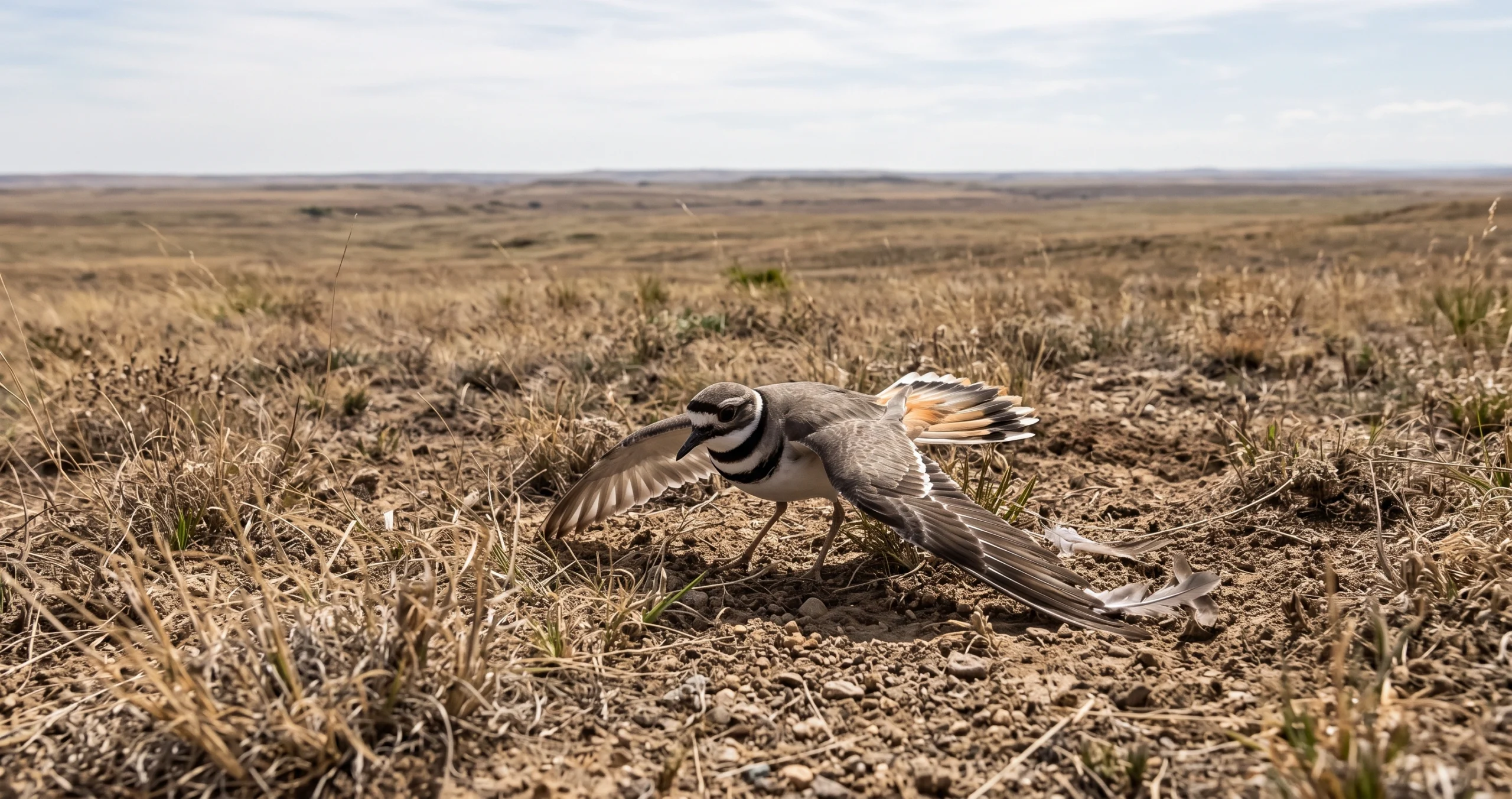
A killdeer suddenly appears in front of you, dragging one wing across the ground as though it has suffered a serious injury. It stumbles forward, gives distressed calls, and seems barely capable of escaping. But the dramatic killdeer broken wing display is often not an injury at all. It is a sophisticated distraction behavior designed to draw attention away from something far more vulnerable: the bird’s eggs or chicks.
For a ground-nesting bird with an exposed nest, confronting a fox, raccoon, dog, or other predator directly would be dangerous. Instead, the killdeer turns itself into a more tempting target and attempts to lead the threat away.
The performance can be remarkably convincing. Once the intruder has followed far enough, the supposedly injured bird suddenly recovers, folds its wing normally, and flies away.
Table of Contents
- What Is the Killdeer Broken Wing Display?
- How the Predator Decoy Trick Works
- Why This Behavior Evolved
- Why Killdeer Nests Are So Vulnerable
- How Killdeer Decide When to Perform
- Other Birds That Fake Injuries
- How to Recognize a Killdeer Nest
- What to Do If You Find a Nest
- Common Myths
- FAQ
- Conclusion
What Is the Killdeer Broken Wing Display?
The killdeer (Charadrius vociferus) is a North American shorebird in the plover family. Despite being classified as a shorebird, it frequently lives surprisingly far from water.
Killdeer are common around fields, gravel lots, pastures, golf courses, roadsides, construction areas, rooftops, and other open spaces.
These habitats provide the bare or sparsely vegetated ground the birds prefer for nesting.
That preference also creates a problem.
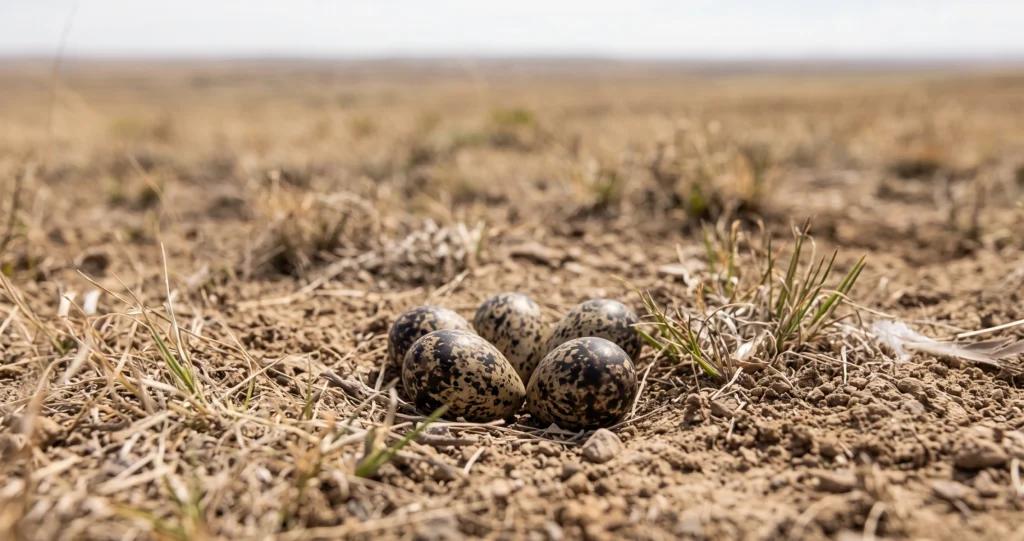
Unlike songbirds that hide nests inside bushes or trees, killdeer place their eggs directly on the ground in a shallow scrape. If a predator gets close enough to notice the nest, there is little physical protection available.
The killdeer broken wing display provides another kind of defense.
Instead of defending the eggs through force, the adult attempts to manipulate the predator’s attention.
How the Killdeer Broken Wing Display Works
The behavior usually begins when an animal or person approaches the nesting area.
Rather than remaining beside the eggs, an adult killdeer moves away from them. The bird then lowers itself, spreads or droops a wing, and begins moving as though the wing has been damaged.
Its movements may become awkward and exaggerated.
The bird can flutter, stumble, drag the apparently injured wing, and make conspicuous calls. To a predator, the performance suggests an adult bird that should be unusually easy to capture.
That impression is deliberate.
If the predator changes direction and begins following the adult, the killdeer continues moving farther from the nest.
The distance between predator and eggs gradually increases.
When the adult determines that the threat has been drawn sufficiently far away, the illusion ends. The killdeer suddenly flies away, leaving the predator without either the apparently injured adult or the hidden eggs it was protecting.
The bird may eventually circle back toward the nesting territory once the danger has passed.
Why the Broken-Wing Trick Evolved
Natural selection strongly favors behaviors that increase reproductive success.
For killdeer, the central challenge is obvious. Ground nesting makes eggs and newly hatched chicks accessible to many predators.
A bird that simply remained on its nest until a predator arrived would risk losing both itself and its offspring.
Flying away immediately would protect the adult but could leave the eggs exposed.
The killdeer broken wing display offers another strategy.
By presenting itself as an apparently vulnerable target, the adult may redirect a predator that has approached too closely.
This behavior is generally known as a distraction display or injury-feigning display.
It works because predators often respond strongly to prey that appears weakened or injured. An adult bird dragging a wing may seem easier and more rewarding to pursue than searching the surrounding ground for well-camouflaged eggs.
The behavior therefore exploits the predator’s own hunting instincts.
Importantly, this does not require the killdeer to understand what a predator is “thinking” in a human sense. Individuals whose behaviors successfully diverted predators would have been more likely to raise offspring that inherited the biological foundations for similar defensive responses.
Across generations, natural selection could refine the behavior.
Why Killdeer Nests Are So Vulnerable
To understand the killdeer broken wing display, it helps to see how minimal a killdeer nest actually is.
The nest often begins as little more than a shallow depression scraped into gravel, dirt, stones, or another open surface.
The adults may later add small stones, pieces of shell, plant material, or other nearby objects.
Killdeer typically lay four heavily patterned eggs. Their mottled coloration helps them disappear against gravel and bare soil.
This camouflage can be remarkably effective.
A person may walk close to a nest without noticing it, which is one reason killdeer nests are sometimes accidentally damaged by vehicles, lawn equipment, pets, or foot traffic.
According to the Cornell Lab of Ornithology’s All About Birds, killdeer regularly occupy human-modified environments including parking lots, gravel roads, rooftops, and lawns.
These habitats can resemble naturally open nesting areas from the bird’s perspective.
Unfortunately, they can also place eggs directly in the path of human activity.
How Killdeer Decide When to Perform
A killdeer does not necessarily begin its most dramatic distraction display every time something appears nearby.
Its response can vary according to the situation.
When a potential threat is still far away, an adult may simply leave the nest quietly. Drawing attention to itself too early could reveal that something valuable is nearby.
As the threat becomes more immediate, defensive behavior may intensify.
Calls, movements, alarm behavior, and distraction displays can become increasingly conspicuous.
The killdeer broken wing display is therefore part of a broader defensive repertoire rather than a single automatic performance used identically in every situation.
The identity and behavior of the intruder may matter as well.
A slow-moving mammalian predator presents a different challenge from a flying predator. Humans, domestic dogs, vehicles, and natural predators also approach nests in very different ways.
Killdeer can adjust their behavior accordingly.
Camouflage and Deception Work Together
The broken-wing performance is only one layer of killdeer nest defense.
The first layer is camouflage.
Eggs are patterned to resemble their surroundings, and newly hatched killdeer chicks are also cryptically colored. Their spotted brown, tan, black, and pale plumage blends remarkably well with gravel and dry vegetation.
The second layer is behavior.
Adults can leave the immediate nest area, give alarm calls, or perform distraction displays to move attention elsewhere.
This creates an effective combination.
Camouflage makes the nest difficult to discover in the first place. The killdeer broken wing display becomes particularly useful when that passive protection is no longer enough.
It is a strategy seen repeatedly in nature: avoid detection when possible, then redirect danger when necessary.
For another remarkable example of birds using specialized behavior to protect reproductive success, see our article on how male bowerbirds build and decorate elaborate bowers to attract a mate. Although bowerbirds and killdeer face very different challenges, both demonstrate how complex behaviors can evolve when reproductive success is at stake.
Other Ground-Nesting Birds That Fake Injuries
Killdeer are famous for injury-feigning, but they did not invent the strategy.
Similar distraction displays occur in numerous ground-nesting birds, particularly shorebirds.
Other Plovers
Several other members of the plover family use distraction behavior around nests or chicks.
Because many plovers nest in exposed coastal, grassland, gravel, or tundra habitats, they face challenges similar to those encountered by killdeer.
Piping plovers, for example, use distraction and defensive behaviors when threats approach nesting areas.
Sandpipers
Various sandpipers and related shorebirds also use injury-feigning or conspicuous distraction displays.
Some appear to flutter helplessly or move erratically while gradually drawing the predator away.
Again, the fundamental principle is the same: make the adult more noticeable while making the nest less relevant.
Lapwings
Lapwings are another group of ground-nesting shorebirds with elaborate nest-defense behaviors.
Depending on species and circumstances, they may use vocal alarms, aggressive flights, mobbing, or distraction tactics.
Ducks and Other Ground-Nesting Birds
Some ducks and other birds nesting close to the ground may also use distraction displays.
The exact performance differs among species.
Not every bird performs the classic dragging-wing routine associated with killdeer, but many use the broader strategy of conspicuous adult behavior to divert attention from eggs or young.
This repeated evolution makes biological sense.
Ground-nesting birds around the world face the same fundamental problem: they cannot physically hide a nest high in a tree.
Behavior becomes part of the nest’s defense system.
How to Recognize a Killdeer Nest
Finding a killdeer nest is often surprisingly difficult.
Look for a shallow depression in an open area covered with gravel, stones, dry soil, or sparse vegetation.
There may be almost no recognizable nest structure.
The eggs provide another clue. A typical clutch contains four pointed, mottled eggs covered with dark brown or black markings.
Their camouflage is excellent, so avoid deliberately searching closely through a nesting area once adult defensive behavior begins.
The adults themselves may provide the strongest warning.
Repeated alarm calls, nervous movements, or a killdeer broken wing display can indicate that you have approached eggs or chicks.
If a bird suddenly begins acting injured while you are crossing an open gravel or grassy area, assume there may be a nest nearby.
Do not follow the bird.
That is precisely what the display is designed to make a predator do.
What to Do If You Find a Killdeer Nest
The best response is usually simple: increase your distance.
Back away slowly in approximately the direction you came from. Once the adult no longer considers you an immediate threat, it can return to normal nesting behavior.
Do not touch the eggs or chicks.
Keep dogs leashed and prevent children or other visitors from approaching the nesting site.
If the nest is located somewhere vulnerable, such as a driveway, parking area, worksite, or frequently used path, the surrounding area may sometimes be temporarily marked so people can avoid it.
Any barrier should leave plenty of space around the nest and should not trap the birds or attract unnecessary attention to the eggs.
Do not attempt to relocate the nest yourself.
In the United States, killdeer are protected under the Migratory Bird Treaty Act, and active nests, eggs, and birds should not be disturbed or moved without appropriate authorization. The U.S. Fish and Wildlife Service provides information about federal protections for migratory birds.
If an active nest creates a genuine safety or operational problem, contact the appropriate wildlife agency or qualified wildlife professional for guidance.
The goal should always be reducing disturbance rather than getting closer for photographs.
Common Myths About the Killdeer Broken Wing Display
Myth 1: The Bird Is Actually Injured
Sometimes birds really are injured, so context matters.
However, a killdeer that suddenly begins dragging a wing when you approach a nesting area and then flies normally once you move away is probably performing a distraction display.
Myth 2: Killdeer Only Nest Near Water
Despite being shorebirds, killdeer frequently nest far from shorelines.
Fields, pastures, gravel rooftops, parking lots, roadsides, lawns, and industrial areas can all provide suitable open habitat.
Myth 3: The Bird Is Trying to Attack You
The killdeer broken wing display is generally about diversion rather than attack.
The adult wants the perceived threat moving away from its eggs or chicks.
Myth 4: Following the Bird Helps You Find the Nest
Usually the opposite is true.
The bird is deliberately attempting to move you away from the nest.
Following it increases the disturbance and forces the adult to continue defensive behavior.
Myth 5: Moving the Eggs Somewhere Safer Helps
A location that looks dangerous to a human may still be the nesting site selected and recognized by the adults.
Moving eggs can interfere with incubation and may violate wildlife-protection laws.
Leave the nest alone and seek professional advice if intervention is genuinely necessary.
FAQ
Why does a killdeer pretend to have a broken wing?
The killdeer broken wing display helps redirect potential predators away from eggs or chicks. By appearing injured, the adult presents itself as an apparently easy target and attempts to lure the threat farther from the nesting area.
Does the killdeer’s wing actually hurt during the display?
No injury is required.
The bird deliberately changes its posture and movements to create the appearance of a damaged wing.
Will a killdeer sacrifice itself for its chicks?
The goal is not normally to be caught.
The adult attempts to remain close enough to hold the predator’s attention while maintaining the ability to escape. Once the threat has moved sufficiently far from the nest, the bird can fly away.
What should I do if a killdeer starts acting injured near me?
Stop approaching and move away from the area.
The behavior often indicates that eggs or chicks are nearby.
Where do killdeer build nests?
Killdeer generally nest on open ground with sparse vegetation. Gravel, stones, bare soil, short grass, roadsides, parking areas, rooftops, and agricultural landscapes can all be used.
How many eggs do killdeer lay?
Four eggs are typical, although clutch size can vary.
Their heavily mottled shells provide camouflage against gravel and bare ground.
Do both parents protect the nest?
Both members of a killdeer pair participate in parental care and nest defense.
After hatching, the chicks are precocial, meaning they are relatively well developed and capable of walking soon after leaving the egg.
Should I photograph a killdeer doing the broken-wing display?
Photography should never require pursuing the bird.
If your presence is repeatedly triggering the killdeer broken wing display, you are already close enough to cause defensive behavior. Moving away is more important than obtaining the photograph.
Long lenses allow wildlife photographers to observe natural behavior without forcing birds to repeatedly respond to a perceived threat.
Conclusion
The killdeer broken wing display looks theatrical because that is exactly what makes it effective.
For a bird nesting in an exposed patch of gravel or bare ground, fighting every approaching predator would be dangerous. Abandoning the area immediately would leave eggs or chicks vulnerable.
Instead, the killdeer redirects attention.
By drooping a wing, stumbling across the ground, calling, and presenting itself as apparently injured prey, the adult can transform itself into a moving decoy. When the predator follows, the bird gradually leads danger away before revealing that its “broken” wing works perfectly well.
The strategy is not unique to killdeer. Plovers, sandpipers, and other ground-nesting birds have evolved variations of the same fundamental tactic because they face similar reproductive risks.
For people, recognizing the behavior has a practical benefit.
A killdeer pretending to be injured is often telling you something important about your surroundings. There may be a nearly invisible nest or tiny camouflaged chicks somewhere nearby.
The appropriate response is not to investigate.
Giving the bird space allows one of nature’s most remarkable predator-decoy strategies to end exactly as evolution intended: with the adult safe, the intruder gone, and the hidden offspring still undetected.
Internal Link Suggestions:
- How Male Bowerbirds Build and Decorate Elaborate Bowers to Attract a Mate
Use naturally in the section discussing how specialized bird behaviors evolve around reproductive success. - How Birds Navigate Using Earth’s Magnetic Field
Use in a contextual passage about extraordinary behavioral and sensory adaptations found in birds.
External Dofollow Authoritative Sources:
- Cornell Lab of Ornithology — All About Birds: Killdeer
https://www.allaboutbirds.org/guide/Killdeer/overview - U.S. Fish & Wildlife Service — Migratory Bird Program
https://www.fws.gov/program/migratory-birds - Audubon — Killdeer Species Guide
https://www.audubon.org/field-guide/bird/killdeer