
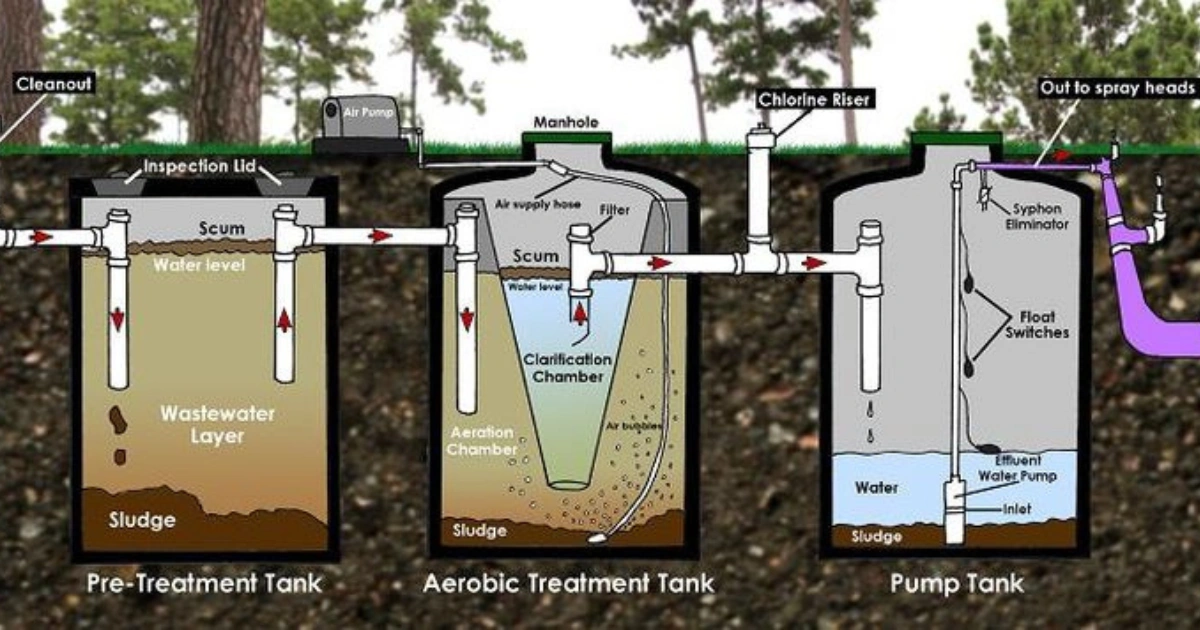
A 3-stage septic system is designed to treat household wastewater efficiently before it is released back into the soil. Each stage has a specific function that helps separate solids, break down organic matter, and clarify water, reducing environmental and health risks.
Understanding how this system works is essential for proper maintenance and long-term performance.
Stage 1: Settling Chamber
The first chamber is where all wastewater from the home enters.
In this tank, separation begins naturally:
- Heavy solids sink to the bottom and form sludge
- Lighter materials, such as grease and oils, float to the surface as scum
- The partially clarified liquid remains in the middle
This initial separation prevents large solids from moving further into the system, protecting downstream components from clogging or damage.
Stage 2: Bacterial Breakdown Chamber
The second stage focuses on biological treatment.
Naturally occurring anaerobic bacteria break down organic waste by:
- Digesting solid and dissolved organic material
- Reducing overall waste volume
- Lowering the concentration of harmful substances
This process significantly improves water quality before it reaches the final stage. A healthy bacterial environment is critical for system efficiency.
Stage 3: Final Clarification Chamber
In the third chamber, the wastewater undergoes further refinement.
During this stage:
- Remaining fine particles settle out
- Water becomes clearer and more stable
- Flow is regulated before soil absorption
By this point, most solids and organic matter have already been removed.
Soil Absorption and the Leach Field
After treatment in the tanks, the wastewater enters the leach field.
Here, the soil plays a vital role:
- Water slowly disperses through gravel and surrounding soil
- Soil microbes naturally filter remaining bacteria and nutrients
- Cleaned water safely returns to the groundwater system
Healthy soil is essential for completing the treatment process effectively.
Why a 3-Stage Septic System Is Effective
This type of system offers several advantages:
- Reduces environmental contamination
- Protects groundwater quality
- Uses natural biological processes
- Operates with minimal energy input
Because treatment is spread across multiple stages, the system is more reliable and less prone to failure when properly maintained.
Maintenance and Long-Term Performance
Regular maintenance is essential to keep a 3-stage septic system functioning correctly.
Best practices include:
- Periodic inspections
- Timely pumping of sludge and scum
- Avoiding excessive water use
- Preventing chemicals and grease from entering the system
Proper care extends the system’s lifespan and prevents costly repairs.
Final Notes
A 3-stage septic system is an efficient, low-energy solution for household wastewater treatment. By combining physical separation, biological breakdown, and natural soil filtration, it protects both your property and the surrounding environment.
Understanding how each stage works helps homeowners make informed decisions and maintain a safe, effective system for years to come.
Paragliding over Cotton Castle Travelshopbooking offered excellent value and service. The tour was well organized, and communication was clear. https://shor.by/FOcB
Guided Pamukkale tours Travelshopbooking offered excellent organization and service. https://linke.to/travelshopbooking
In regulated and intensely competitive verticals like finance and iGaming, SEO has evolved into a core customer acquisition channel. Since advertising is often restricted or expensive for these industries, organic visibility becomes a compliant, sustainable, and trust-oriented solution. This is particularly true for iGaming, where credibility and technical performance decide rankings, and for financial services, where YMYL standards demand high-quality, accurate content backed by authority.
In New Zealand, this ecosystem is amplified by digital maturity. With 95% internet penetration, Google controlling approximately 90% of the search market, and 94% of users browsing via smartphones, brands are essentially invisible without strong search presence. Add to this the rise of AI-generated summaries and zero-click SERPs, and it’s clear why businesses in sensitive niches are prioritising E-E-A-T, compliance, and deep topical authority instead of just surface-level SEO tactics.
These pressures have reshaped the local agency landscape. Businesses now expect measurable results, transparency, and technical insights—especially when evaluating SEO in sectors where compliance matters. Agencies that provide diagnostic tools, ROI calculators, and clear reporting frameworks are gaining trust, since they empower firms to make data-driven decisions rather than relying on vague deliverables or vanity metrics. For companies operating in YMYL categories, that level of clarity is essential.
For a detailed look at how these factors intersect—and how modern SEO agencies position themselves in New Zealand’s competitive environment—this in-depth overview breaks down both the market data and the strategic approach:
SEO in 2026 — New Zealand’s Digital Landscape & the Liquid Web Advantage
This perspective is especially relevant for brands in regulated markets that need compliant, credible, and technically sound SEO to grow while navigating restrictions that affect paid advertising and traditional marketing.
look at this site https://web-breadwallet.com
сколько стоит купить диплом медсестры сколько стоит купить диплом медсестры .
read more https://toast-wallet.net/
Choose a trusted platform for your gaming sessions by heading to mosbeth, offering strong reliability and excellent playing conditions.
Protagonists face both courtly schemes and mystical elements.
In regulated and intensely competitive verticals like finance and iGaming, SEO has evolved into a core customer acquisition channel. Since advertising is often restricted or expensive for these industries, organic visibility becomes a compliant, sustainable, and trust-oriented solution. This is particularly true for iGaming, where credibility and technical performance decide rankings, and for financial services, where YMYL standards demand high-quality, accurate content backed by authority.
In New Zealand, this ecosystem is amplified by digital maturity. With 95% internet penetration, Google controlling approximately 90% of the search market, and 94% of users browsing via smartphones, brands are essentially invisible without strong search presence. Add to this the rise of AI-generated summaries and zero-click SERPs, and it’s clear why businesses in sensitive niches are prioritising E-E-A-T, compliance, and deep topical authority instead of just surface-level SEO tactics.
These pressures have reshaped the local agency landscape. Businesses now expect measurable results, transparency, and technical insights—especially when evaluating SEO in sectors where compliance matters. Agencies that provide diagnostic tools, ROI calculators, and clear reporting frameworks are gaining trust, since they empower firms to make data-driven decisions rather than relying on vague deliverables or vanity metrics. For companies operating in YMYL categories, that level of clarity is essential.
For a detailed look at how these factors intersect—and how modern SEO agencies position themselves in New Zealand’s competitive environment—this in-depth overview breaks down both the market data and the strategic approach:
SEO in 2026 — New Zealand’s Digital Landscape & the Liquid Web Advantage
This perspective is especially relevant for brands in regulated markets that need compliant, credible, and technically sound SEO to grow while navigating restrictions that affect paid advertising and traditional marketing.
Мы предлагаем дипломы психологов, юристов, экономистов и любых других профессий по приятным ценам. Диплом об окончании института прежде считался главным документом, способствовавшим удачному устройству на работу. Купить диплом о высшем образовании!: investir-en-grece.fr/agent/fssmyron988443
Приобрести диплом института по невысокой цене вы сможете, обращаясь к надежной специализированной компании. Для того, чтобы проверить компанию до покупки воспользуйтесь реальными отзывами в онлайне. Так можно заказать диплом из любого университета России teslawiki.cz/index.php/User:JeanetteKeble0
Mindful play is an essential part of a healthy entertainment experience.
It enables users to keep awareness while enjoying interactive activities.
Establishing clear limits minimizes negative outcomes.
Responsible play also encourages smart behavior.
https://dosweeps.com/casinos
By controlling spending and time, players can avoid stress.
This approach builds a positive long-term experience.
Understanding of personal habits plays a major role.
In the end, responsible gaming keeps entertainment enjoyable for everyone.
As a local family-owned car rental company, we aim to make the process simple and stress-free for travelers. Here’s what most people want to know before renting:
• Which cars are available?
• How does pick-up and drop-off work?
• Is airport service available?
• What’s included in the price?
• Are there any hidden fees?
To help with this, we’ve put together clear info and transparent pricing on our website:
?? Auckland CBD Car Rental
If you’ve rented a car in Auckland before and have tips, suggestions, or questions, feel free to share! Hearing from other travelers helps everyone make better decisions and enjoy their stay.
Thanks for supporting local businesses — and safe travels in Aotearoa! ????
As a local family-owned car rental company, we aim to make the process simple and stress-free for travelers. Here’s what most people want to know before renting:
• Which cars are available?
• How does pick-up and drop-off work?
• Is airport service available?
• What’s included in the price?
• Are there any hidden fees?
To help with this, we’ve put together clear info and transparent pricing on our website:
?? book a car
If you’ve rented a car in Auckland before and have tips, suggestions, or questions, feel free to share! Hearing from other travelers helps everyone make better decisions and enjoy their stay.
Thanks for supporting local businesses — and safe travels in Aotearoa! ????
**mitolyn official**
Mitolyn is a carefully developed, plant-based formula created to help support metabolic efficiency and encourage healthy, lasting weight management.
As I website possessor I believe the content matter here is rattling great , appreciate it for your efforts. You should keep it up forever! Best of luck.
Discover the thrill of flying high with the exciting game aviator today!
Tournament variants and leaderboards create competitive incentives for skilled players.
Discover the thrill of real-money live casino action at https://maxispin-au.com/, where you can enjoy live dealers, top software providers, and exclusive promotions.
Improvements are focused by the team on elevating both performance and usability.