
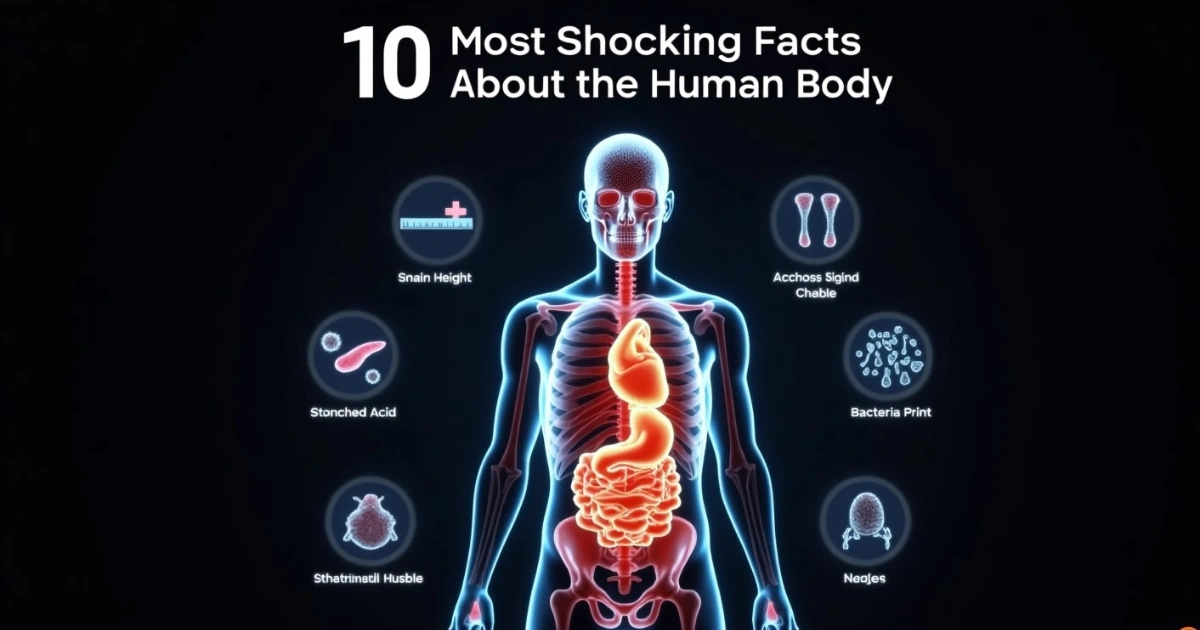
The human body is one of the most complex biological systems known. It functions through the precise coordination of bones, muscles, nerves, organs, and cells, all working together every second of life. While exact numbers can vary slightly depending on scientific definitions and ongoing research, there are well-established approximate figures that help us understand the scale and sophistication of the human body.
This article presents clear, educational facts about the human body, explaining what these numbers mean and why they matter, while remaining accurate, accessible, and suitable for general learning.
How Many Bones Are in the Human Body?
An adult human body contains approximately 206 bones. These bones form the skeletal system, which provides structure, protects vital organs, and allows movement when combined with muscles and joints.
At birth, humans have more bones, but many fuse together during growth. This is why adults have fewer bones than infants.
Bones are not static structures. They constantly remodel themselves, responding to stress, nutrition, and age, which makes them living tissue rather than inert material.
Ligaments and Their Role in Stability
The human body contains roughly 900 ligaments. Ligaments are strong bands of connective tissue that connect bones to other bones, stabilizing joints and guiding movement.
Without ligaments, joints would lack control and strength. They play a crucial role in balance, posture, and coordinated motion, especially during walking, lifting, and athletic activities.
Muscles: The Engines of Movement
There are about 650 muscles in the human body. These muscles are responsible for movement, posture, circulation, digestion, and even facial expression.
Muscles can be grouped into three main types:
- Skeletal muscles, which control voluntary movement
- Smooth muscles, which operate internal organs
- Cardiac muscle, which powers the heart
Together, these muscle systems allow the body to function both consciously and automatically.
Neurons and the Nervous System
The human brain contains approximately 86 billion neurons. Neurons are specialized cells that transmit electrical and chemical signals throughout the nervous system.
These signals control thoughts, emotions, movement, memory, and automatic functions such as breathing and heart rate. Neurons form complex networks, allowing the brain and spinal cord to process information at remarkable speed.
Nerves: Communication Pathways
The human nervous system includes about 43 pairs of nerves. This total is typically divided into:
- 12 pairs of cranial nerves
- 31 pairs of spinal nerves
These nerves act as communication highways between the brain, spinal cord, and the rest of the body, transmitting sensory information and motor commands.
How Many Cells Make Up the Human Body?
The human body is made up of approximately 37 trillion cells. These cells vary greatly in size, shape, and function, from red blood cells to neurons and muscle fibers.
Cells constantly divide, specialize, and die, maintaining balance and allowing growth, healing, and adaptation throughout life.
Organs and Their Functions
The human body contains around 78 to 80 organs, depending on classification. Organs are structures composed of different tissues working together to perform specific functions.
Examples include the heart, lungs, liver, kidneys, brain, and skin. Each organ plays a unique role, and the failure of one can affect the entire system.
Blood Vessels and Circulation Length
If all blood vessels in the human body were laid end to end, they would measure close to 100,000 kilometers in total length. This vast network includes arteries, veins, and capillaries.
Blood vessels transport oxygen, nutrients, hormones, and waste products, supporting every cell in the body. This circulation system operates continuously, without rest.
Why These Numbers Are Approximate
Scientific understanding evolves constantly. Many of these figures are estimates because:
- Individual bodies vary naturally
- Definitions may differ between studies
- New discoveries refine measurements
For this reason, these values are considered approximate and are used for educational purposes rather than absolute measurement.
Why Understanding These Facts Matters
Learning basic facts about the human body helps build appreciation for health, biology, and personal care. It also encourages respect for the complexity of life and the importance of maintaining physical well-being.
Understanding how systems work together highlights why balance, nutrition, movement, and rest are essential for long-term health.
Frequently Asked Questions
Are these numbers the same for everyone?
No. While the general figures apply to most adults, variations exist based on age, genetics, and health.
Do children have the same number of bones as adults?
No. Babies are born with more bones, many of which fuse during growth.
Is the number of organs fixed?
The number varies slightly depending on how organs are classified by researchers.
Are neurons replaced like other cells?
Most neurons do not regenerate, which is why protecting the brain and nervous system is critical.
Why are blood vessels so long?
Capillaries reach nearly every cell, allowing efficient nutrient and oxygen delivery throughout the body.
Internal Linking Suggestions
For related educational content on secretsofthegreengarden.com, consider linking to:
- How the human body adapts to environmental changes
- The role of circulation in overall health
- Understanding biological systems through simple facts
External Linking Suggestions
For authoritative, non-commercial references, consider linking to:
- National Institutes of Health educational resources
- University biology departments explaining human anatomy
- World Health Organization pages on human physiology
These sources provide reliable, science-based information suitable for educational use.
Final Thoughts
The human body is an extraordinary system made up of trillions of interconnected parts working in harmony. From bones and muscles to neurons and blood vessels, each component plays a vital role in sustaining life.
While the numbers may be approximate, they offer valuable insight into the scale, efficiency, and sophistication of the human body, reinforcing both curiosity and respect for human biology.
Sự chuyên nghiệp của 888slot poker đến từ dịch vụ hỗ trợ khách hàng 24/7 và tốc độ nạp rút siêu tốc. Đây là lựa chọn số 1 cho các bet thủ lâu năm. TONY04-03O