
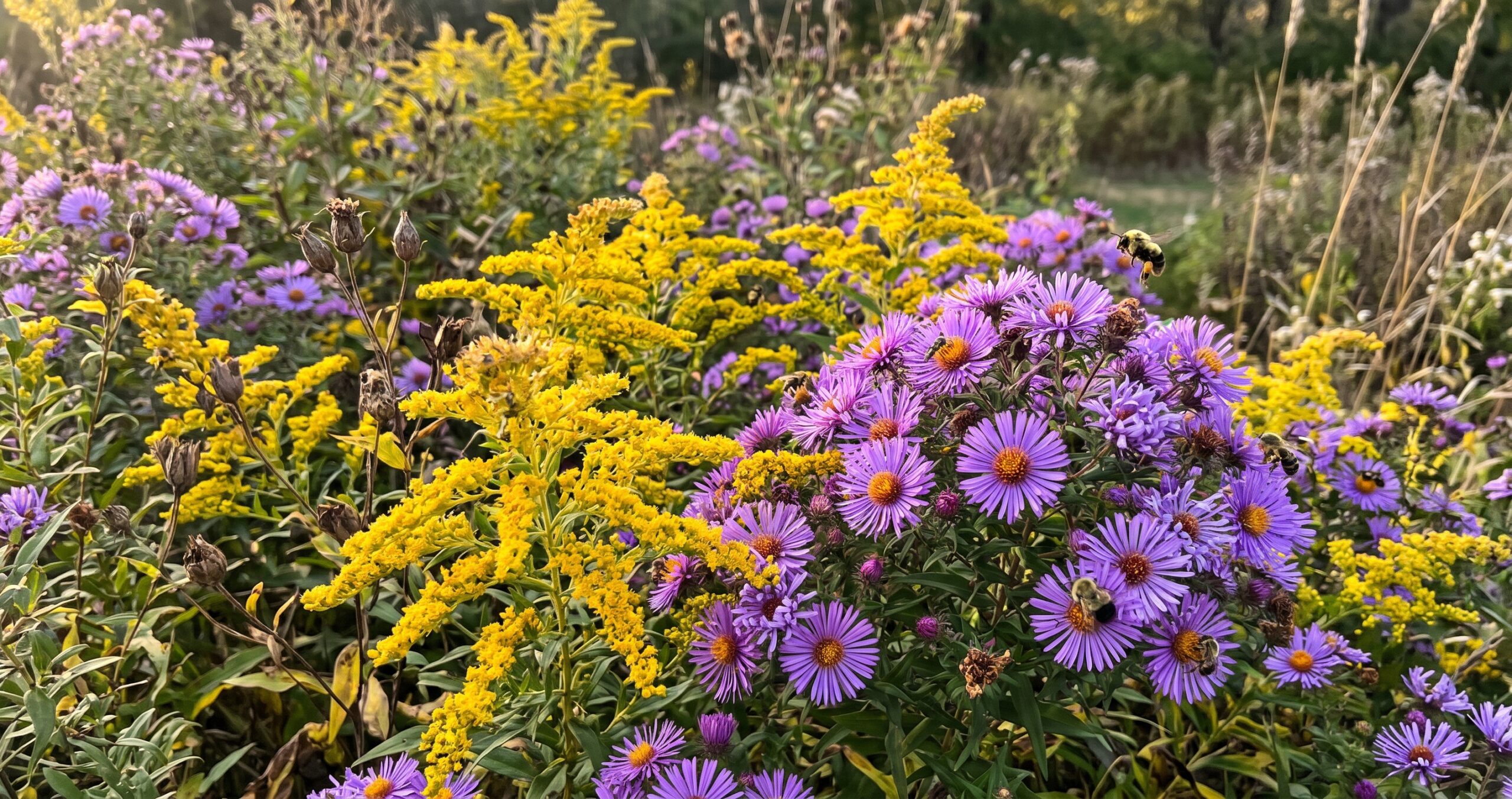
As summer flowers begin to fade, bees, butterflies, and other beneficial insects still need reliable sources of nectar and pollen. Planting native fall flowers for pollinators can help fill this seasonal gap while bringing beautiful color to American gardens. Among the most valuable choices are New England aster, goldenrod, aromatic aster, and blue-stemmed goldenrod.
These four native perennials offer different flower shapes, growing habits, and habitat preferences. Together, they can support late-season foraging insects in sunny meadows, perennial borders, and partially shaded woodland gardens. Choosing species suited to local conditions is essential, however, because a plant native to one part of the United States is not necessarily native everywhere.
Table of Contents
- Why Native Fall Flowers Matter for Pollinators
- Native Fall Flowers for Pollinators: Four Excellent Choices
- New England Aster (Symphyotrichum novae-angliae)
- Goldenrod (Solidago rugosa)
- Aromatic Aster (Symphyotrichum oblongifolium)
- Blue-Stemmed Goldenrod (Solidago caesia)
- Comparing the Four Fall-Blooming Plants
- How to Combine Them in a Pollinator Garden
- When and How to Plant Native Fall Flowers
- Supporting Pollinators Beyond the Flowers
- Regional Considerations Across the United States
- Common Mistakes to Avoid
- Frequently Asked Questions
- Conclusion
1. Why Native Fall Flowers Matter for Pollinators
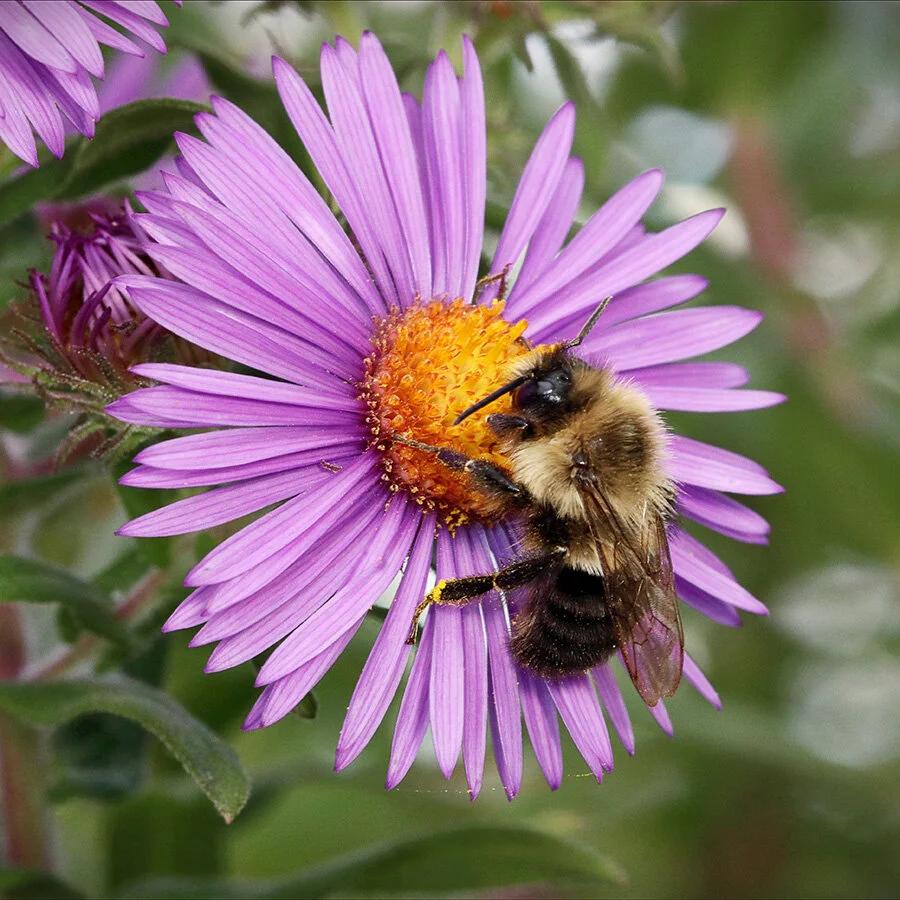
Autumn is an important feeding season for many insects. Although pollinator activity generally declines as temperatures fall, some bees, butterflies, flies, and wasps continue visiting flowers during warm daylight hours.
For bumble bees, late-season nectar can be especially valuable. Newly produced queens need sufficient energy reserves before entering their overwintering period, while workers may continue collecting food for their colonies.
Migrating monarch butterflies also use autumn flowers where their migration routes and flowering periods overlap.
Native asters and goldenrods are particularly useful because many species flower when summer-blooming plants have finished.
Research and conservation guidance from the Xerces Society identify these plant groups as important late-season resources for bumble bees and other insects.
Xerces Society
However, no single flower provides everything pollinators need. A successful garden should also contain plants that bloom in spring and summer, nesting habitat, and suitable overwintering shelter.
2. Native Fall Flowers for Pollinators: Four Excellent Choices
The four plants discussed here belong to the aster family, Asteraceae, but their appearances and growing requirements differ considerably.
New England aster produces large clusters of purple to pink flowers, while aromatic aster forms a lower, bushier display of violet-blue blooms.
Goldenrods provide contrasting yellow flowers. Rough-leaved goldenrod favors relatively moist conditions, while blue-stemmed goldenrod is particularly useful in woodland edges and partial shade.
For clarity, the general name goldenrod in this article refers specifically to rough-leaved goldenrod, Solidago rugosa. North America contains many other goldenrod species with different environmental requirements.
Quick comparison
| Plant | Typical bloom period | Light | Preferred soil |
|---|---|---|---|
| New England aster | August–October | Full sun to partial shade | Moist, reasonably well-drained |
| Rough-leaved goldenrod | August–October | Full sun to light shade | Moist to wet, especially well-drained to moderately wet sites |
| Aromatic aster | Late summer–first hard frost | Full sun | Well-drained, average to dry |
| Blue-stemmed goldenrod | August–October | Partial shade to full sun | Well-drained, average to moderately dry |
These dates are approximate. Local climate, weather, elevation, and growing conditions can shift flowering periods.
3. New England Aster (Symphyotrichum novae-angliae)

New England aster is one of the most recognizable native fall wildflowers in eastern and central North America.
Its flowers feature numerous purple, violet, or occasionally pink ray florets surrounding yellow central disks. Mature plants can develop tall stems carrying abundant flower clusters.
Native range and habitat
Despite its common name, New England aster is not restricted to the northeastern United States.
Its native distribution extends through much of eastern and central North America, including the Great Lakes region, parts of the Midwest, and portions of the southeastern United States.
It naturally occurs in meadows, prairies, moist open ground, and woodland edges.
The University of Waterloo’s Astereae research program documents its broad native range and association with open, relatively moist habitats.
University of Waterloo
Light and soil requirements
New England aster grows best in full sun, although it can tolerate some partial shade.
It generally performs well in moderately moist, reasonably well-drained soil. Established plants can tolerate occasional dry periods, but prolonged drought may reduce growth and flowering.
The species can become several feet tall, so gardeners should provide adequate space.
In fertile soil, tall stems may lean outward. Placing plants among sturdy neighboring perennials or selectively reducing stem height earlier in the season can help maintain a compact appearance.
Bloom window and insect benefits
New England aster commonly flowers from August through October, depending on the region.
Its flower heads provide nectar and pollen for bumble bees, other native bees, butterflies, hoverflies, and additional flower-visiting insects.
The University of Wisconsin–Madison Arboretum has documented visits by the endangered rusty patched bumble bee to New England aster. This illustrates the plant’s potential value, although planting it does not guarantee that particular bee species will appear.
UW Arboretum
For gardeners with sunny, moderately moist borders, this species provides both height and important late-season floral resources.
4. Goldenrod (Solidago rugosa)

Rough-leaved goldenrod, also called wrinkleleaf goldenrod, is a native perennial known for its arching clusters of small yellow flowers.
Unlike some goldenrods with upright, plume-shaped flower clusters, this species often produces graceful, branching flower sprays.
Native range and habitat
Solidago rugosa is native to a broad region of eastern North America, including the northeastern and southeastern United States and parts of the eastern Midwest.
It occurs in varied habitats, including moist meadows, wet openings, marsh edges, and other relatively open environments.
Its wide ecological tolerance makes it useful in naturalistic plantings, although local populations differ in their adaptation to particular conditions.
Light and soil requirements
Rough-leaved goldenrod prefers full sun to light shade.
It performs particularly well in moist soil and can tolerate wetter conditions than many plants used in ordinary perennial borders.
It is suitable for moist meadow gardens, rain garden margins, and sunny areas where soil moisture remains relatively consistent.
Some cultivated selections, including ‘Fireworks,’ are valued for their arching floral display.
Plants may gradually expand into patches, so gardeners should allow adequate room and monitor spreading where space is limited.
Bloom window and insect benefits
Flowering generally occurs from late summer into October, with timing influenced by geography and weather.
The numerous small flower heads attract bees, butterflies, flower flies, beetles, and parasitoid wasps.
Goldenrods also support insects that develop on their stems and foliage, extending their ecological importance beyond nectar production.
The Missouri Department of Conservation emphasizes that goldenrods support a diverse community of insects, including species associated with stem galls and their predators.
Missouri Department of Conservation
Goldenrod and seasonal allergies
Goldenrods are often incorrectly blamed for fall hay fever.
Their pollen is relatively heavy and typically transported by insects rather than released in large quantities into the air.
Ragweed, which often flowers at the same time, produces windborne pollen and is a much more important cause of seasonal pollen allergies.
This distinction makes goldenrod an unfairly overlooked choice for pollinator gardens.
5. Aromatic Aster (Symphyotrichum oblongifolium)

Aromatic aster offers a different growing habit from the taller New England aster.
It forms a dense, branching perennial with numerous small violet-blue flowers. Its leaves release a noticeable scent when crushed, giving the plant its common name.
Native range and habitat
Aromatic aster is native across parts of the central and eastern United States, with occurrences extending into portions of the Great Plains and other suitable regions.
It is associated with prairies, rocky openings, limestone outcrops, and dry woodland edges.
These habitats help explain its tolerance of relatively dry soil once established.
Light and soil requirements
Aromatic aster performs best in full sun and well-drained soil.
It tolerates average to dry conditions and can be particularly useful in sunny planting areas where excessive irrigation would be undesirable.
Plants commonly form mounds roughly one to three feet tall, although size depends on growing conditions.
Poor drainage and overcrowding can contribute to disease problems, including powdery mildew.
The North Carolina Extension Gardener Plant Toolbox recommends full sun and good drainage for this species.
North Carolina Extension Gardener Plant Toolbox
Bloom window and insect benefits
Aromatic aster typically flowers from late summer into fall.
In suitable climates, blooms may remain available until the first hard frost, sometimes extending into November.
Its flowers attract bees, butterflies, and other nectar-feeding insects during a period when many summer flowers have declined.
Some specialist native bees rely on pollen from asters and related plants, although individual bee species vary in their host associations and geographic distributions.
Aromatic aster is particularly useful near the front or middle of sunny borders, where its dense floral display remains visible late in the season.
6. Blue-Stemmed Goldenrod (Solidago caesia)

Blue-stemmed goldenrod is one of the most adaptable goldenrod choices for gardens with partial shade.
Its common name refers to the blue-green or purplish coloration that can develop along its stems.
Unlike goldenrods that produce large terminal plumes, this species bears small yellow flower clusters along the upper portions of its stems.
Native range and habitat
Solidago caesia is native to central and eastern North America.
Within the United States, its range includes much of the eastern woodland region, extending into parts of the Midwest and South.
It naturally grows in open woods, woodland edges, and other habitats receiving filtered sunlight.
This makes it a useful alternative where sun-loving meadow species perform poorly.
Light and soil requirements
Blue-stemmed goldenrod grows in partial shade and can also tolerate full sun when moisture conditions are suitable.
It prefers reasonably well-drained soil with average to moderately dry moisture conditions.
Established plants are relatively adaptable, although performance depends on local environmental conditions.
Unlike some more aggressively spreading goldenrods, blue-stemmed goldenrod generally maintains a comparatively restrained clumping habit.
Bloom window and insect benefits
Flowering usually occurs from August through October.
Its yellow flowers provide resources for bees, butterflies, and other flower-visiting insects.
Blue-stemmed goldenrod also supports the larvae of the wavy-lined emerald moth (Synchlora aerata), illustrating that native flowers can contribute to insect biodiversity beyond feeding adult pollinators.
North Carolina State Extension identifies the plant as valuable for specialized bees, butterflies, and other wildlife.
North Carolina Extension Gardener Plant Toolbox
For woodland gardens, this is often a better choice than forcing a sun-dependent goldenrod into a heavily shaded location.
7. Comparing the Four Fall-Blooming Plants
Although all four belong to the aster family, their landscape roles are different.
New England aster is best suited to sunny, moderately moist plantings where its height and abundant purple flowers can be accommodated.
Rough-leaved goldenrod provides yellow flowers in moist, sunny areas. Aromatic aster is more appropriate for relatively dry, sunny sites, while blue-stemmed goldenrod works especially well in partial shade.
A combination of these species can provide varied flower structures and overlapping bloom periods.
However, planting all four is not necessary or appropriate in every garden. Selecting two species matched to local soil and light conditions may be more successful than planting four in unsuitable habitat.
8. How to Combine Them in a Pollinator Garden
A useful planting design groups compatible native fall flowers for pollinators rather than scattering individual plants randomly.
In a sunny meadow border, New England aster and rough-leaved goldenrod can create a strong combination of purple and yellow flowers.
Aromatic aster can occupy a drier, well-drained section of the same garden.
Where a planting transitions toward trees or shrubs, blue-stemmed goldenrod can provide flowers in partial shade.
Plant in clusters
Grouping several plants of the same species creates a more visible floral display and can make foraging more convenient for visiting insects.
Clusters should still allow adequate air circulation and room for mature growth.
A naturalistic design can combine these flowering perennials with native grasses, shrubs, and earlier-blooming wildflowers.
The overall objective is to provide a sequence of flowering resources, not simply a colorful display during one month.
9. When and How to Plant Native Fall Flowers
Spring and fall are both suitable planting periods in many parts of the United States.
Fall planting can allow roots to establish while temperatures are relatively cool, provided the soil remains workable and sufficient moisture is available.
In regions with early, severe winters, spring planting may give young plants more time to establish.
Preparing the planting site
Begin by checking sunlight, drainage, and the natural soil characteristics.
Remove aggressive perennial weeds before planting, especially in new meadow beds.
Avoid automatically adding large amounts of compost or fertilizer.
Many native perennials grow well in ordinary garden soil, and excessive fertility can encourage tall, weak growth in some species.
Water new transplants during establishment, even when mature plants are considered drought tolerant.
Growing from seed
These species can also be established from seed.
Some native wildflower seeds benefit from periods of cold, moist conditions before germination.
However, dormancy requirements vary among species and seed lots.
Follow species-specific propagation instructions rather than assuming every native seed requires identical treatment.
10. Supporting Pollinators Beyond the Flowers
Flowering plants provide food, but a pollinator-friendly garden also needs suitable shelter and nesting habitat.
Many native bees nest in soil, while others use hollow or pithy plant stems.
Reducing unnecessary pesticide applications and preserving appropriate nesting sites can help support insects throughout their life cycles.
Leave some stems and leaves
Allow some perennial stems to remain standing through winter instead of cutting every plant to ground level in fall.
Native bees and other insects may use stems, soil, or sheltered vegetation for nesting and overwintering.
Fallen leaves beneath shrubs and in garden borders also provide habitat for many invertebrates.
Our guide to why fallen leaves support wildlife explains how retaining leaf litter can help protect small organisms and support garden biodiversity.
green garden
Combining native flowers with less intensive seasonal cleanup helps create a more complete habitat.
11. Regional Considerations Across the United States
The term native does not mean that every listed plant naturally occurs throughout the country.
These four species are primarily associated with eastern and central North America.
Gardeners in New England, the Great Lakes region, and much of the eastern Midwest may find several suitable options, depending on their local soil and habitat.
In the Southeast, heat, humidity, and drainage can influence which species perform best.
Aromatic aster is often useful in sunny, well-drained southern sites, while rough-leaved goldenrod may suit moister environments.
Gardeners in the Great Plains should verify whether a particular species occurs naturally in their area.
In much of California, the Pacific Northwest, and the desert Southwest, different regional native asters and goldenrods may be more appropriate.
Local native plant societies, university extension services, and regional plant databases can help determine which species belong to a particular ecological community.
12. Common Mistakes to Avoid
One common mistake is selecting plants according to flower color without considering moisture and sunlight.
Planting aromatic aster in persistently waterlogged soil, for example, can reduce its performance.
Another mistake is assuming all goldenrods spread equally aggressively. Different Solidago species have different growth habits.
Avoid treating native plants as completely maintenance-free during establishment.
New plantings may need watering, weed control, and protection from accidental mowing.
Finally, remember that autumn flowers cannot replace spring and summer resources.
A diverse planting with overlapping bloom periods is more useful for pollinators than a garden that flowers during only one season.
13. Frequently Asked Questions
Which native fall flowers attract the most bees?
Asters and goldenrods are widely recognized as valuable late-season bee plants. The number and diversity of visitors depend on plant species, local insect populations, weather, and surrounding habitat.
Is goldenrod harmful to people with pollen allergies?
Goldenrod is primarily insect-pollinated and is not a major source of airborne hay fever pollen. Ragweed, which flowers at a similar time, is a much more significant cause of fall pollen allergies.
Can native asters grow in containers?
Yes, some asters can grow in large containers with appropriate drainage and watering. Compact aromatic aster selections are generally easier to manage than very tall New England asters.
Which goldenrod grows best in partial shade?
Blue-stemmed goldenrod is especially well suited to woodland edges and partially shaded gardens. It generally tolerates shade better than many goldenrods associated with open meadows.
Should native fall flowers be cut down before winter?
Not necessarily. Leaving some standing stems and undisturbed ground cover can preserve habitat for overwintering insects and provide seeds for wildlife.
14. Conclusion
Planting native fall flowers for pollinators is a practical way to extend the ecological value of a garden beyond summer.
New England aster offers abundant purple blooms, rough-leaved goldenrod provides yellow flowers for numerous insects, aromatic aster brightens dry sunny borders, and blue-stemmed goldenrod brings late-season color to partially shaded spaces.
Their different growing requirements make it possible to select plants suited to a variety of eastern and central American landscapes.
The most effective approach is to choose locally appropriate species, provide flowers throughout the growing season, and preserve nesting and overwintering habitat.
With thoughtful planting and maintenance, an autumn garden can remain an important source of food and shelter for bees, butterflies, and other beneficial insects long after many summer flowers have faded.
Suggested article image placement
[Insert one image after Section 2: A naturalistic American fall pollinator garden featuring purple New England asters, yellow goldenrods, and native bees.]
Image alt text: Native fall flowers for pollinators including New England aster and goldenrod supporting bees in an autumn garden.