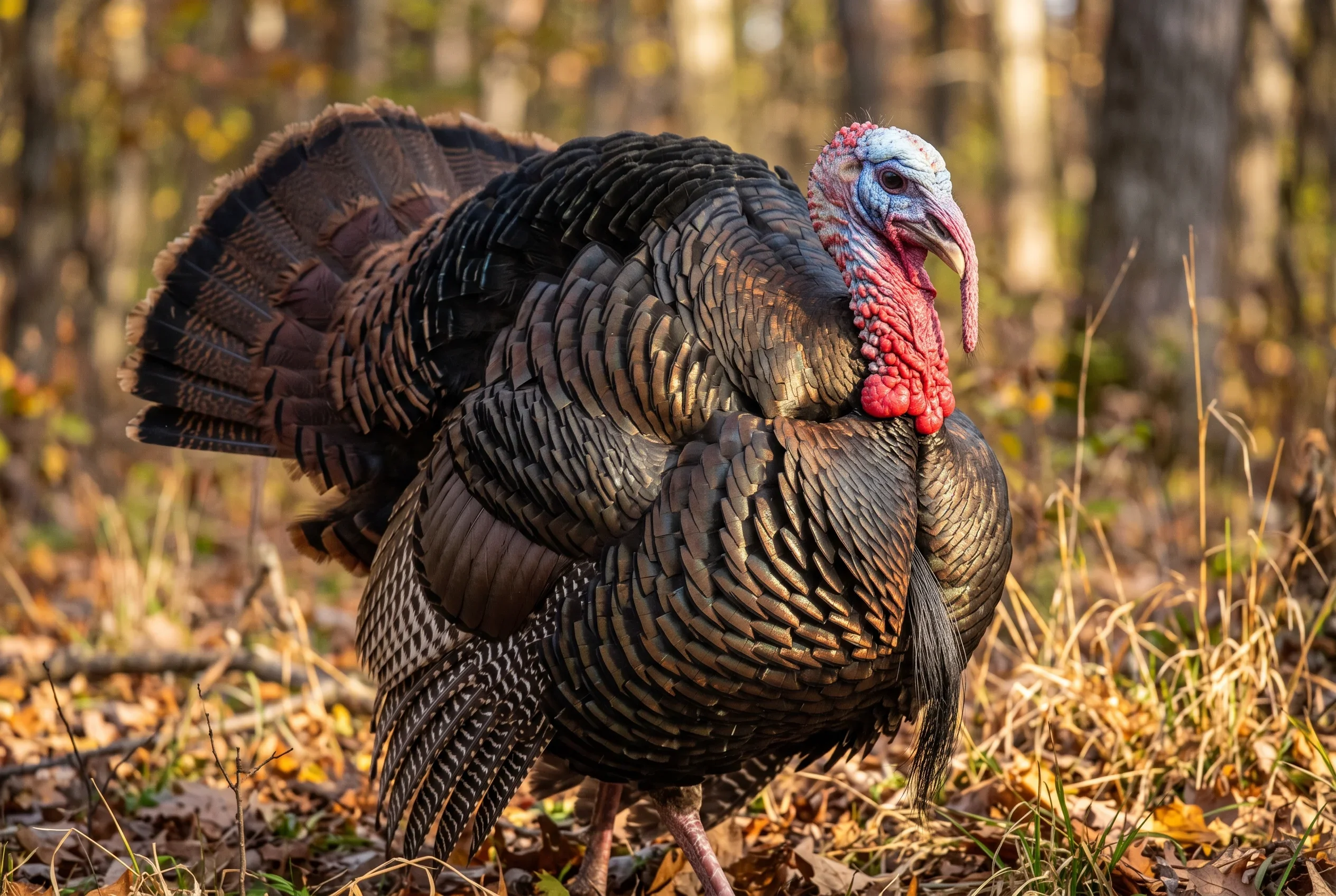
A wild turkey’s head can shift from pale pink to brilliant red, blue, and white, sometimes during a single courtship display. These dramatic changes are not caused by feathers or artificial pigments. They occur in the bird’s exposed facial skin.
Understanding why wild turkeys change face color reveals a fascinating relationship between blood circulation, skin structure, hormones, and social behavior.
The wild turkey (Meleagris gallopavo) is famous for its impressive tail fan and iridescent feathers. Yet its colorful, nearly featherless head is equally remarkable. During breeding displays, adult males can develop striking contrasts between red fleshy structures and pale blue or whitish skin.
Changes in circulation help explain the intensity of some colors, while the physical properties of skin influence how light is reflected and scattered. The complete mechanism is more complex than a simple change in blood flow.
These displays offer a window into the sophisticated visual communication of one of North America’s most recognizable birds.
Table of Contents
- Why Wild Turkeys Change Face Color
- The Anatomy of a Wild Turkey’s Head and Neck
- The Science Behind Red, Blue, and White Facial Skin
- How Courtship Influences Turkey Face Color
- What Facial Colors Communicate to Other Turkeys
- Differences Between Male and Female Wild Turkeys
- Do Turkey Face Colors Change With Stress or Temperature?
- Common Myths About Wild Turkey Facial Colors
- Frequently Asked Questions
- Conclusion
Why Wild Turkeys Change Face Color
Wild turkeys have exposed skin across much of their heads and upper necks. Unlike feathered areas, this skin can display noticeable changes in appearance as the bird’s physiological state changes.
Rapid Changes in Skin Appearance
During courtship, competition, or heightened arousal, a male turkey’s facial colors may become more vivid.
The changes can affect different regions simultaneously. One area may appear intensely red while another becomes pale blue or whitish.
This does not mean that the entire head changes uniformly or that every turkey displays an identical pattern.
Blood Flow and Red Coloration
The skin contains blood vessels that can influence its visible appearance.
When circulation near the surface increases, reddish coloration may become more prominent. Changes in vascular tone can therefore contribute to the dramatic appearance of an actively displaying male.
However, blood flow alone cannot adequately explain every shade visible on a turkey’s head.
The Role of Skin Structure
Some bird skin colors are influenced by microscopic tissue structures that scatter particular wavelengths of light.
Blue coloration in birds is often structural rather than the result of blue pigment. In turkeys, optical properties of the skin are relevant to understanding the appearance of blue and pale regions, although the precise contribution of each mechanism to rapid color changes requires careful species-specific interpretation.
The Anatomy of a Wild Turkey’s Head and Neck
The colorful face of a turkey contains several distinctive anatomical features.
The Snood
The snood is a fleshy appendage extending from the forehead above the beak.
In adult males, it can elongate considerably during display, hanging over the upper bill.
Research on wild turkeys has examined snood length as a potentially important ornament in social and reproductive interactions.
The Wattle
The wattle is the fleshy structure hanging beneath the throat.
It contributes to the bird’s distinctive appearance and may become particularly conspicuous when the head and neck are flushed with color.
The wattle should not be confused with the snood, which originates above the beak.
Caruncles and Exposed Skin
Caruncles are small, fleshy projections found on portions of the turkey’s head and neck.
Together with the snood, wattle, and exposed skin, they create a complex visual display.
These structures are generally more prominent in adult males, particularly during the breeding season.
The Science Behind Red, Blue, and White Facial Skin
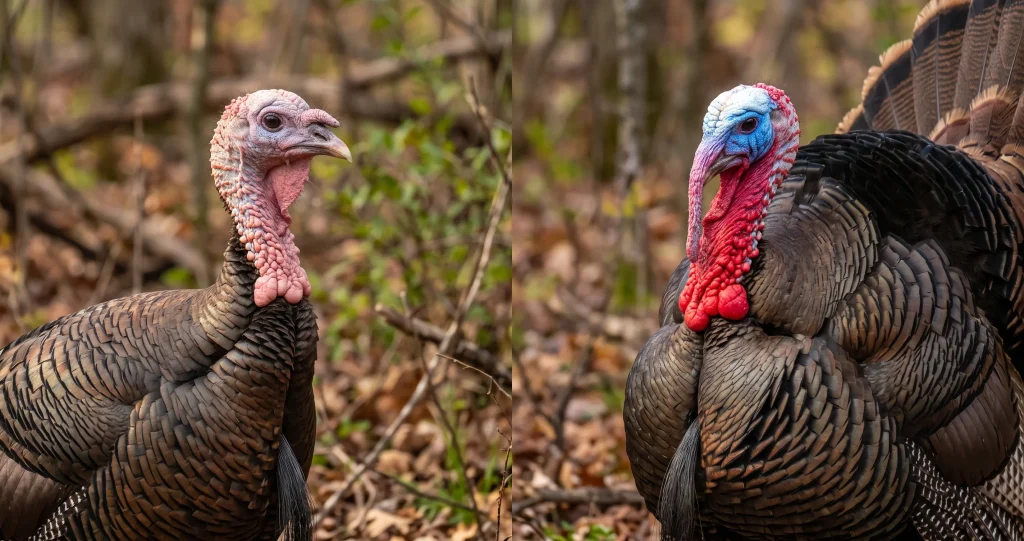
The remarkable combination of red, blue, and white is one of the most distinctive features of wild turkey coloration.
Why Red Becomes More Intense
Reddish skin coloration is influenced by the presence and distribution of blood within superficial tissues.
During heightened physiological activity, changes in blood vessel diameter and circulation can affect how red these areas appear.
The result may be especially noticeable in the wattle and other fleshy facial structures.
Why Some Areas Appear Blue
Blue coloration does not mean turkeys have blue blood.
In many birds, blue skin coloration results from the interaction of light with microscopic structures within the skin.
Research on avian structural coloration has shown how organized collagen arrangements can produce blue appearances through light scattering.
Such research provides an important biological framework for interpreting turkey skin coloration, but it should not be assumed that every blue region changes through exactly the same mechanism.
Why White or Pale Areas Appear
Pale or whitish regions may reflect differences in tissue structure, optical scattering, and the visibility of underlying blood.
Changes in circulation can alter the contrast between pale and red areas.
It is therefore misleading to describe turkey facial coloration as a simple system in which each color corresponds to a single emotion.
How Courtship Influences Turkey Face Color
During spring, male wild turkeys perform elaborate displays designed to attract females and interact with competing males.
The Male Courtship Display
A displaying male, commonly called a tom, raises and fans his tail, spreads his body feathers, lowers his wings, and struts slowly across the ground.
He may also produce gobbling calls and low-frequency sounds associated with display.
The combination of movement, vocalization, and colorful ornaments creates a highly conspicuous presentation.
Facial Color During Display
During courtship, the male’s exposed head and neck can appear particularly vivid.
Red areas may become more pronounced, while blue and pale regions create striking contrasts.
These changes occur alongside other visible modifications, including elongation of the snood.
However, facial coloration is only one part of the display. Posture, movement, vocalizations, and ornament size also contribute to the overall signal.
The Relationship Between Color and Mate Selection
Scientific research has demonstrated that some wild turkey ornaments are relevant to female mate choice.
In a 1995 study published in Animal Behaviour, Richard Buchholz found that females preferred males with longer snoods and wider skullcaps in experimental comparisons.
The study also identified relationships between certain ornamental characteristics and measures of parasite burden.
These findings support the importance of male ornamentation, but they do not establish that females select mates solely according to facial color.
What Facial Colors Communicate to Other Turkeys
Wild turkey communication involves several types of signals operating together.
Their facial coloration can accompany courtship displays, heightened arousal, and interactions between males.
A displaying bird may combine vivid skin colors with a fanned tail, lowered wings, an extended snood, and distinctive vocalizations.
Other turkeys can observe these visible characteristics during social encounters.
However, scientists should not assume that every color has one fixed meaning.
A redder head does not necessarily prove aggression, just as a pale or blue head does not automatically indicate fear.
Behavioral context is essential.
Research published in Journal of Avian Biology in 1997 also found that relative snood length was associated with the outcomes of male dominance trials, reinforcing the importance of fleshy head ornaments in turkey social interactions.
Differences Between Male and Female Wild Turkeys
Male and female wild turkeys differ in several visible characteristics.
Adult males generally have more conspicuous head ornaments, larger bodies, and more elaborate courtship displays.
Their snoods and other fleshy structures become especially prominent during breeding activity.
Females, commonly called hens, also have exposed skin on their heads and may display variations in coloration.
However, their head ornaments are generally less developed, and their overall appearance is usually more subdued.
Age, individual condition, and reproductive state can influence these differences.
The presence of exposed facial skin is therefore not exclusive to males.
Do Turkey Face Colors Change With Stress or Temperature?
The appearance of a turkey’s exposed skin can be influenced by its physiological condition.
In birds generally, blood circulation through exposed skin can participate in heat exchange. Changes in vascular activity may also accompany stress or arousal.
These principles help explain why skin coloration can vary, but they should not be interpreted as a precise emotional thermometer.
A particular shade of red, blue, or white cannot reliably diagnose whether an individual wild turkey is frightened, aggressive, overheated, or healthy.
Lighting conditions, viewing angle, individual differences, and the bird’s behavior must also be considered.
The most reliable interpretation comes from observing the whole animal rather than focusing on one color.
Common Myths About Wild Turkey Facial Colors
Myth 1: A Wild Turkey’s Face Always Has the Same Color
False. The exposed skin of a wild turkey can vary in appearance, particularly during courtship and other periods of heightened physiological activity.
Myth 2: Every Color Change Is Caused Only by Blood Flow
Not entirely. Blood circulation contributes to visible coloration, especially redness, but the optical properties of skin can also influence its appearance.
Myth 3: Blue Skin Means Turkeys Have Blue Blood
False. Wild turkeys have red blood containing hemoglobin. Blue coloration is an optical appearance, not evidence of blue blood.
Myth 4: Each Facial Color Represents a Specific Emotion
There is no reliable scientific basis for interpreting every facial color as a distinct emotion. Social context and other behaviors matter.
Myth 5: Only Male Turkeys Have Colorful, Exposed Heads
Both sexes have exposed facial skin. Adult males generally display more prominent ornaments and stronger contrasts during courtship.
Frequently Asked Questions
1. Why do wild turkeys change face color?
Wild turkey facial coloration varies with physiological state, including changes in circulation and the appearance of exposed skin. These changes can accompany courtship and social interactions.
2. Why does a wild turkey’s head turn red?
Increased blood circulation near the skin surface can make reddish areas more prominent, particularly during heightened arousal or display.
3. Why do wild turkeys have blue heads?
Blue coloration is associated with how light interacts with skin tissues. Structural coloration is well documented in birds, although the precise mechanisms and their relative contributions in wild turkeys require species-specific interpretation.
4. What causes white coloration on a turkey’s face?
Pale or whitish coloration may reflect skin optical properties and changes in the visibility of underlying blood. It should not be interpreted as a single, definitive emotional signal.
5. Do turkeys change color when excited?
Their exposed head and neck skin can become more vividly colored during courtship and heightened physiological activity.
6. Do female wild turkeys change head color?
Female turkeys have exposed head skin that can vary in appearance, although their facial ornaments and displays are generally less conspicuous than those of adult males.
7. What is the purpose of a turkey’s snood?
The snood is a fleshy head ornament involved in visual signaling. Research indicates that snood length can be relevant to female mate choice and interactions between males.
8. Can turkey facial coloration indicate courtship behavior?
Yes. Vivid facial coloration can accompany male courtship displays, especially when combined with tail fanning, strutting, vocalizations, and an elongated snood.
Conclusion
Understanding why wild turkeys change face color reveals that their unusual appearance is more than a decorative feature.
The striking red, blue, and white regions of a turkey’s head reflect an interaction between physiological processes, skin properties, and behavior.
Blood circulation influences visible redness, while optical characteristics of skin contribute to the appearance of other colors.
During courtship, these features become part of an elaborate display that also includes movement, sound, and specialized fleshy ornaments.
Scientific research has demonstrated that some of these ornaments influence mate choice and social competition, although the exact significance of individual facial colors remains more complex.
The next time a male wild turkey fans his tail and displays his colorful head, his appearance offers a remarkable glimpse into the sophisticated visual signals used by wildlife.
External sources
1. Cornell Lab of Ornithology. Wild Turkey Identification. All About Birds. Documents the species’ exposed head skin, color variation, sexual differences, and courtship behavior. Read source.
2. Prum, R. O., and Torres, R. (2003). Structural colouration of avian skin: convergent evolution of coherently scattering dermal collagen arrays. Journal of Experimental Biology, 206, 2409–2429. Explains structural coloration in avian skin across multiple bird species; it should not be treated as direct proof of every mechanism in wild turkey facial skin. Read research.