
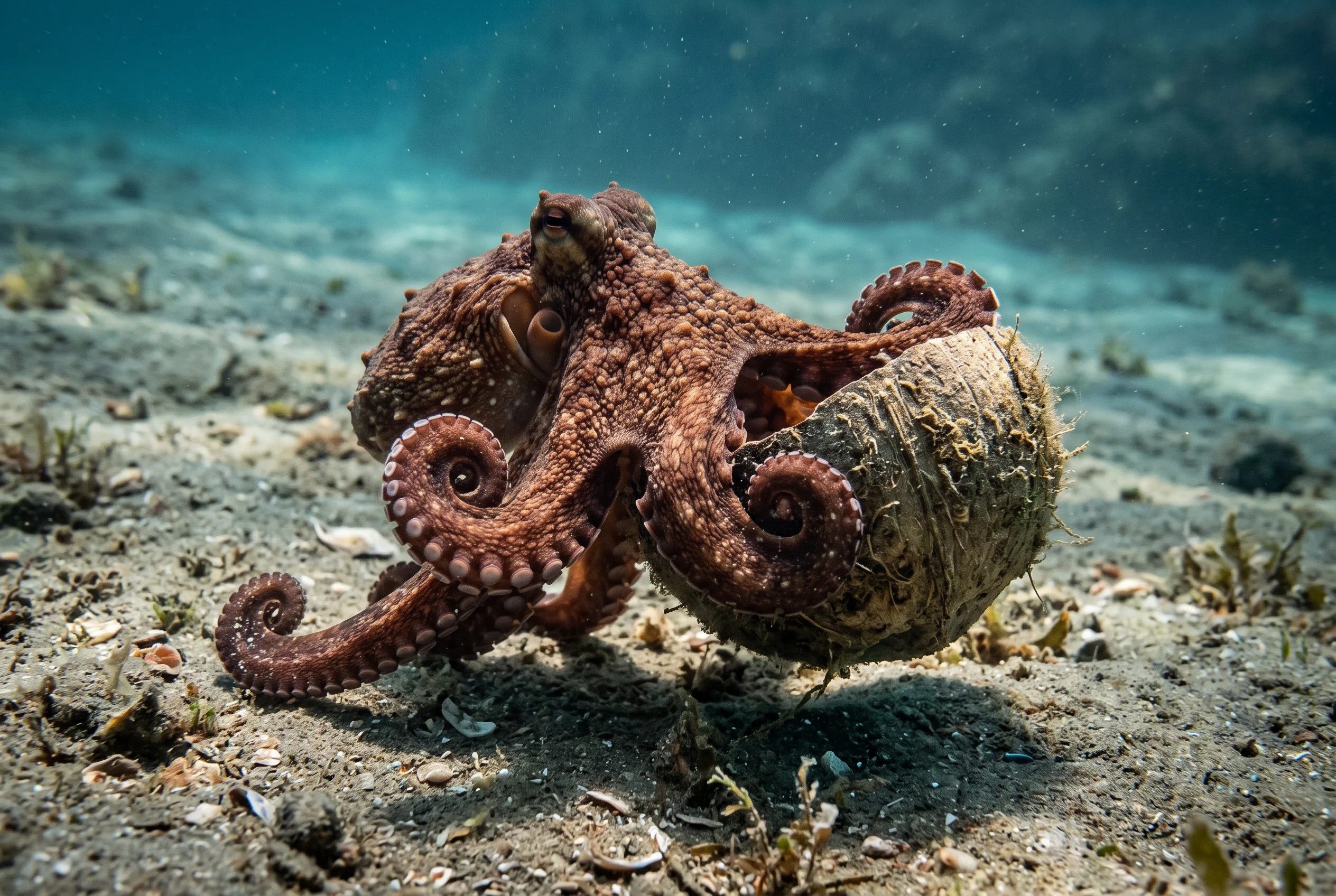
Imagine an octopus moving across the ocean floor while carrying part of a coconut shell beneath its body. After reaching a suitable location, it stops, arranges the shell, and uses it as a temporary hiding place.
This unusual behavior belongs to the coconut-carrying octopus, also known as the veined octopus (Amphioctopus marginatus).
Unlike animals that simply hide inside available crevices, this octopus has been observed collecting discarded coconut shell halves and transporting them for later use. Scientists consider this behavior a remarkable example of defensive tool use in an invertebrate.
The discovery attracted international attention because it challenged traditional assumptions about how animals without backbones interact with objects in their environments.
But the most fascinating part is not simply that an octopus hides inside a shell. It is that the animal can carry shelter material across the seabed before using it.
Understanding the coconut-carrying octopus reveals how flexible behavior, specialized anatomy, and environmental opportunities can combine to produce extraordinary survival strategies.
Table of Contents
- What Is the Coconut-Carrying Octopus?
- How the Coconut-Carrying Octopus Uses Coconut Shells
- Why Scientists Consider This Behavior Tool Use
- How the Coconut Octopus Carries Its Portable Shelter
- Why Coconut Shells Make Useful Octopus Shelters
- What This Behavior Reveals About Octopus Intelligence
- Where the Coconut-Carrying Octopus Lives
- Other Examples of Octopus Object Manipulation
- Common Myths About the Coconut Octopus
- Frequently Asked Questions
- Conclusion
What Is the Coconut-Carrying Octopus?
Scientific Name and Identification
The coconut-carrying octopus is a marine mollusk scientifically known as Amphioctopus marginatus.
It belongs to the cephalopods, a group that also includes squid, cuttlefish, and nautiluses.
Like other octopuses, it has eight flexible arms equipped with suckers that allow it to grip, investigate, and manipulate objects.
Its body commonly displays brownish, reddish, and mottled coloration, with patterns that can change depending on its surroundings and behavior.
The octopus’s soft body allows it to enter confined spaces that would be inaccessible to many similarly sized animals.
Natural Habitat
The veined octopus inhabits tropical Indo-Pacific waters, particularly shallow marine environments with sandy, muddy, or mixed seabeds.
These environments may contain scattered shells, stones, and other objects that can provide shelter.
Unlike rocky reefs with numerous permanent crevices, some soft-bottom habitats offer relatively limited natural cover.
Portable shelter materials may therefore be especially useful.
Why It Is Called the Coconut Octopus
The common name comes from observations of individuals collecting and transporting coconut shell halves.
These shells can accumulate in coastal marine environments after entering the water from nearby land or human activity.
The octopus does not produce the shells. It makes use of objects already available in its surroundings.
How the Coconut-Carrying Octopus Uses Coconut Shells
Finding Discarded Coconut Shells
A coconut shell resting on the seabed may appear unremarkable.
For a veined octopus, however, its hard curved surface can provide a useful protective structure.
Researchers have documented octopuses investigating and gathering discarded coconut shell halves.
The animals may also use other objects, including bivalve shells.
Collecting and Transporting the Shells
After obtaining a suitable shell, the octopus can position it beneath its body.
Its arms and suckers help maintain contact with the object while it moves across the seabed.
In documented observations, some individuals transported shell halves over considerable distances relative to their body size.
The behavior is especially noteworthy because the shell may provide little immediate protection while being carried.
Assembling a Temporary Shelter
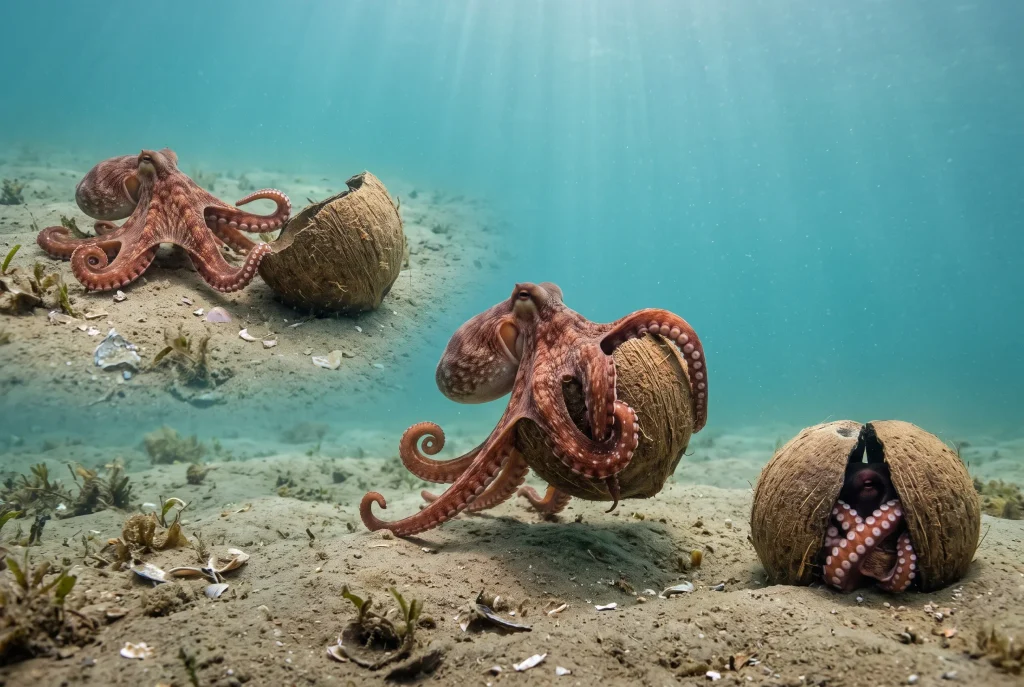
When the octopus reaches a suitable location, it can use the transported material to create a hiding place.
Two coconut shell halves may be arranged together to form an enclosure around the animal.
However, not every observed individual carries two halves or assembles an identical shelter.
The important feature is the ability to collect, transport, and later use a protective object.
Why Scientists Consider This Behavior Tool Use
What Counts as Tool Use in Animals
Animal tool use generally involves manipulating an external object to accomplish a particular function. However, researchers do not always agree on which behaviors meet the strictest definitions.
An octopus hiding beneath a rock is not necessarily using a tool. The distinction becomes more interesting when it actively collects an object, transports it, and deploys it when needed.
Carrying an Object for Later Use
The coconut-carrying octopus is especially notable because the shell provides no immediate protection while being transported.
The animal accepts the inconvenience of carrying it in exchange for the possibility of using it later.
This separation between collecting an object and benefiting from it makes the behavior scientifically significant.
The Scientific Discovery
In 2009, researchers Julian Finn, Tom Tregenza, and Mark Norman published their observations in Current Biology.
Their paper, “Defensive Tool Use in a Coconut-Carrying Octopus,” documented veined octopuses transporting coconut shell halves and assembling shelters when required.
The researchers described a distinctive transport movement they called stilt-walking. Their observations provided compelling evidence of tool use by an invertebrate.
How the Coconut Octopus Carries Its Portable Shelter
The Role of Flexible Arms and Suckers
An octopus’s arms combine flexibility with remarkable control.
Numerous suckers allow it to grip curved objects, adjust their positions, and maintain contact while moving.
These abilities make it possible to handle coconut shells despite their awkward shape.
An Unusual Form of Movement
When transporting a coconut shell, the octopus may arrange its arms around the object and move using an unusual walking-like motion.
This movement looks different from ordinary crawling.
Researchers described it as cumbersome because carrying the shell restricts the animal’s normal movement.
The Costs of Carrying a Shell
Transporting shelter material requires effort.
A shell can reduce maneuverability, and the animal may remain relatively exposed while moving.
The potential benefit comes afterward, when the shell can be deployed as protective cover.
This balance between immediate costs and later usefulness is central to the scientific interpretation of the behavior.
Why Coconut Shells Make Useful Octopus Shelters
Octopuses have soft bodies and no external skeleton to protect most of their anatomy.
Finding suitable cover can therefore be important.
Coconut shells offer several useful physical characteristics. Their curved surfaces can create enclosed spaces, their hard walls provide a barrier, and their size may accommodate a small octopus.
On open sandy or muddy seabeds, movable objects can provide shelter where permanent crevices are scarce.
Researchers have directly documented the use of coconut shells as shelters. However, the precise degree of protection against different predators has not been established by the original observations alone.
The octopus may also exploit other suitable objects, particularly large shells.
What This Behavior Reveals About Octopus Intelligence
Flexible Behavior and Object Manipulation
Octopuses possess sophisticated nervous systems and highly developed sensory abilities.
Their arms can investigate objects through touch and chemical sensing, allowing detailed interaction with the environment.
The ability to handle and reposition coconut shells illustrates their remarkable motor flexibility.
Learning and Behavioral Flexibility
Scientific research has demonstrated that cephalopods can learn associations, remember information, and adapt behavior to changing circumstances.
A major review in Biological Reviews emphasizes that these abilities make cephalopods important subjects for comparative cognition research.
However, sophisticated behavior does not automatically reveal the exact mental processes responsible for it.
Tool Use Without Human-Like Thinking
The coconut-carrying octopus demonstrates behavior consistent with defensive tool use.
That does not prove that it imagines future situations or consciously plans in a human-like manner.
Researchers must distinguish observable actions from interpretations about internal mental experiences.
The behavior remains extraordinary without attributing unsupported intentions to the animal.
Where the Coconut-Carrying Octopus Lives
The veined octopus occurs in tropical Indo-Pacific marine environments, including waters around Indonesia.
It is associated with shallow soft-bottom habitats where sand, mud, scattered shells, and other objects create a varied underwater landscape.
These environments provide opportunities to encounter materials suitable for temporary shelter.
The availability of objects likely affects which materials an individual can use.
However, observations of coconut-shell transport should not be interpreted as evidence that every population uses identical techniques.
Other Examples of Octopus Object Manipulation
The coconut-carrying octopus is not the only octopus known to interact with external objects.
Other species have been observed moving rocks, arranging shells, and modifying den entrances.
The Natural History Museum in London describes octopuses using stones and other available materials to create protective barriers around their shelters.
Such behaviors demonstrate impressive object manipulation, although not every example necessarily satisfies strict scientific definitions of tool use.
The coconut-carrying octopus remains especially important because researchers documented the collection, transportation, and later deployment of shelter materials.
Common Myths About the Coconut Octopus
Myth 1: Every Octopus Carries Coconut Shells
Coconut-shell transport has been documented in the veined octopus. It should not be assumed to occur in every octopus species.
Myth 2: The Octopus Manufactures Its Own Shells
The animal does not produce coconut shells. It collects and reuses objects already present in the environment.
Myth 3: Coconut-Shell Transport Proves Human-Like Intelligence
The behavior demonstrates flexible object use, but it does not establish human-like reasoning or conscious planning.
Myth 4: The Octopus Always Carries Two Shell Halves
Observed behavior varies. An octopus may transport one shell half or use multiple pieces when constructing a shelter.
Myth 5: Coconut Shells Are Used Exclusively for Hunting
The documented behavior involves defensive shelter use, not simply catching prey.
Frequently Asked Questions
1. What is a coconut-carrying octopus?
The coconut-carrying octopus, or veined octopus (Amphioctopus marginatus), is a marine cephalopod known for collecting and transporting discarded coconut shells.
2. Why do coconut octopuses carry coconut shells?
They use coconut shells as portable shelter materials that can provide protective cover when needed.
3. Is the coconut octopus using tools?
Researchers have described its behavior as defensive tool use because the animal collects, transports, and later deploys external objects.
4. How does an octopus carry a coconut shell?
It uses its flexible arms and suckers to hold the shell beneath its body while moving across the seabed in an unusual walking-like motion.
5. Do coconut octopuses build their own shelters?
They can arrange existing coconut shell halves into temporary protective enclosures. They do not manufacture the shell material.
6. Where does the coconut octopus live?
The species inhabits tropical Indo-Pacific waters, particularly shallow sandy and muddy marine environments.
7. Are coconut octopuses intelligent?
Their behavior demonstrates sophisticated object manipulation. Broader research supports substantial learning and behavioral flexibility among octopuses, although the precise cognitive mechanisms behind shell transport remain uncertain.
8. Do other octopuses use objects as tools?
Other octopuses manipulate stones, shells, and objects around their dens. Whether a particular behavior qualifies as tool use depends on the scientific definition applied.
Conclusion
The coconut-carrying octopus demonstrates how an animal can use ordinary objects in extraordinary ways.
By collecting discarded coconut shells, transporting them across the seabed, and arranging them into temporary shelters, the veined octopus displays an unusual form of defensive behavior.
The scientific importance lies not simply in hiding inside a shell, but in carrying an external object for later use.
This remarkable adaptation highlights the diversity of behaviors found among marine invertebrates.
It also reminds us that sophisticated interactions with the environment are not limited to mammals and birds.
Beneath the ocean’s surface, even an abandoned coconut shell can become part of a fascinating biological story.
External sources
1. Finn, J. K., Tregenza, T., & Norman, M. D. (2009). Defensive tool use in a coconut-carrying octopus. Current Biology, 19(23), R1069–R1070. Original research.
2. Schnell, A. K., et al. (2021). How intelligent is a cephalopod? Lessons from comparative cognition. Biological Reviews, 96(1), 162–178. Research review.
3. Ponte, G., et al. (2022). Cephalopod Behavior: From Neural Plasticity to Consciousness. Frontiers in Systems Neuroscience. Research review.
4. Natural History Museum, London. Octopuses Keep Surprising Us — Here Are Eight Examples How. Educational resource.